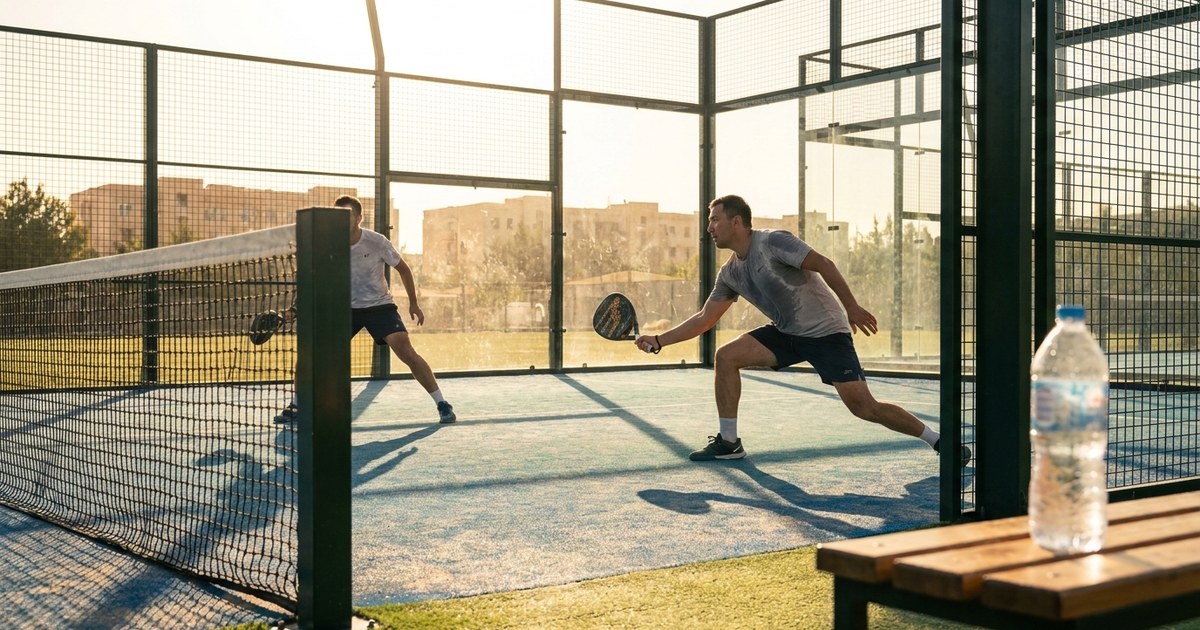
Padel looks gentler than tennis — the court is smaller, big serves are impossible, and the glass absorbs part of every shot. That's exactly why padel injuries sneak up on people: sudden stops, the twisting motion behind a bandeja or víbora, and hours of play with no warm-up quietly add up. Here's where the most common padel injuries actually come from, and what genuinely helps you avoid them.
Why padel injuries happen more often than you'd expect
From the outside, padel looks forgiving: a 20×10 m court, a light racket, an underarm serve. In practice the load builds up from the nature of the movements, not their raw power:
- Constant starting and stopping. Players keep shuffling half a step forward and back, twisting toward the glass and away from it — that's repeated impact on the ankles and knees.
- Rotational shots. The bandeja, víbora and overhead shots all demand shoulder and lower-back rotation, often with the arm extended — the leading cause of elbow and lower-back pain.
- Playing off the glass. A ball bouncing off the back wall forces you to reach in an awkward position, usually at the last second.
- Short points, but a lot of them. In an hour of play you might make dozens of explosive starts — the cumulative load is higher than it feels in the moment.
- Warm-ups get skipped more than in tennis. It's a doubles game with four people on court, and players often just "start playing" rather than hold everyone else up.
None of these is dangerous on its own. The problem starts when your body steps onto the court "cold," week after week: skipping one warm-up won't hurt you, but making a habit of it will — and the effect builds quietly, so the first real sign often shows up the next morning, not mid-rally.
There's also a scheduling issue specific to padel. In tennis, it's two people on court — if one wants a longer warm-up, the other just waits. In padel, four people means the warm-up often becomes a compromise: someone's already hitting at full pace while someone else just got out of the car. If you're the newer player among a more experienced group, it's completely fine to ask for ninety seconds to warm up on your own before the games start — that's a normal request, not a delay.
The most common padel injuries
Here's what players of every level tend to run into — from total beginners to people playing three times a week.
| Injury | Typical cause | What lowers the risk |
|---|
| Padel elbow (tendinitis) | Stiff frame/strings, hitting "with the wrist," under-warmed forearm | Continental grip, wrist warm-up, a softer racket |
| Ankle sprain | Sudden change of direction, a slippery surface | Padel-specific shoes with lateral support, side-step warm-up drills |
| Lower back pain | Twisting without warming up, hitting the bandeja "with the back" | Core warm-up, driving the shot with the legs, not just the arm |
| Hip/groin strain | An explosive lunge to the net or a corner with no warm-up | Dynamic stretching before play, not static |
| Shoulder injuries | Too many overhead shots in a row (smash, víbora) without shoulder work off-court | Rotator-cuff strengthening, pacing smashes in training |
This isn't a diagnosis or medical advice — it's a general pattern of where padel players most often feel it, based on what clubs and coaches commonly see. If you have sharp pain or suspect an actual injury, see a doctor or physiotherapist, not a blog post.
It's also worth separating acute injuries from cumulative ones. An ankle or hip strain almost always happens at a specific moment — an awkward lunge, a bad landing after a smash, a slip on the sand infill. Elbow and lower-back pain, on the other hand, usually isn't caused by "one shot" — it builds from dozens of repetitive movements over a season without a technique fix or a warm-up habit. That means cumulative injuries are easier to prevent early and harder to treat once ignored, because the pain doesn't show up right away — only once the tendon or joint is already chronically irritated.
Warming up before you play: where to start
A good warm-up takes 8–10 minutes and needs nothing but a racket and a few balls. The order matters — general movement first, then padel-specific:
- Light jogging or brisk walking around the court for 2–3 minutes to raise your heart rate and muscle temperature.
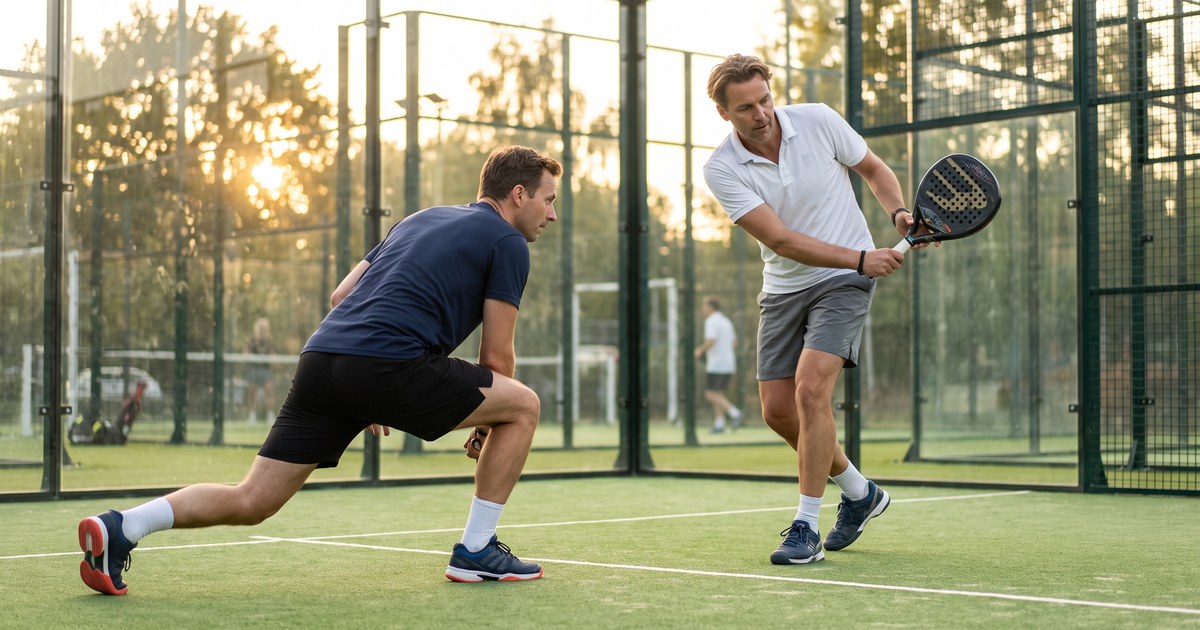
- Dynamic lunges forward and to the side — 8–10 per leg, mimicking the movement toward the net and toward the glass.
- Arm and shoulder circles — loosen the joint before your first overheads.
- Standing trunk rotations, arms crossed over your chest, slow turns left and right — the exact motion that loads your lower back during play.
- Split-step hops in place — 10–15 reps to switch on your ankles and knees.
- Soft rally balls from a partner — 15–20 balls off the volley and off the bounce, building pace gradually.
- A couple of light smashes and bandejas at the very end, at match speed — only once your body is properly warm.
If a full warm-up isn't realistic on court that day, at least steps 1, 4 and 6 take about three minutes and cover most of the risk.
Summer play on outdoor courts deserves a specific note: heat can trick you into thinking you don't need to warm up, because your muscles already feel "hot" from the air temperature. In reality, heat warms your skin and surface tissue faster than it warms joints and tendons, which creates a false sense of readiness. If you're playing in direct sun on a hot day, don't cut the warm-up short — cut your time in the heat instead, and drink more between games.
Grip, racket and the load on your elbow
Padel elbow is the single most common complaint at every level, and more often than not it's not about swing technique — it's about the combination of grip and racket. The continental grip spreads the impact across your whole hand and forearm rather than concentrating it in one spot — that's the foundation worth getting right first: we have a dedicated breakdown of grip technique if you're just starting out.
The racket itself matters too:
- A stiffer frame and higher string tension transmit more vibration straight into your elbow.
- A heavier racket adds strain to your forearm with every series of shots.
- Head-heavy balance (built for power) demands a stronger forearm than handle-heavy balance (built for control).
If you're a beginner still choosing your first racket, don't optimize for power alone — read our guide to choosing your first padel racket, which covers this exact angle.
Overgrip is another underrated factor. A worn or too-thin grip makes you squeeze the handle harder than necessary just to stop it twisting in your hand — and that extra tension in your wrist transfers straight into your forearm on every shot. Replace your overgrip before it starts slipping or fraying, not after you've already noticed it on court.
Shoes and court surface matter more than people think
Your ankles suffer not just from sudden movements but from a mismatch between your shoes and the surface you're playing on. Hard-court or running shoes don't grip the same way as padel-specific shoes with a wider sole and lateral support. Outdoor courts add sand infill, which behaves differently in humid weather; indoor courts bring a different temperature and traction profile. If you play both indoors and outdoors, we've broken down the difference between indoor and outdoor padel courts — useful to know what to expect from a surface before you push it at full speed. Good courts in Tashkent, with an even surface, no dips and no standing water, already lower the risk on their own: check the list of venues if you're deciding where to play.
One thing rarely considered in advance: artificial turf wears unevenly over time, and the zones near the lines and the glass — exactly where players brake and turn most — wear out faster than the middle of the court. On heavily worn turf, shoe traction becomes unpredictable right where you're stopping suddenly by the glass — which is exactly where the load on your ankle is already highest. If you notice a court "sliding" in specific spots, mention it to the club or simply stay more alert in those areas.
What to do after you play: recovery
A warm-up lowers your injury risk during the match, but what you do afterward decides whether you're back on court fresh in two days or nursing a sore lower back.
- A light cool-down — 5 minutes of easy walking instead of stopping dead after the last point.
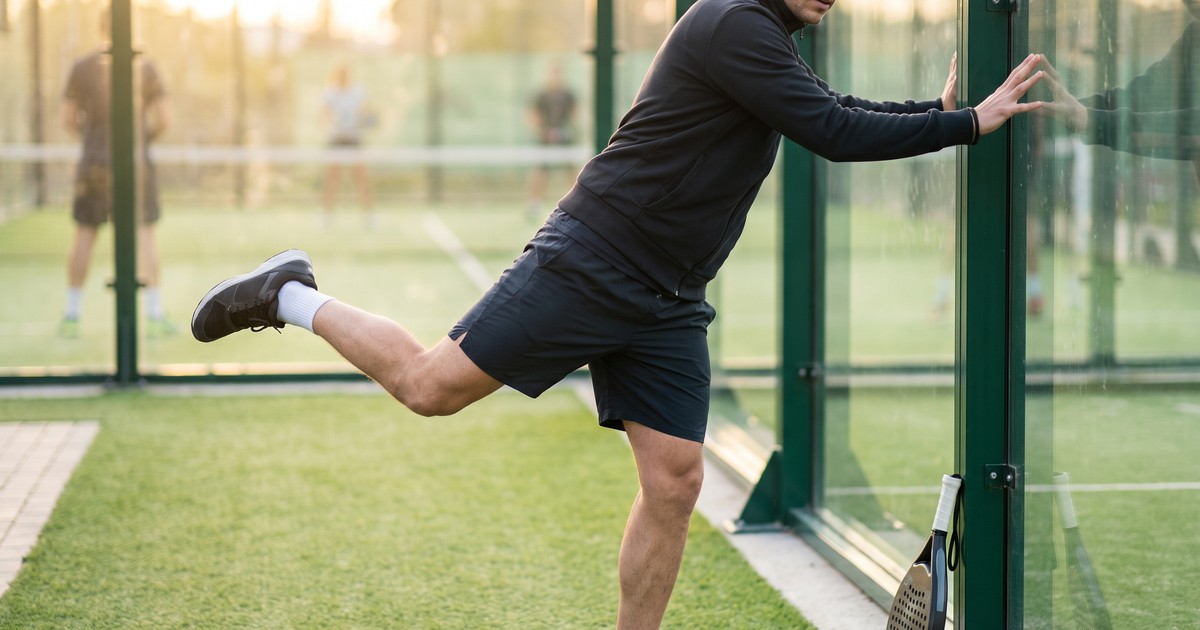
- Static stretching — now, after play, not before it: forearms, shoulders, calves, hamstrings, lower back. Hold each stretch 20–30 seconds without bouncing.
- Water and electrolytes, especially after playing outdoors in the heat — dehydration on its own raises the risk of cramps and strains at your next session.
- Ice on an elbow or knee at the first sign of irritation, rather than once it's already a constant ache — 10–15 minutes, never directly on bare skin.
- Sleep — an underrated factor in tendon and muscle recovery; chronic sleep debt is one reason injuries seem to "suddenly" show up in the middle of a busy tournament season.
When to push through and when to take a break
Some muscle soreness after a good session is normal and fades in a day or two. The signals that suggest you should scale back or take a break look different:
- Pain that gets worse during play, not just afterward.
- Pain in the same spot (elbow, knee, shoulder) across several sessions in a row.
- Swelling or reduced range of motion in a joint.
- Pain that doesn't ease up after 48–72 hours of rest.
In those cases, it's smarter to skip a couple of sessions and, if it doesn't improve, see a doctor or physiotherapist, than to push through and turn a minor strain into a chronic problem for the whole season. This isn't a substitute for professional advice — just a general sense of when to take it seriously.
There's a psychological side to this too: skipping a session with your regular group is often harder than just playing through the pain. But the math is simple — a week off to let a ligament heal is almost always shorter than the month or two you'd lose if a mild strain turns into a tear or a chronic inflammation. Your playing partners, as a rule, understand this better than it feels like in the moment.
Building fitness between sessions
A pre-match warm-up works better when your body is generally conditioned for padel's demands — you don't need to hit the gym every day for that. A compact routine two or three times a week, targeting your core, ankles and forearms, cuts injury risk far more than a perfect five-minute warm-up on a body that's never trained those areas. If you don't have gym access, we have a collection of padel exercises you can do at home with no equipment — exactly the kind of thing that strengthens the areas in the table above.
Three areas are worth prioritizing specifically because of how padel loads the body:
- Ankles — balance work (standing on one leg, ideally with your eyes closed, for 20–30 seconds) strengthens the small stabilizing muscles that most often fail during a sudden change of direction.
- Forearm and grip — simple grip-strength squeezes or slow wrist curls with light weight, a couple of sets a few times a week, cut padel-elbow risk more effectively than switching rackets does.
- Core and lower back — planks and rotational plank variations strengthen the muscles that stabilize your trunk during overheads and the bandeja, taking load off your lower back.
This isn't a full training plan — just the three directions that pay off fastest for a small time investment. Ten to fifteen minutes, two or three times a week, is enough to noticeably reduce minor injuries for regular players.
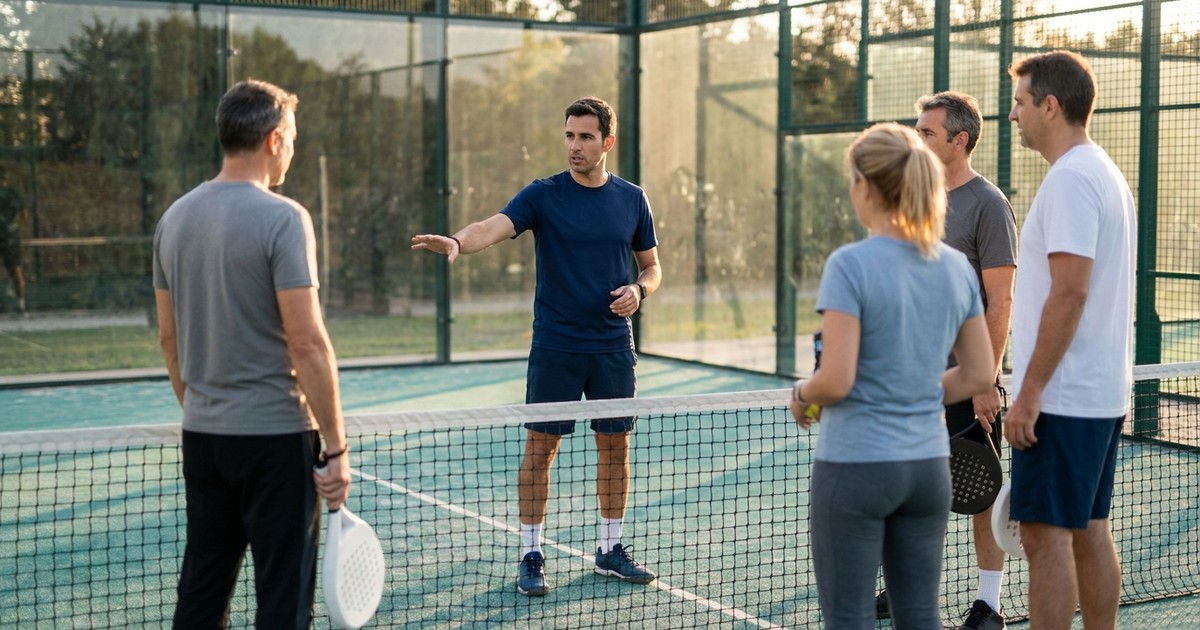
If you're getting ready for your first tournament or just want to play consistently without recovery breaks, it's also worth looking into coaching — a lot of PlayPadel lessons already include technique work that reduces joint strain through better movement, not just more strength.
Frequently Asked Questions
What is "padel elbow," and is it the same as tennis elbow?
The mechanism is similar to classic tennis elbow (lateral epicondylitis) — inflammation of the forearm tendons at the elbow from repetitive impact. In padel it's usually triggered by a stiff racket, an incorrect grip, and hitting "with the wrist" instead of involving the whole body.
How long should I warm up before playing padel?
Aim for 8–10 minutes: a bit of cardio, dynamic stretching, and a few easy balls before you ramp up to match pace. Even 3–4 minutes beats walking onto court completely cold.
Should I stretch before or after I play?
After. Dynamic movements — lunges, rotations — work better before play, since they warm up muscles and joints without limiting power. Static, held stretches are for the cool-down after play, once your muscles are already warm.
Can the wrong racket cause an injury?
Yes, especially at the elbow. A stiff frame, high string tension and heavier weight all increase vibration and forearm load on every shot — it's one of the most common, and most fixable, causes of elbow pain among recreational players.
Should I keep playing through mild pain?
Some general muscle fatigue is normal. But if the pain is concentrated in one joint, gets worse during play, or doesn't ease up after 2–3 days of rest, that's a signal to take a break and, if needed, see a specialist, rather than push through to the next session.
Does the court surface affect injury risk?
Yes. Shoes that don't match the surface, and uneven or damp courts, raise the risk of an ankle sprain. Padel-specific shoes and well-maintained courts are a simple way to lower that risk.


 Training
 Training