

The 10-Minute Padel Warm-Up Every Beginner Should Know
Beginners strain muscles more than experienced players do with a cold start. A step-by-step 10-minute warm-up, common mistakes, and tips for Tashkent's summer heat.
Contents
- Why beginners actually need to warm up
- The principle: general to specific
- Step 1. General activation (2–3 minutes)
- Step 2. Dynamic stretching, not static
- Step 3. Padel-specific movement
- Step 4. Bringing the ball in: a progression of contact
- How long it takes and how to fit it into your booking
- Common warm-up mistakes beginners make
- Warming up in Tashkent's summer heat
- What to do after the game
- Warming up is part of the game too
- Frequently Asked Questions
- Do I need to warm up if I'm only playing for 40 minutes?
- Can I replace the warm-up with static stretching right on court, without moving?
- What's the bare minimum if I really have no time?
- Do I need a different warm-up for solo practice versus playing with partners?
- Should I still warm up if I'm training with a coach?
- What if the court is occupied and there's nowhere to warm up before playing?
Fifteen minutes until your court booking. Racket in the bag, shoes on your feet — and you walk straight from the door onto the court to smack the first ball. Sound familiar? That's how almost every beginner's session starts, and it's exactly why beginners pull a hamstring or tweak a shoulder in the second or third minute far more often than experienced players do. A warm-up isn't a boring formality from a school gym class — it's ten minutes that decide how the rest of your session actually feels, from whether you strain something to whether you're timing the ball well from the first rally instead of the fifth.
Why beginners actually need to warm up
Padel looks gentler than tennis at first glance: the court is smaller, the serve is underarm, and the walls let you retrieve balls that would sail out in tennis. That deceptive calm is exactly why so many new players assume warming up is only for "serious" players who hit hard and risk something real. The opposite is true: a body that hasn't yet adapted to sharp stops, side lunges and overhead swings suffers more from a cold start than the body of a player with years of accumulated muscle memory and tissue elasticity.
Here's what happens to your body in the first five minutes of any game, even a casual one:
- you sprint to the net for a short ball, accelerating from a standing start;
- you brake hard and change direction near the back wall, often on bent knees;
- you jump for an overhead smash, stretching your shoulder, lower back and obliques in one motion;
- you drop into a deep lunge for a low ball on the sideline, loading your groin and inner thigh;
- you twist your torso sharply on the backhand, using muscles that barely fire in everyday life.
Every one of these movements, performed on cold, "sleeping" muscles, is a small but very real strain risk. A warm-up doesn't guarantee you won't pull something, but it meaningfully lowers the odds. And just as important for a beginner, it stops you from losing the first five to seven minutes of the game to "getting your legs under you," when the ball never quite feels like it's listening to your racket, your feet are half a step slow, and your eyes haven't yet calibrated to the speed and bounce of that particular court.
There's a third effect people rarely mention: warming up is a mental switch from "regular day" mode into "game" mode. A few minutes of deliberate movement help you focus and settle in, which directly shapes how confidently you make decisions in the first rallies.
The principle: general to specific
A good pre-padel warm-up follows the same logical script every time, and it's easier to remember than it sounds: first you raise your body temperature overall, then you prepare your joints and muscles for sharp, sport-specific movement, and finally you transfer all of that onto the court, starting with gentle ball contact and gradually building up intensity and range of motion. This general-to-specific, slow-to-fast progression isn't unique to padel — nearly every racket sport uses it, because it gives your body time to adapt at each stage instead of demanding maximum output right away.
The mistake almost every beginner makes is skipping the first two stages and jumping straight to the third — walking onto court and just starting to hit. The result: your first overhead or your first sharp sprint to the net lands on a body that's still "asleep" and physiologically unready for an explosive effort. Below is a working 8–12 minute warm-up you can do right by the court, no equipment and no changing into separate training gear required.
Step 1. General activation (2–3 minutes)
The goal here is simply to gradually raise your heart rate and body temperature — nothing more. Skip stretching, loaded squats or any sharp explosive movement; keep it light and steadily building.
- Light jogging or brisk marching in place — 60–90 seconds to get blood flowing through your whole body, arms and shoulders included.
- Side shuffles along the sideline — a simple imitation of the lateral movement you'll use in nearly every rally.
- Arm circles — small at first, then gradually wider, to warm up the shoulder joints that work hard on the serve, the smash and overhead shots in padel.
- Jumps in place with soft, cushioned landings — 10–15 reps to prepare your ankles and knees for the sharp stops and starts of net play.
If you feel a light sweat and slightly faster breathing after this block, you're on track — it's a reliable physiological signal that your body is ready for the next, more specific step.
Step 2. Dynamic stretching, not static
This is where it's crucial not to mix up two very different kinds of stretching — one of the most common mistakes among beginners who still remember "warming up = holding a stretch for twenty seconds" from school PE class. Before a match, that formula actually works against you.
| Dynamic stretching (before play) | Static stretching (after play) | |
|---|---|---|
| What it is | Stretching in motion: swings, lunges, torso rotations | Holding one position for 20–30 seconds without moving |
| When to do it | Before playing, as part of the warm-up | After playing, for recovery |
| Effect on muscles | Activates the nervous system, boosts readiness for explosive movement | Relaxes, lowers muscle tone |
| Risk before a match | Low, if done smoothly | Can temporarily reduce power and reaction speed |
Before a match, dynamic, "live" movements are what work:
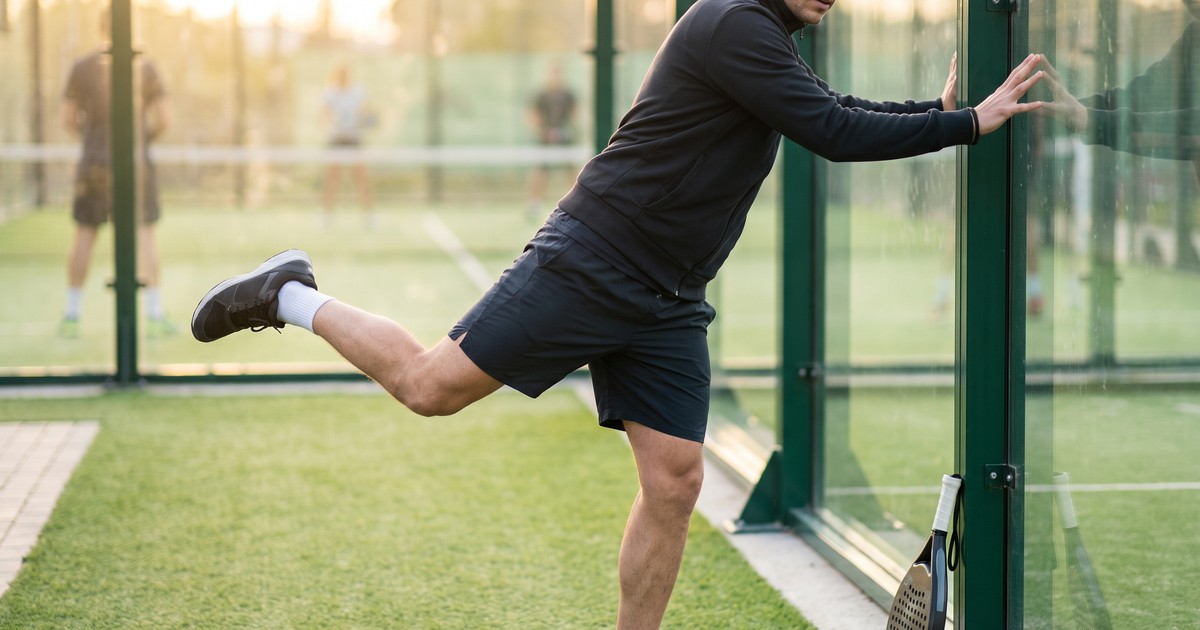
- Leg swings forward and back — 10 reps per leg, holding the court fence for balance if needed. This warms up the hamstring, the single most common strain zone for beginners.
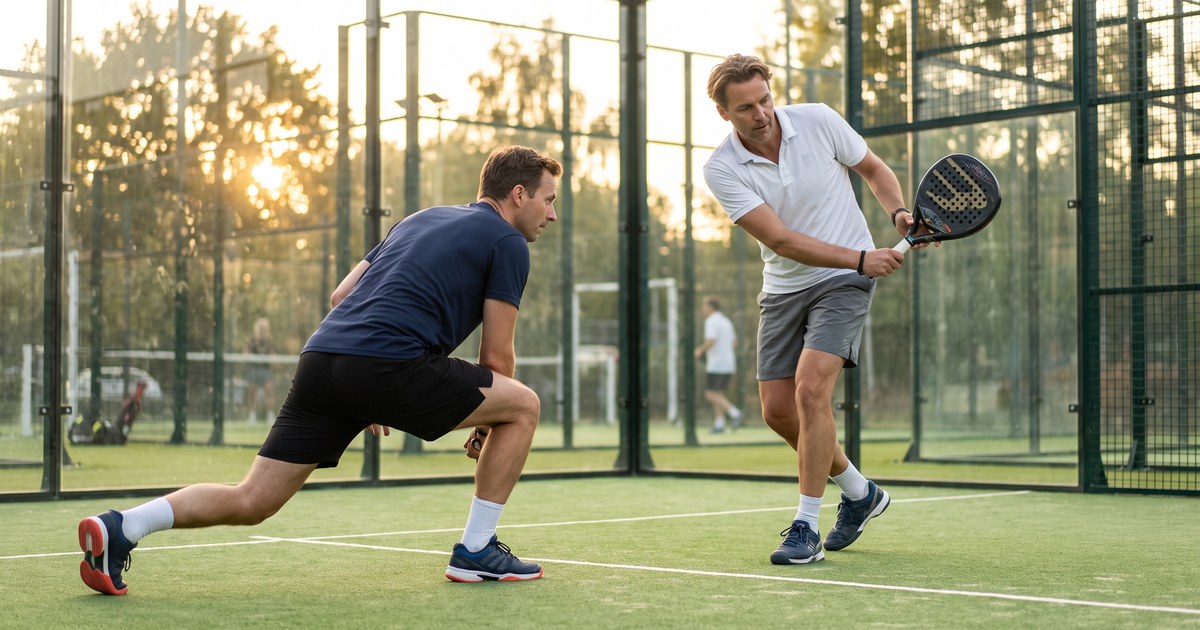
- Walking lunges with a torso twist — step into a lunge, then rotate your torso toward the front leg; this move prepares both your legs and your core together for the rotational shots that come up constantly in padel.
- Forearm stretch in motion — flex and extend your wrist against light resistance from the other hand, 10–15 reps per side; the forearm is often overloaded in beginners from gripping the racket too tightly.
- Torso rotations — smooth turns left and right with slightly bent knees, mimicking the wind-up before a shot.
Save static stretching — the kind with a long-held position — for the very end of your session. It's excellent for long-term recovery and flexibility, but done cold, right before a match, it tends to temporarily relax and "switch off" your muscles rather than prepare them for an explosive push or jump.
Step 3. Padel-specific movement
This is the bridge between general warm-up and actual ball contact — you're still without an opponent or live play, but you're already moving exactly the way you will during a real rally.
- Split step — the soft hop before every rally we covered in detail in our piece on the split step. Do 8–10 reps: hop, land softly on slightly bent knees, ready to move instantly in any direction. This movement is the foundation of reaction speed in padel, and warming it up specifically before playing matters a lot.
- Shadow swings — imitate your forehand and backhand with no ball and no opponent, 10–12 reps per side. This isn't about power; it's about letting your shoulder, elbow and core "remember" the correct swing path before a real ball is involved.
- Serve and smash imitation — a few overhead swings at a slow, controlled pace, gradually increasing range of motion with each rep.
- Quick steps in four directions — forward, back and to each side, 3–4 quick steps each way, returning to your starting position — this prepares your body for the unpredictable movement that real play demands.
Three to four minutes on this block and your body already understands, physically, what kind of game it's about to play.
Step 4. Bringing the ball in: a progression of contact
The final part of your warm-up is what most players just call "hitting a few balls," but it has its own clear internal logic too. The biggest mistake here is going straight into smashes and full-power shots without the gradual build-up below.
- A short net exchange (1–2 minutes) — soft touches at close range, almost no backswing, just to feel the ball and racket again after the break.
- Baseline rallies at an easy pace (2–3 minutes) — forehand and backhand without power, focused on clean contact in the center of the strings rather than ball speed.
- Wall play (1–2 minutes) — a few rallies using the back and side glass to get used to the bounce on this specific court: the surface, net tension, glass thickness and cleanliness vary noticeably from club to club.
- A handful of serves and overheads (1–2 minutes) — now that your body is fully warmed up through the previous steps, you can gradually add range and speed, bringing intensity up to match level.
By the end of this progression you're not just physically ready — you've also calibrated your eyes to the speed, spin and bounce of that specific court and conditions, an often underrated skill that shapes the first few rallies of the match.
How long it takes and how to fit it into your booking
The full warm-up described above takes 8–12 minutes — a realistic block of time worth planning for in advance, not squeezing in between changing shoes and stepping onto court. If you're booking through the venue directory, it's worth arriving 10–15 minutes before your slot starts: most clubs in Tashkent won't mind you warming up next to the court while the previous pair finishes their match.
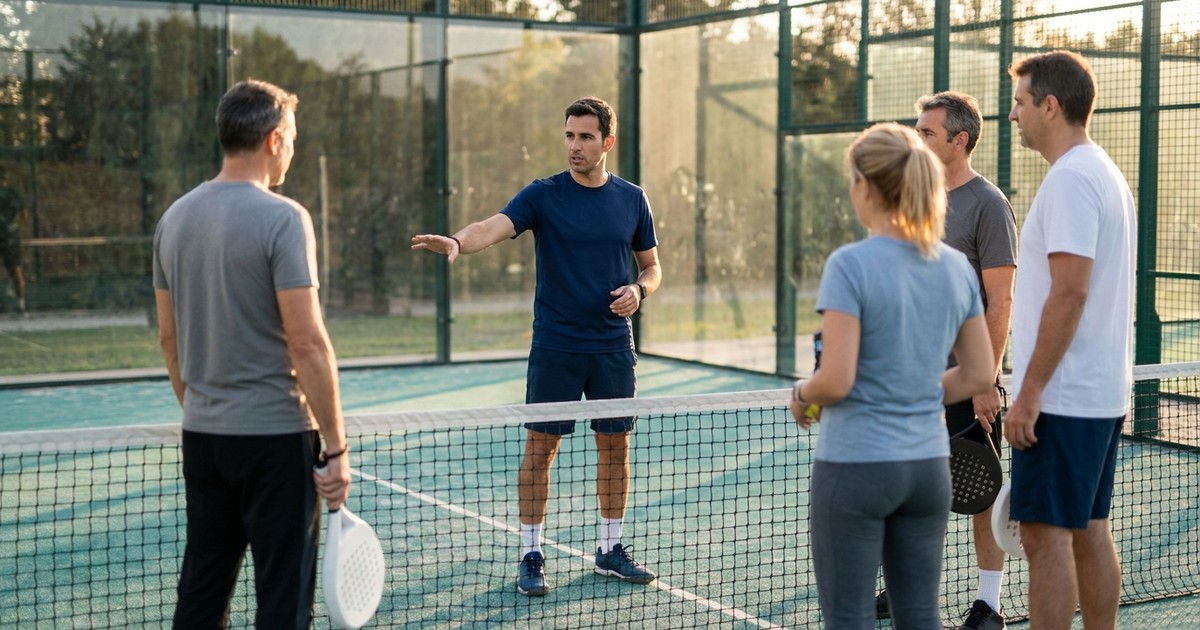
If you're training with a coach, it's worth discussing part of the warm-up ahead of time — a coach's profile on the site usually notes whether they work with beginners, and many coaches build a structured warm-up into the first few minutes of the lesson themselves, which is handy if you're not yet confident doing it on your own. If you're preparing for your first amateur tournament, look for one early in the events section and plan to arrive with a generous buffer — on tournament day, warm-up courts fill up fast and you'll be sharing your warm-up minutes with dozens of other players.
Common warm-up mistakes beginners make
Even knowing the theory, it's easy to fall into the same traps, especially in your first few months when all your attention is on the shots themselves rather than preparing for them. The most common ones:
- Skipping the warm-up entirely — the most obvious and most widespread mistake. "We'll hit a few balls and it'll warm us up naturally" works noticeably worse in practice than a structured 8–10 minutes following the steps above.
- Static stretching while cold — holding a hamstring stretch standing still with no prior activation doesn't prepare your muscles for load, and can even temporarily reduce explosive power.
- Going full power on the first shot — the urge to really smack the very first ball you get, skipping the gentle progression in Step 4, is one of the most common causes of a strained shoulder or elbow specifically in newer players.
- Ignoring your legs — most beginners diligently warm up their arms and shoulders while forgetting their ankles and knees, even though sharp stops and direction changes — not the shots themselves — are the most common cause of padel injuries overall.
- Warming up too far in advance — if you warm up in the changing room 40 minutes before play and then wait around at the club café for your turn, most of the effect is lost as muscles cool down again. Warming up needs to happen right before you walk onto court, not long before.
Warming up in Tashkent's summer heat
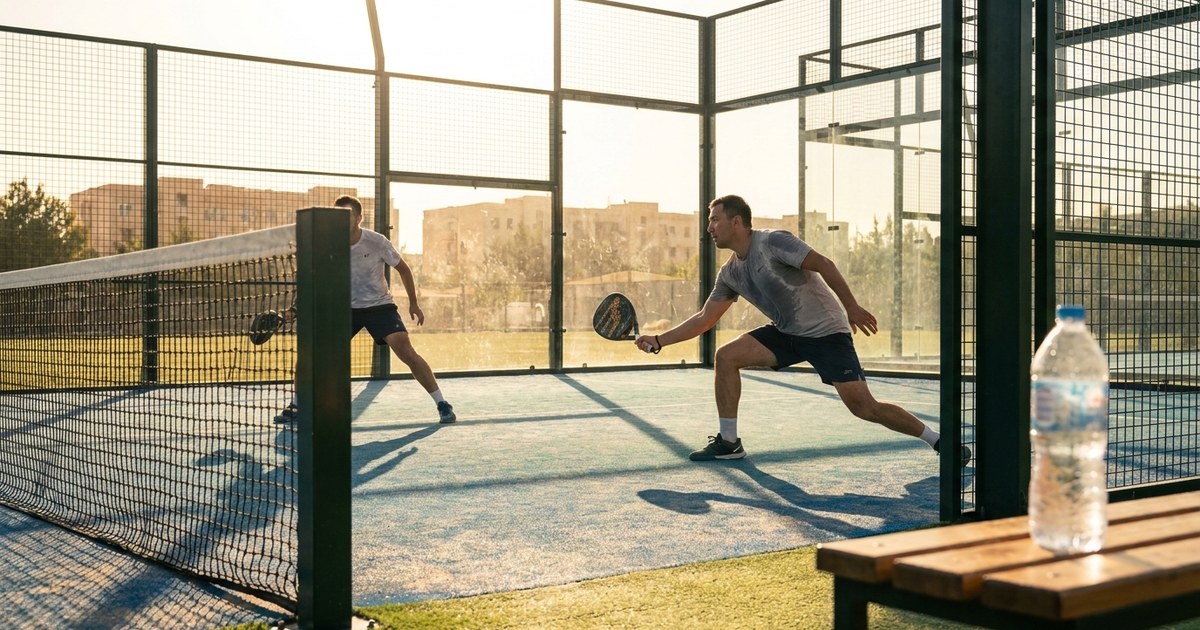
Summer in Tashkent adds its own wrinkle, which we covered in detail in our piece on playing padel in the heat: in high air temperature, your body warms up noticeably faster, but you also dehydrate faster. That doesn't mean you can shorten or skip the warm-up itself — your joints still need preparation regardless of the air temperature. It's more about shifting your emphasis:
- drink water before the warm-up starts, not just during play, so you don't begin the match already slightly dehydrated;
- trim the general activation in Step 1 down to a minimum if it's genuinely hot outside — 60–90 seconds is usually enough since your body is already warm from the heat;
- spend a bit more time on the dynamic stretching and padel-specific movement in Steps 2–3, so your joints and ligaments are properly prepared even though your muscles already feel warm from the outdoor heat;
- warm up in shade or an air-conditioned lobby where possible if you're playing an outdoor court during the day.
Early morning and evening, when it's cooler, the standard routine works with no adjustments needed.
What to do after the game
Warming up is only half the equation — recovery right after the match is the other half. After playing, it's worth spending 5–7 minutes on genuine static stretching — the kind with a 20–30 second hold — targeting your main muscle groups: hamstrings, calves, shoulders and forearms. It won't dramatically speed up recovery, but it noticeably reduces stiffness and soreness the next day, especially if you're playing two or three times a week.
If you're regularly feeling actual pain after games rather than normal muscle fatigue, that's a sign to reconsider not just your warm-up but your overall training load and how gradually you're building it up. We covered the most common padel injuries and how to prevent them, including typical load mistakes beginners make, in a separate piece on preventing padel injuries.
Warming up is part of the game too
Experienced players rarely think of the warm-up as a separate, standalone ritual — it's simply built into the habit of stepping onto court, the way brushing your teeth is built into the habit of starting your morning. For a beginner, it's mostly a question of repetition and habit too: the more often you run through the same sequence of steps, the faster your body starts to recognize the "we're about to play" signal and switch on ahead of time, before the first shot. After a few weeks of consistent training, these 10 minutes stop feeling like wasted court time — they become a natural part of the enjoyment, right alongside the match itself.
If you're just starting to figure padel out — and how the whole game fits together — check out the rest of our beginner's diary: honest breakdowns of the first steps, from choosing your first racket and shoes to getting ready for your very first tournament.
Frequently Asked Questions
Do I need to warm up if I'm only playing for 40 minutes?
Yes. A short session isn't a reason to skip warming up: the injury risk from a cold start doesn't depend on how long you're playing, and skipping the warm-up just eats into your already-limited match time with a slow, sloppy start instead.
Can I replace the warm-up with static stretching right on court, without moving?
No, not if it's static stretching on cold muscles. Start with light general activation and the dynamic movement in Steps 1–3, and save classic held stretches for after the game.
What's the bare minimum if I really have no time?
Even 4–5 minutes — light general activation plus a few shadow swings and split steps from Step 3 — beats skipping the warm-up entirely. Do the full ten-minute version whenever your court time allows it.
Do I need a different warm-up for solo practice versus playing with partners?
The core principle stays the same, but before playing with partners it's worth adding a couple of minutes of paired net exchanges within Step 4 — it helps you sync tempo and rhythm with your partner before the score even starts.
Should I still warm up if I'm training with a coach?
Yes, but it's worth checking the format with your coach first: many coaches on the site build the first few minutes of a lesson as a structured warm-up themselves, and in that case part of this routine can naturally blend into the start of the lesson.
What if the court is occupied and there's nowhere to warm up before playing?
You can do the general activation and dynamic stretching from Steps 1–2 in any open space near the court — a parking area, the club lobby, a patch of grass nearby. None of it actually requires the court itself; the only thing that matters is doing it right before you step onto it, not half an hour ahead of time.
An honest diary for absolute beginners: first lessons, the mistakes nobody warns you about, choosing your first racket and your first steps on court. Thinking about your first game? Start here.
Related articles
 Training
Preventing Padel Injuries: A Practical Guide
Why padel injuries happen, how to warm up properly, and what actually helps you recover between sessions — a practical guide from the PlayPadel team.
 Training
Group vs. Private Padel Lessons: What Actually Speeds Up Progress
Group classes are cheaper and more social; private lessons fix technique faster. Here's which to pick at each stage — and how to combine both.
 Training
Padel in Tashkent's Summer Heat: Hydration & Court Tips
How to play padel safely through Tashkent's summer heat: how much to drink, what to wear, when to book a court, and which court type to pick.