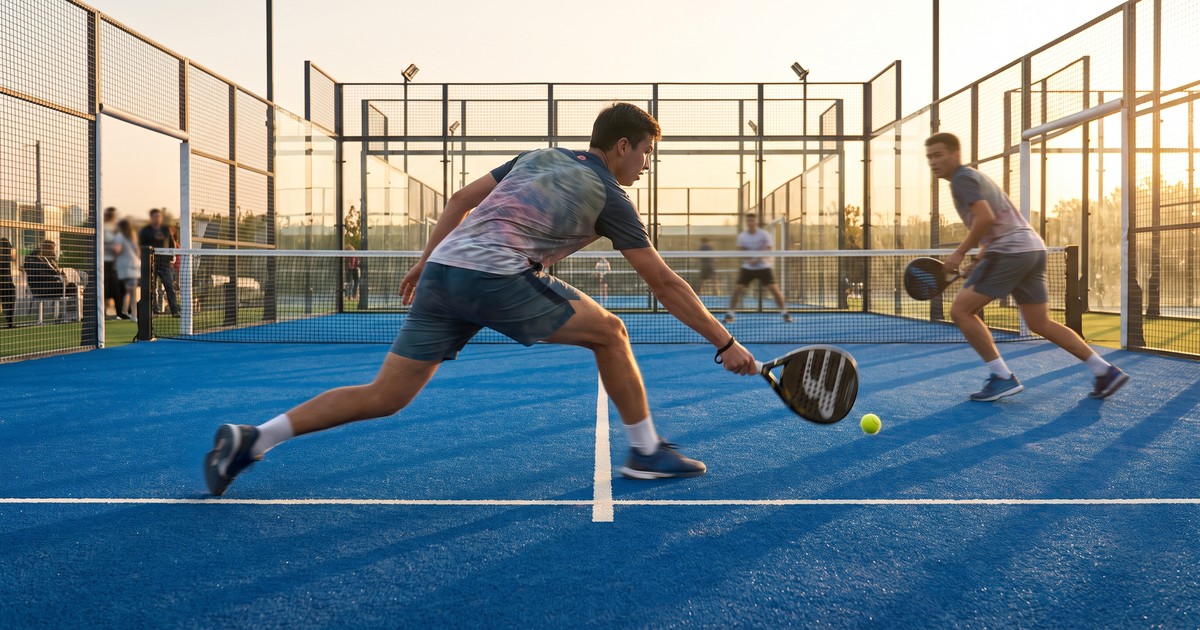
If you could pick one habit that would raise your padel level faster than anything else, we wouldn't point you toward another advanced shot — we'd point you toward a movement that lasts less than half a second and doesn't involve your racket at all. That's the split step: the small hop you make right as your opponent hits the ball, and it decides whether you actually reach the next shot or spend the whole point chasing it.
What the split step is, and why you can't skip it
The split step is a small, two-footed hop a player makes the instant an opponent's racket makes contact with the ball. For a fraction of a second the body is airborne, then it lands on slightly bent, shoulder-width (or wider) legs — a wide, stable stance you can explode out of in any direction.
Skip it, and you're either standing on straight legs with a 0.2–0.3 second reaction delay, or you're already drifting the wrong way and burning time braking and turning around. In padel, where the ball can change direction sharply off the glass and mesh, that gap is often the entire difference between a clean volley and a ball that sails past your racket.
This isn't an advanced-player trick — good academies teach it in the first week, because every other technical skill only matters once your feet have actually delivered you to the ball on time. If you've already read about court positioning, think of the split step as the next logical layer: good positioning is useless if you can't launch from it at the exact right instant.
Timing: exactly when to jump
The most common mistake is jumping at the wrong moment. The split step should land right as your opponent's racket touches the ball — not earlier, not later.
Too early — you land, wait half a second on straight legs, lose the spring in your knees, and end up standing flat-footed again just as the ball arrives.
Too late — you're still airborne, or only starting to bend your knees, when the ball has already come off the glass, and your first step is a beat behind.
The cue is not the sound of the ball being hit — it's the moment the opponent's strings meet the ball, which you read with your eyes, not your ears (on an open-air court, ambient noise from neighboring games is as distracting as wind).
Timing shifts depending on where you are on the court and what's happening in the rally:
Situation
When to land
What to watch
Common mistake
Net play
Exactly as the opponent hits from the baseline
The opponent's swing, not the ball
Jumping too early, freezing on straight legs
Back-wall rally
A touch earlier, with margin for the glass rebound
The ball's path to the glass behind you
Skipping the split step, trusting running momentum instead
Defending a lob
Earlier than usual, to leave room to retreat
The lob's height and spin
Landing too close to the net, no room to step back
A "slow", easy rally
Just as precisely as in a fast exchange
The opponent's swing, not the ball's pace
Not doing a split step at all — "it's an easy ball"
If you're not sure where to start, drill the timing at the net first — that's where a fraction-of-a-second error is most visible and turns into a missed ball fastest.
The mechanics of a good split step
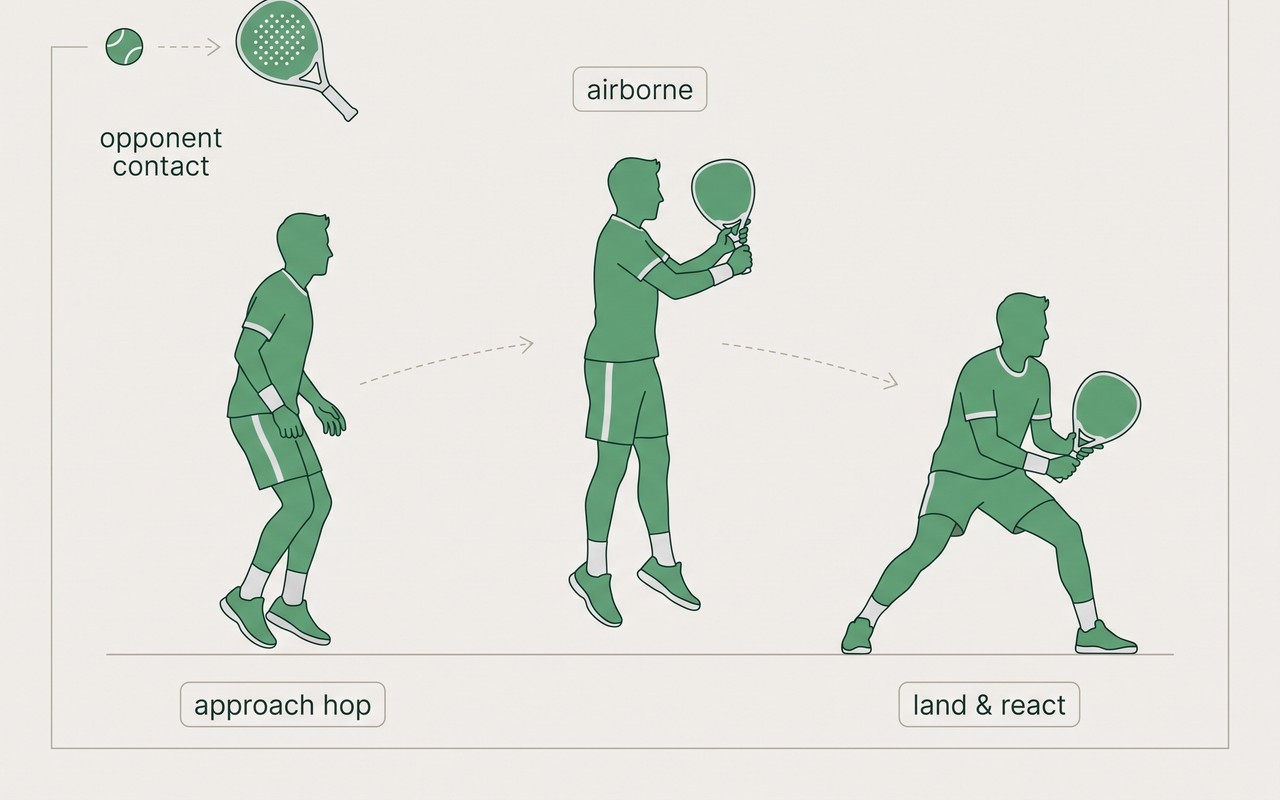
Break the movement into phases:
A small approach hop. This isn't a vertical jump — the knees bend and the feet leave the ground by a few centimeters, no more.
The airborne moment. This is when you actually "read" the opponent's shot — where it's headed, what spin it carries, whether it's a lob or a short ball.
Landing on bent legs, slightly wider than shoulder width. Weight on the balls of the feet, not the heels; torso leaning slightly forward; racket already up, not hanging down.
The first step toward the ball — immediately, with no pause to straighten the legs first.
On landing, the feet usually rotate a little toward the anticipated direction of travel — that saves a fraction of a second on turning the torso. The arms stay free through all of this: the split step is leg work, not a racket swing.
Diagram of the three split-step phases: the hop at the moment of the opponent's contact, the brief airborne phase, and landing in a wide, stable stance. The illustration shows the general principle of the movement, not one player's exact technique.
At the net: the volley starts with your feet, not your hand
Nowhere is split-step timing more critical than at the net. The distance to your opponent is at its shortest there, which means your reaction window is too. If you've read our piece on the volley, you know a good volley is a short, compact shot with almost no backswing. But even perfect hand technique won't save you if your feet haven't delivered your racket to the right spot first.
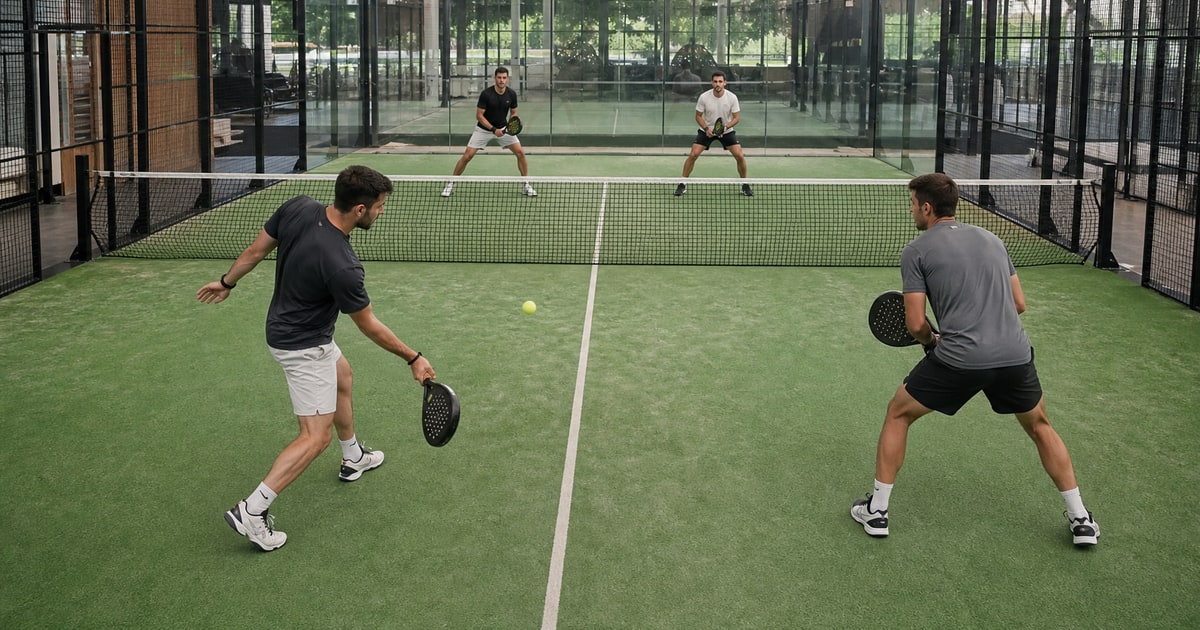
At the net, players split-step on every single opponent shot — not only on a smash, but on an ordinary shot from the baseline too. Pros at the net effectively "hop" dozens of times per rally; it looks fidgety from the stands, but that's exactly how the body stays ready for a sudden change of direction: a shot at the body, a chiquita played low, or a lob overhead.
At the back wall: the split step before a bandeja or víbora
At the back glass, the logic shifts slightly: the split step there helps with balance while moving backward more than with pure direction. Before playing a bandeja or víbora off the rebound, a player has to shed backward momentum and re-set into a stable stance — and the same short hop works as a brake and a launch pad at once.
The timing reference is different too: at the back wall, you're reading not just the opponent's contact but also the moment the ball rebounds off the glass behind you. Experienced players effectively double-check here — one split step for the opponent's shot, a quick positional correction, then a light second "top-up" of the stance right before their own shot.
Common mistakes that kill the split step
Jumping too high. The higher you jump, the longer you're airborne and the later your first step lands. The split step is measured in centimeters, not centimeters-plus-ten — plenty of players confuse it with a vertical jump and land later than the situation allows.
Landing on straight legs. With no bend in the knees there's no spring, and every first step comes with a delay — the body has to bend the knees first and only then push off, losing exactly the fraction of a second the whole movement exists to save.
A stance that's too narrow on landing. Feet placed close together give you less of a base to push off sideways from; the center of gravity is easier to tip over than to explode from.
Watching your own racket instead of the opponent. Many players lose the moment to jump precisely because, in that last split second, they glance at their own shot preparation instead of the opponent's swing — your eyes need to stay on the opponent right up to contact.
Skipping the split step on "unimportant" balls. It's exactly these relaxed rallies that most often end in a missed short ball or a surprise lob, because the body simply isn't ready to move.
Doing the split step and then stopping there. Landing means nothing on its own if the first step doesn't follow immediately — some players seem to "hang" in the stable stance for an extra beat instead of using it as a springboard.
Three drills to build the habit
The split step is a motor skill, and it trains the same way any other movement does — through repetition in controlled conditions, not only under match pressure.
Jump on cue from a partner. A partner without a racket, on the other side of the court, raises a hand at random moments — you split-step exactly as the hand goes up, with no ball involved at all. This strips away everything else and isolates timing alone.
Fed balls at the net. A partner or coach feeds soft balls one at a time — every single ball requires a full split step before the shot, even one aimed straight at you.
Shadow drilling with narration. Alone, without a ball, say the moment of "opponent contact" out loud (you can use footage of a professional match) and split-step in sync with what you see on screen — this trains reading the swing itself, not reacting to the sound of the ball.
If you're still finding your feet in the game overall, you don't need to tackle everything at once — working with a coach early on is the easier way to set your posture and stance correctly the first time, instead of unlearning bad habits later.
What this has to do with general fitness
The split step is, at its core, a short plyometric jump, and how well you can execute it depends on leg strength and overall explosive readiness, not technique alone. Weak ankles and thighs are often the real reason a player "knows" how to split-step but physically can't repeat it reliably deep into a match — by the end of the first set, a tired player's split step turns into a soft shuffle.
Endurance matters here too: if a rally runs 20–30 seconds with six or seven split steps in a row, and half an hour into the session the legs "stop answering," good timing habits are the first thing to fall apart — well before the arms get tired. A few weeks of consistent padel-specific fitness work, especially for explosive leg strength and ankle stability, tends to speed up the split step noticeably more than it improves your volley or serve, simply because this movement lives entirely in the legs.
The split step and the transition zone: what happens after you land
A split step rarely exists in isolation — it's usually followed by a move into the transition zone: the strip of court between the baseline and the net where the point is decided between staying in defense or moving into attack. Land your split step, and you immediately read whether the ball is short (move in toward the net) or deep (reset at the glass once more).
That's exactly why the split step isn't a one-off move for a single shot — it's part of a continuous loop: split step → shot or movement → split step again on the opponent's next shot. In a fast net exchange, that loop can repeat five or six times in ten seconds.
Syncing it as a pair: two split steps at once
Padel is played four to a court, and the split step is also an invisible part of teamwork. When both partners split-step in sync on the opponent's shot, the pair moves as a single unit — equally ready to shift left or right, equally ready to cover a partner who's stepping in toward the net.
Being out of sync is a common cause of gaps in defense: one player has already landed and is ready to move, while the other is still on straight legs and a beat behind. It's especially visible in pairs where one player is technically stronger than the other: the more experienced partner instinctively split-steps on time, while the newer player is still keying off the sound of the ball, and the pair moves out of step even when their court position is technically sound.
If you play regularly with the same partner, drill the shared timing on purpose — during warm-up before an event or tournament, try counting "one-two" out loud on the opponent's swing until you feel a shared rhythm. Over time this stops needing words: a pair that has trained together long enough syncs the split step through peripheral vision, reading a partner's movement in the corner of the eye rather than only watching the opponent.
Frequently Asked Questions
Do beginners need the split step, or is it only for advanced players?
The split step helps at every level — the sooner it becomes a habit, the sooner it stops requiring conscious effort. Beginners should start with slow, predictable balls to drill the timing itself, rather than panicking under speed.
Is the split step just standing on your toes?
No. Standing on your toes is a static position, while the split step is a short, dynamic movement with an airborne phase and a landing. You can be up on your toes and still be late if your body isn't "springing" at the exact moment your opponent makes contact.
Why can't I time my jump correctly?
Usually it's not reaction speed — it's that your eyes drift away from the opponent at the last moment, often toward your own racket or toward the ball that's still in flight. Train yourself to read the opponent's swing specifically, rather than reacting to the sound or to a ball that's already on its way.
Do you need to split-step on every ball, even in a slow rally?
Yes — the habit only works if it isn't selective. Skip the split step on "calm" balls, and you risk missing exactly the moment your opponent suddenly speeds things up or plays a chiquita.
Can you learn the split step on your own, without a coach?
The basic mechanics, yes — especially with the drills above. But a coach will spot small errors faster — jumping too high, landing in too narrow a stance — and help you fix the movement before it hardens into a stubborn bad habit.
How long does it take for the split step to become automatic?
It varies, but most players who train it deliberately — rather than hoping it "just happens" during matches — notice real progress within a few weeks of consistent practice, as long as the drills above are part of every session rather than an occasional add-on.
The blog's deepest column: advanced shots (bandeja, víbora), positional play, periodised training and honest gear breakdowns — grounded in the experience of Tashkent's playing coaches.
Reviews
Log in to leave a review
Bote pronto means meeting the ball right after it bounces off the court, before it reaches the glass. Here's the technique, timing and when to use it.