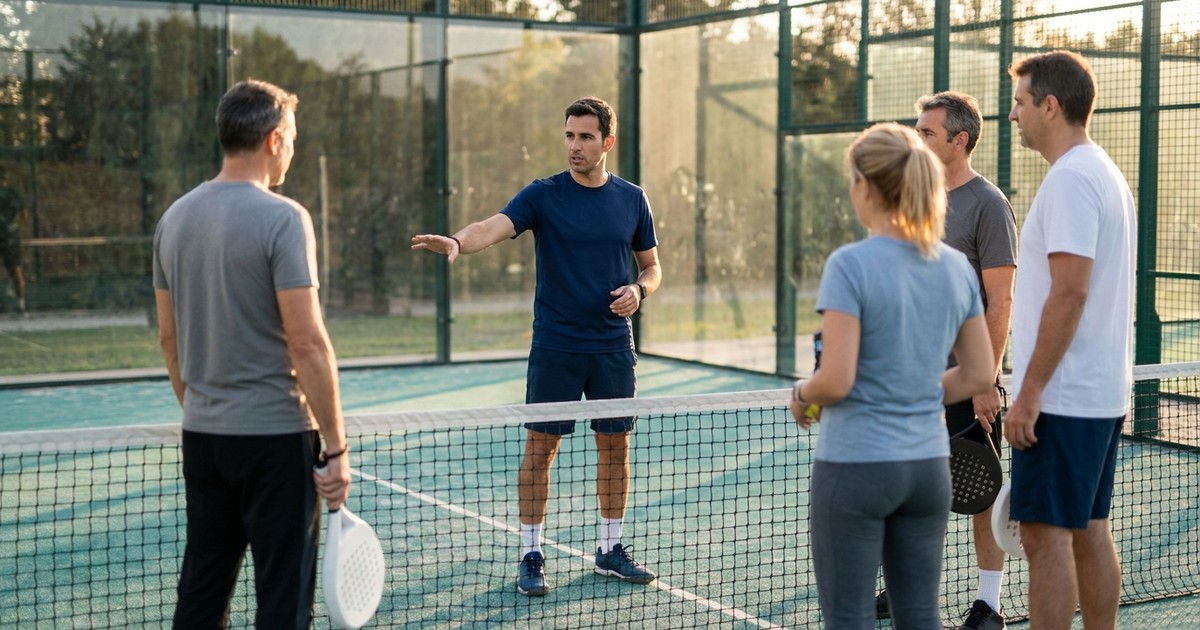
If you've been playing for a month or two and feel like you've hit a wall, it's almost never about your shots. It's about where you stand and how the two of you move. Padel is a four-player team game, and a pair that moves as one beats a pair with bigger weapons but ragged positioning. The good news: positioning is faster to learn than technique, and it asks for understanding, not athleticism.
Why position beats power
The padel court is small — 20×10 metres, glass on every side, walls in play. On a court that size you almost never win a point by hitting a clean winner past your opponent: the ball rebounds off the glass and stays alive. Points are won by patience and pressure from the right position, not by one big swing.
That leads to the core principle: you win at the net and defend from the back. The pair that owns the net hits down, intercepts and finishes. The pair pinned at the back defends and waits for the error. All of padel positioning is the fight to seize the net and hold it without breaking your line.
Aziz Karimov, a national-team coach from our PlaySport coaches roster, puts it plainly: "Amateurs think they lose because their shot is weak. Nine times out of ten they lose because they're standing in the wrong place and chasing the ball alone, leaving half the court empty."
The two zones: net versus back
Forget "somewhere in the middle." Padel has two working zones, and the middle of the court is no man's land — the place where you're defenceless.
- Attack zone — at the net. Both partners about 2–3 metres off the net. From here you volley, hit the bandeja and smash, apply pressure and end rallies.
- Defence zone — at the back glass. Both partners a metre or so off the back wall so you can play the ball after it rebounds.
- No man's land — the middle. Balls land at your feet here, the bounce is awkward, and you can't reach the net in time. Standing here is gifting points.
The rule is simple: you're either moving forward to the net or retreating to the glass, but never stranded in the middle. Every rally is movement between the two zones, not loitering in one spot.
The wall of two: move as a pair
The single most important idea in positioning: you and your partner aren't two separate players — you're one wall the width of the court. The court is only 10 metres wide, and together you cover it only if you move in sync.
The imaginary rope
Picture a rope 6–7 metres long tying you to your partner. When one of you shifts right toward the side wall, the other must shift too, so the rope never pulls tight and no gap opens up in the centre. Your opponent always aims for the seam between you — close it with movement, not a stretched arm.
Up together, back together
This is the golden rule almost every beginner breaks:
- Going to the net? Go together. If you charge forward and your partner stays back, a diagonal opens between you, and any lob over you catches the pair flat-footed.
- Retreating under a lob? Retreat together. If your partner backs up for a deep ball, back up too — otherwise they're covering the rear alone.
- One up, one back is the most vulnerable shape. That pair gets split by a lob over the front player, or a ball at their feet. If you've ended up "staggered," it's an emergency, and job one is realigning.
Marco Rossi, a playing coach with World Padel Tour experience, repeats one line in his clinics: "Padel se juega en línea" — padel is played in a line. Two players on the same line, moving together, are the foundation.
Who takes the middle
A ball straight between the two partners is the classic moment where both freeze ("yours!") or both swing (rackets clash). Agree the rules in advance:
- The middle belongs to the player whose forehand is in the centre. In a standard setup, the ball down the middle is usually played by whoever has their forehand facing in — it's stronger and more reliable than the backhand.
- A lob down the middle goes to whoever's bandeja is steadier. The overhead in the centre is played by the partner with the more dependable shot above the head.
- In doubt? Call it. A short "mine!" solves 90% of collisions. Silence is the number-one reason middle balls get lost.
Work these agreements out with a regular partner — which is exactly why playing with the same people matters. We covered how to build your circle of players in the guide on finding padel partners in Tashkent.
Base positions by zone
The start of the point: serve and return
Positioning begins before the first ball. The serving pair pushes to the net: you serve and immediately both move forward to seize the net, because in padel the serve gives no advantage — the right to attack has to be taken with your feet. The returning pair starts at the back: both of you stay deep, take the ball calmly off the wall rebound, and look for the first lob to steal the net. Understanding this from the first second of the rally saves you half the work.
Both pairs at the net
If all four come to the net, the winner is whoever first hits sharp and low into the opponents' feet, or drops a clever short lob behind them. Stand 2–3 metres off the net (not glued to it — or you'll be lobbed), racket up in front of your body, weight on your toes.
Defending from the back
When the opponent has taken the net, your job is not to panic or try to blast a winner. Both of you stand at the back glass, let the ball rebound off the wall, and play patient lobs, pushing the opponent back. The aim of defence isn't to win the point immediately — it's to win the net back. We covered the errors that stop beginners defending well in the piece on first-month padel mistakes.
| Situation | Where you stand | What you do |
|---|
| You own the net | Both 2–3 m off the net | Apply pressure: volley, bandeja, smash |
| Opponent at the net | Both at the back glass | Patient lobs, wait for your chance |
| Transition moment | Move forward together | Lock in after a good shot |
| Lob over your head | Retreat together | Bandeja or defend off the wall |
The transition from defence to net
This is the most technically difficult moment in padel — when you move from defence to the front. It's easy to get wrong: go too early and you take a ball at your feet on the run; go too late and you miss the chance.
- Only move forward after your own good shot. A deep lob or a biting bandeja that pinned the opponent is your signal to advance.
- Move together and brake on the opponent's hit. As the opponent winds up, pause for an instant (a split step) so you can react either way, then continue forward.
- Behind a good bandeja, step to the net. The bandeja exists precisely to hold or regain the net. If you've mastered it (full breakdown in the article on the bandeja shot), use every one as a springboard forward.
Don't try to sprint through no man's land at full speed — brake on every opponent hit, or a ball at your feet will catch you mid-stride.
Pair communication: what to say and when
Padel is a loud sport, and that's fine. Silent pairs lose the "nobody's" balls and clash rackets. Agree on a minimal set of short calls:
- "Mine!" / "Yours!" — who plays the ball between you. The most important word on court.
- "Switch!" — when you've crossed onto your partner's side (after chasing a lob, say) and need to swap places.
- "Long!" / "Out!" — telling your partner to leave a ball that's heading out.
- "Lob!" — a warning that the opponent has thrown one behind you and it's time to retreat together.
Speak short and early, not after the mistake. And above all — never criticise your partner mid-rally. Save the debrief for after the games; on court it's only cues and support. A healthy partnership is half the result, and it's what keeps a community of players together season after season.
Splitting your coverage
When you stand as a pair, each player has an unspoken zone to cover:
- Lobs over the head are covered by whoever the ball is flying toward, while the partner backs up the middle.
- Attacks down the middle are handled by the player whose forehand faces in.
- Wide balls along your own glass — each is responsible for their half at the side wall.
- A short ball at the net is finished by whoever's closest, while the other instantly shifts to cover the space they left.
The key isn't "everyone knows their box" — it's constant adjustment: the moment one player is pulled out of position, the other slides over to close the gap. That's moving as a pair in its purest form.
Five positioning mistakes
- Getting stranded in the middle. The costliest error. Fix: drill the rule "forward to the net or back to the glass — but never the middle."
- The stagger: one up, one back. The opponent immediately lobs over the front player. Fix: the moment you spot a gap, realign with your partner, even if that means dropping back.
- Silence on middle balls. Both leave it or both swing. Fix: a short "mine!" on every contestable ball, no exceptions.
- Charging the net without a split step. You run forward at full speed and take a ball at your feet. Fix: brake on every opponent hit.
- Standing glued to the net. It looks aggressive, but you're easily lobbed. Fix: keep 2–3 metres off the net so you can retreat under the overhead.
Drills for moving as a pair
Positioning is built by reps, not by talking about it. Here are three drills to work on at any of the courts in Tashkent.
Drill 1. The rope
Stand at the net with your partner and ask a third person to feed balls into different corners one at a time. Your job is to move in sync: wherever one shifts, the other shifts too, keeping 6–7 metres between you. No power — just hold the line.
- 5 minutes of continuous movement. Count it a success if no gap ever opens in the centre.
Drill 2. Forward together
Both start at the back glass. A coach-partner feeds a ball, you play a deep lob and both move to the net, braking on each of their next hits.
- 8–10 transitions. A rep only counts if you reach the net on one line, not staggered.
Drill 3. "Mine!"
A half-game rally where half the balls are deliberately aimed into the centre between you. The task is to call every ball out loud and never clash rackets.
- 10–15 rallies. Count how many middle balls you resolve without a silent pause.
Progress is noticeably faster under a coach's eye — from the side it's obvious who lags in movement and where the rope snaps. Pick a doubles specialist from the PlaySport coaches section, and test your positioning in a real game by signing up for upcoming games and matches.
Frequently Asked Questions
Where should I stand in padel — at the net or back?
It depends on the situation, but the goal is almost always the same: take the net, because that's where points are won. At the back glass you defend and try to win the net back with patient lobs. The key is to stay on one line with your partner and not get stranded in the middle.
Who should take the ball down the middle?
Usually the player whose forehand faces the centre — that shot is stronger and more reliable. A lob down the middle goes to whoever has the steadier bandeja. In any contestable case, call a short "mine!" so you don't clash rackets.
Why can't one player stand up and the other back?
The staggered shape opens the court: the opponent lobs over the front player or hits a ball at their feet, and the pair can't reset in time. Move together — both forward and both back.
How do I transition from defence to the net without taking a ball at my feet?
Only move forward after your own good shot (a deep lob or biting bandeja), and always split-step — a short pause — on every opponent hit. That way you're never caught mid-stride at the wrong moment.
How close to the net should I stand?
Around 2–3 metres is ideal. Glued to the net you're easily lobbed and can't retreat under an overhead. From a couple of metres back you can both intercept and recover.
Can I learn positioning without a coach?
You can drill the basics on your own with the exercises above — move as a pair, don't loiter in the middle, call the middle balls. But a coach speeds it up: they can see from the side who's breaking the rope and fix it in the moment.



 Training
 Training