

Both Back: How to Defend as a Pair in Padel
When pressure forces you away from the net, both players must retreat together. Learn when to switch, where to stand and how to win the net back.
Contents
- What the both-back formation actually means
- Both at the net versus both at the back
- Three signals that tell both players to retreat
- How to set up: three steps to a useful defensive line
- Footwork and synchronisation with your partner
- The lob, the glass and the right ball to counterattack
- How to turn defence back into attack
- Using the formation with partners of different levels
- Common mistakes in the both-back formation
- Drills for building a reliable defensive pair
- Frequently Asked Questions
- Is the both-back formation always defensive?
- How quickly should both players retreat?
- Do we have to stand on exactly the same line?
- Which shot is most useful from the back: a lob or a ball after the glass?
- Can we attack directly from the both-back formation?
- Does this formation need separate practice?
Sometimes the smartest way to win a rally is to stop trying to finish it. When the opponents take control at the net, dropping back together gives your pair time, space and access to the glass. The both-back formation may look passive, but good defence is an active skill: you read the pressure, protect the middle, choose a ball that changes the situation and then move forward as one unit.
What the both-back formation actually means
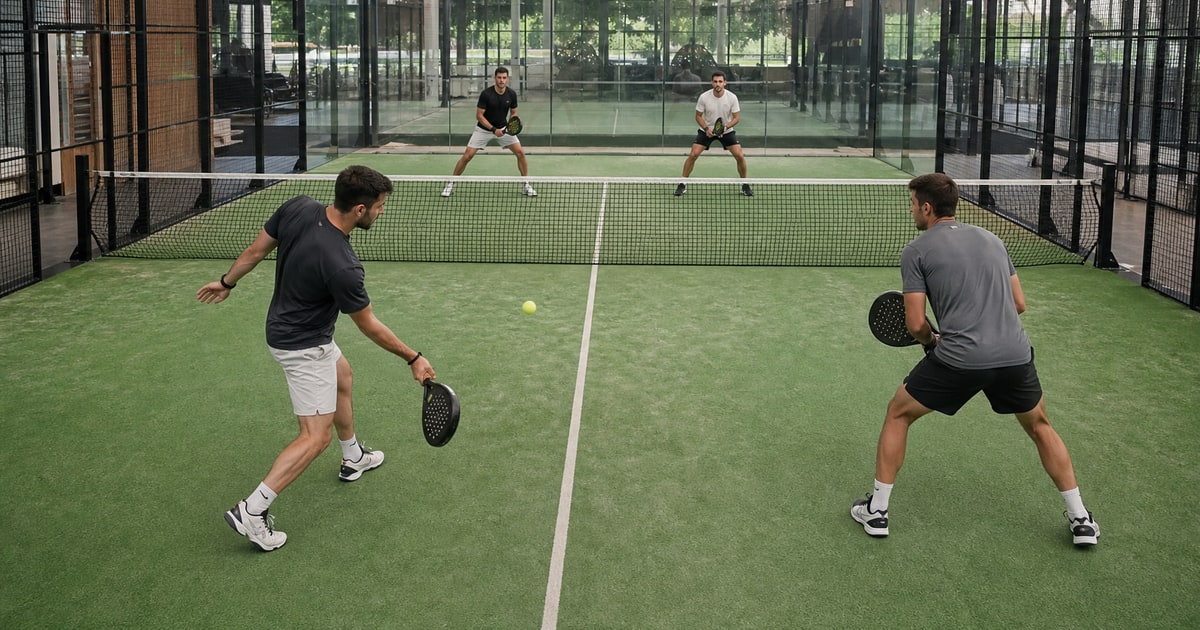
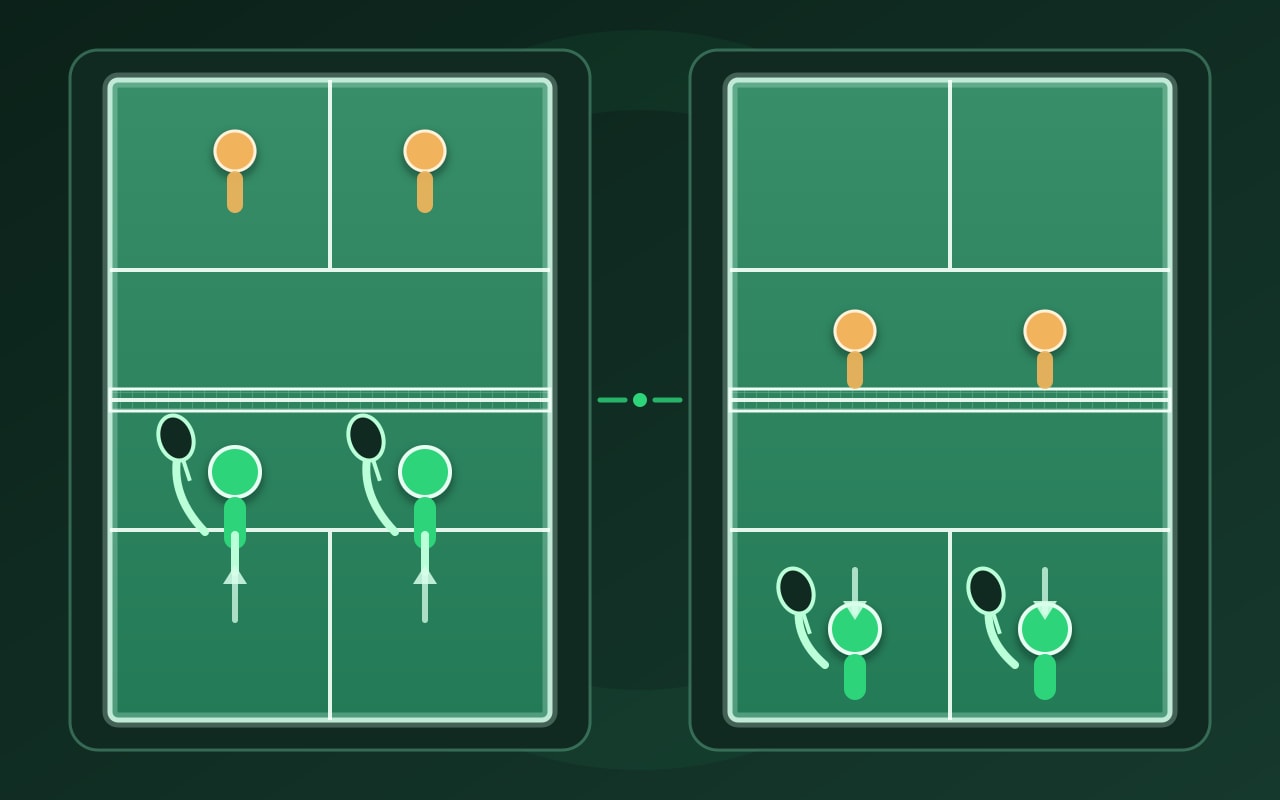
Padel positioning works in pairs. When you are attacking, both partners normally move up and protect the net together; when the other team owns the net and puts you under pressure, both partners defend near the back glass. Leaving one player at the net while the other stays deep stretches the team across the court and opens a large gap through the middle.
In the both-back formation, the two defenders begin at roughly the same depth between the service line and the back glass, often around a step behind the service line. That spot is a reference rather than a painted mark: you adjust it to the speed of the ball, the rebound and your own reach. The aim is not to camp against the wall. It is to give yourself enough room to let deep balls pass, use the glass and send a controlled reply.
Your first job is survival with purpose. Keep the rally neutral, make the net pair hit one more ball and look for a deep lob that forces them away from their attacking position. Defence becomes valuable when it creates the next chance to advance.
Both at the net versus both at the back
These are not rival systems from which a pair chooses one for the whole match. They are two phases of the same rally, and strong teams may move between them several times in a single point.
| Attacking shape: both at the net | Defensive shape: both at the back | |
|---|---|---|
| When it fits | Your pair has time and controls the net | The opponents control the net or push you behind the service line |
| Main objective | Take time away and finish with a volley or overhead | Absorb pressure, recover depth and create a chance to advance |
| Spacing | Both move forward and laterally as a connected line | Both defend at a similar depth near the back glass |
| Typical shots | Volley, bandeja, víbora, controlled smash | Lob, block, ball after the glass, low passing ball when available |
| Main risk | A good lob can send both players back | A short reply gives the net pair an easy attacking ball |
| Route to the next phase | Retreat together if the lob beats you | Advance together after a reply that dislodges the net pair |
The common beginner error is not retreating early enough. One partner recognises that the opponents have won the net while the other remains stranded forward, so the pair tries to defend two different phases at once. The attacking team then has an obvious target: the space between them. Our guide to padel court positioning explains how depth, angles and the middle change as the ball moves.
At club level, expect the balance to keep shifting. Your pair lobs and moves up; the opponents answer with a better lob; you turn, retreat and rebuild. Falling back is not an admission that you are the weaker team. Refusing to adapt after losing the net is the real positional mistake.
Three signals that tell both players to retreat
The decision should be early and shared. If you wait until the overhead has already left the opponent's racket, your first movement becomes a desperate chase rather than an organised transition.
- A lob has gone over both of you. Once neither player can take the ball comfortably overhead, turn safely, let the ball travel and retreat together. Do not leave one partner trying to guard the net alone.
- Your reply gives the opponents a comfortable attacking ball. A short lob, a floating ball or a weak shot through the middle lets the other pair step in. Read the quality of your own shot immediately and give up ground before they strike.
- The opponents have established net control. If both rivals are balanced at the net and your pair is already behind the service line, accept the defensive phase. Moving one player forward without first creating space only divides your formation.
Clear communication makes the transition faster. A simple call such as “back” or “leave” is enough; it should confirm what both players have already read, not begin a debate in the middle of the rally. A well-timed split step also helps you react in either direction instead of committing your weight too early.
How to set up: three steps to a useful defensive line
Both-back defence only works when the partners arrive together and preserve playable space around the glass. Use these three checkpoints rather than trying to stand on an exact spot.
- Start between the service line and the back glass. A useful base is often about a step behind the service line, but it must move with the ball. Drop deeper against pace and step forward for a shorter reply, always leaving enough room to use the glass.
- Match your partner's depth. You do not need to align your toes to the centimetre, but neither player should form a pronounced staircase toward the net. Similar depth closes the central lane and makes responsibilities clearer.
- Keep the racket ready and the body light. Hold the racket in front, around waist height, with soft knees and a neutral stance. From there you can block a faster ball, turn for the glass or move underneath a slower one.
Each player is primarily responsible for one half of the 10-metre-wide court, yet both shade toward the centre when the ball is central. The middle belongs to the pair, not to nobody. On a ball driven into a corner, the near-side player handles the rebound while the partner narrows toward the centre to cover the next angle.
Footwork and synchronisation with your partner
A defending pair should move like an elastic band. When the ball travels toward one side, the nearest player closes the corner and the partner slides toward the middle. When the direction changes, both recover; one player should not be left protecting an entire half plus the centre.
Small adjustment steps matter more than frantic speed. Staying completely still until the striker makes contact delays your reaction, while constant light movement keeps your weight available. Use a split step as the opponent strikes, then move with short lateral steps whenever possible. Cross over only when you genuinely need to cover distance.
The glass also changes your rhythm. You do not have to attack every deep ball before it reaches the floor. Sometimes the calmer choice is to let it bounce, move away from its line and use the back glass to create time. In long rallies, basic conditioning protects this patience: tired players stop adjusting their feet, crowd the rebound and then blame the shot technique.
Synchronisation does not mean copying every step. The corner defender may travel farther, while the other player makes a smaller movement to seal the middle. What must remain shared is the team's depth and its relationship to the ball.
The lob, the glass and the right ball to counterattack
The deep lob is the main route out of the both-back phase. It buys time, travels over the net players and, when it lands close to their back glass, makes them surrender their attacking position. Height alone is not enough: a high but short lob can become an easy smash. The target is height and depth, ideally over the opponent who is less comfortable moving back. For a full technical breakdown, see our guide to the padel lob.
Balls that rebound from the back glass give you a second defensive resource. Letting the glass slow a hard shot can produce a more comfortable contact than taking it early near your feet. From a low or awkward rebound, choose margin: lift the ball, play through the middle or send a controlled low ball at the attackers' feet if the angle is genuinely open.
A bajada belongs to a different situation. It is an attacking shot played after a high, favourable rebound from the back glass. If the ball comes off high enough for you to contact it above a comfortable level, a measured bajada can pressure the net pair and open the way forward. Trying to manufacture one from a low defensive rebound usually leads to the net or the glass. The rebound decides; the name of the shot does not.
How to turn defence back into attack
Both-back is a phase, not a permanent address. A pair that stays deep after earning a clear chance to advance gives the opponents time to regain the net. The transition begins with the quality of your shot, not with a predetermined rush.
- Play a deep lob, an effective low passing ball or a controlled bajada that forces the opponents away from their balanced net position.
- Read their movement. If both opponents turn and retreat, move forward immediately; if one can still take the ball comfortably overhead, hold your ground.
- Advance together, first beyond the service line and then toward a balanced net position. Keep the same depth as your partner rather than sprinting ahead alone.
- Split step as the opponents make their next contact so that your forward momentum does not carry you past the ball.
The key rule is simple: earn the move with your previous shot. Advancing because you hope the lob is deep enough leaves you trapped in no-man's-land if it is not. Advancing after you see both opponents moving back turns defence into controlled pressure.
Using the formation with partners of different levels
When partners have different experience levels, a clear both-back shape can simplify decision-making. The more experienced player may cover a little more of the middle or take the ball that clearly belongs to their stronger side, but should not roam so far that the less experienced partner loses a defined zone.
For the developing player, the useful brief is modest: keep a similar depth, protect your half, choose a high-margin reply and move when your partner moves. That is not “hiding” a weaker player. It teaches the foundations that keep a pair connected under pressure. An attempted winner from beside the back glass is rarely more helpful than one extra accurate lob.
Agree on middle-ball responsibility before the match. Forehand preference, left- or right-side roles and who takes lobs over the centre should be clear enough that neither player hesitates. Learning to read your opponents will also improve the first movement: racket preparation and body position often reveal the likely direction before contact.
Common mistakes in the both-back formation
- Retreating at different times. One player is already near the glass while the other tries to preserve the net. The gap between them becomes the easiest target on court.
- Standing too close to the glass. Fear of being beaten deep makes players pin themselves to the wall, leaving no room to read or play the rebound.
- Forming a staircase. One defender stays several metres farther forward, exposing the centre and creating uncertainty over every diagonal ball.
- Playing a short lob. The intention is correct, but insufficient depth hands the attackers a comfortable overhead. Use more margin or choose a lower, safer reply.
- Forcing a winner from deep. A narrow passing lane can be tempting, yet the attackers own the better angles. Build the point before trying to finish it.
- Moving forward on hope. If your shot has not displaced the net pair, charging to the service line only makes the next volley arrive at your feet.
- Forgetting to recover after the corner. The near-side player handles the glass, but both partners must return toward their neutral lanes once the ball leaves that corner.
After a lost point, identify the phase that failed. Was the retreat late, the spacing uneven, the lob short or the advance premature? That diagnosis is more useful than treating every defensive error as a bad swing.
Drills for building a reliable defensive pair
This formation needs two players. Solo practice can improve a lob or a turn at the glass, but only paired work teaches shared depth, middle coverage and the moment to advance.
- Lob under pressure. Two attackers feed controlled volleys and overheads while the defenders begin at the back. The defenders score a success when a lob makes both attackers retreat, not merely when the ball clears them.
- Mirror movement without a ball. The pair starts near the back glass and follows a coach's directional cues. The near-side player closes the corner while the partner seals the middle; both then recover to equal depth.
- Glass-or-early decision. Feed alternating deep balls at different speeds. Before the bounce, the defender calls “glass” or “early,” then plays the appropriate high-margin reply. This separates reading from improvisation.
- Back-to-net transition. Begin with both defenders deep and both attackers at the net. Once the defenders produce a lob that sends the attackers back, they must advance together and split step before the next contact.
- Restricted-point game. The defending pair may score only after first moving the attackers away from the net. The rule rewards patience and makes a premature winner attempt easy to recognise.
Work in short, focused blocks of 15–20 minutes inside a normal session. Repeating the transition against different feeds—a volley, an overhead, a ball into the corner—builds a more adaptable habit than spending an entire session on one predictable pattern. If you want feedback on spacing and shot selection, browse the coach schedule. For practice conditions with a clean, predictable rebound, use our guide to padel venues in Tashkent; glass, surface and lighting all affect how early you can read the ball.
Tournament rallies make the value of this shape especially clear. Opponents hit with intent, the net changes hands repeatedly and an organised pair can defend without panicking. Both back is not where the rally has gone wrong. It is where you give yourselves the chance to solve it.
Frequently Asked Questions
Is the both-back formation always defensive?
Yes. It describes the phase in which both players defend near the back glass while the opponents control the net. The purpose is not to remain there indefinitely, but to neutralise pressure and create a ball that allows both partners to advance.
How quickly should both players retreat?
As soon as the pair reads that the opponents have taken control or a lob has beaten the attacking line. Early movement creates time to turn and use the glass; late movement turns the same ball into a rushed chase.
Do we have to stand on exactly the same line?
Not to the centimetre. The important point is comparable depth: a pronounced staircase opens the centre and gives each player a different view of the rally. Small differences are natural when one partner covers a corner.
Which shot is most useful from the back: a lob or a ball after the glass?
They solve different problems. The glass helps you control a deep, fast ball; the lob is usually the clearest way to move the opponents away from the net. A bajada is an attacking option only after a high, favourable rebound—use a safer ball with height and depth when the rebound is low or awkward.
Can we attack directly from the both-back formation?
You can counterattack when the ball genuinely allows it, but the pair should not rush forward before the shot has disturbed the net team. Make them retreat or lose balance first, then advance together.
Does this formation need separate practice?
Dedicated practice speeds up the learning process because timing and spacing belong to the pair, not to one player's technique. Short drills that repeat retreat, defence and the return to the net produce clearer habits than match play alone.
The blog's deepest column: advanced shots (bandeja, víbora), positional play, periodised training and honest gear breakdowns — grounded in the experience of Tashkent's playing coaches.
Related articles
 Technique
The Bote Pronto: Taking the Ball Early Without Losing Control
Bote pronto means meeting the ball right after it bounces off the court, before it reaches the glass. Here's the technique, timing and when to use it.
 Technique
Poaching in Padel: When to Cross and Steal the Point
A net poach can win the point in one shot — or tear your side of the court wide open. When to cross the middle, how to read it, and where to move after.
 Technique
The padel dejada: the shot that switches off pace
The dejada is a short, soft, almost spin-free shot that kills the ball's speed instead of adding to it. We break down the grip, technique and when to play it.