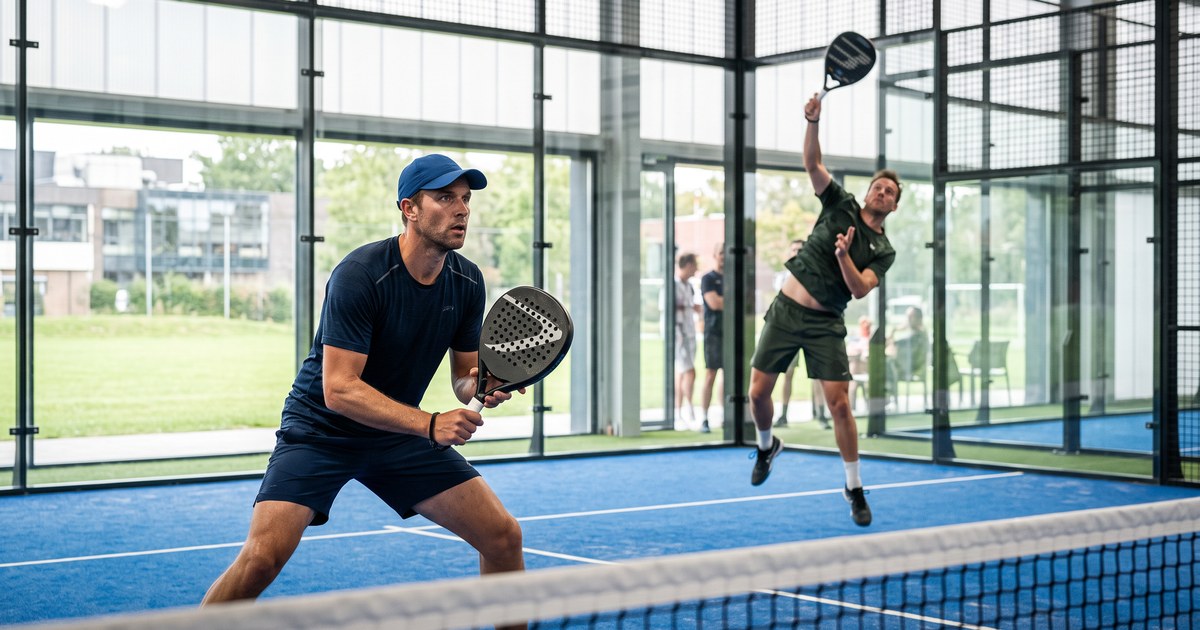
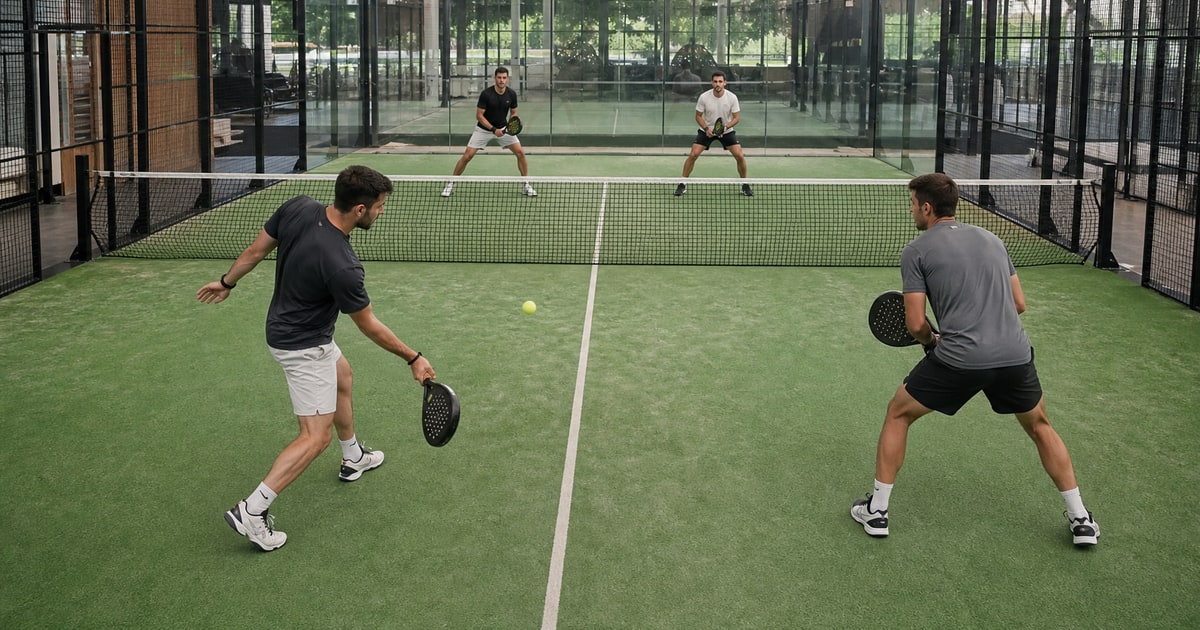
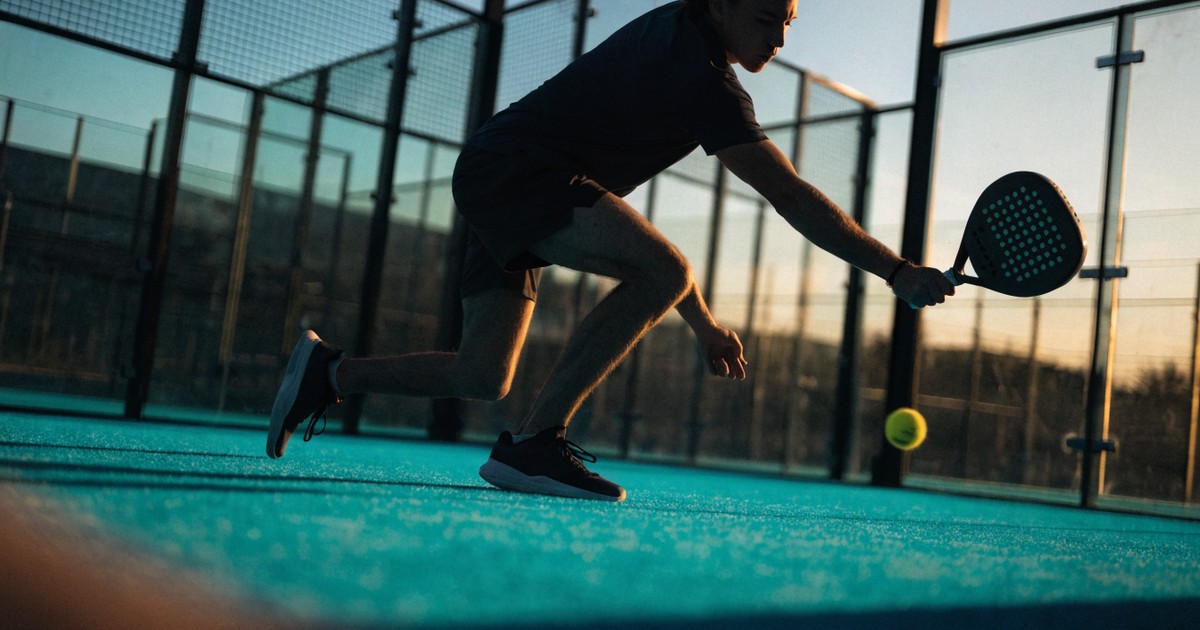
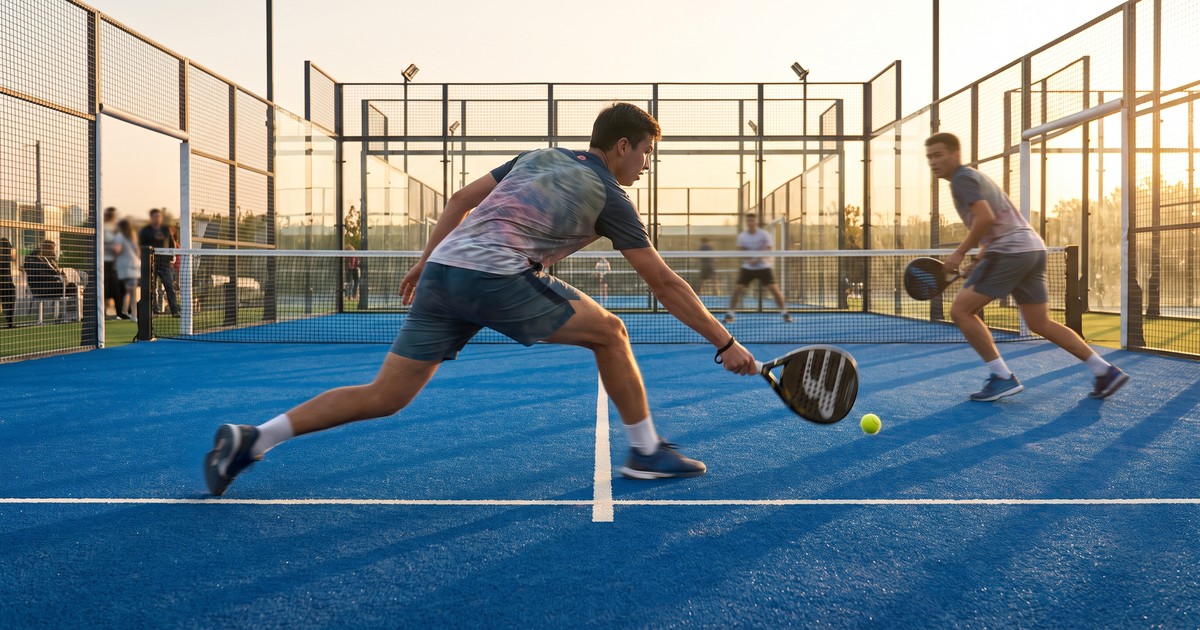
Two players with identical reaction speed and power almost never post the same results on court — the difference comes from who figures out where the ball is going first. On a padel court, which is just 20×10 metres with the ball spending half its life bouncing off glass, half a second of head start decides whether you cut off a volley at the net or spin on your heels for the fifth time in a row. That head start is anticipation — reading your opponent from their preparation, not from the shot itself. Here's what to look for, and how to actually train it.
Why anticipation beats raw speed
Reacting to a ball that's already in flight is a race you mostly lose if your opponent is hitting from a strong position: the time between contact and the ball reaching your side of a padel court is often shorter than your nervous system needs just to register the movement. Players who look "fast" are almost always players who started early — because they'd already made a decision before contact, not after it.
This applies at every level, not just the top of the game. The difference is that a beginner watches the ball, while an experienced player watches the opponent: the backswing, the footwork, whether the racket face is open or closed. The ball is a downstream effect. Learn to read the cause and you buy back time your body physically doesn't have if you're only reading flight.
The good news is that anticipation is a trainable skill, not a fixed talent. It's built through deliberate observation and repetition — and it develops faster than stroke mechanics do. That's exactly why it's worth working on early if you're trying to break through a plateau.
Signal 1: how they prepare the racket
The first thing to watch is the backswing — specifically its height and speed. Three basic patterns tend to give away the shot type before contact:
- Racket rises high and back, torso rotating — almost always an overhead attacking shot: a smash or a bandeja. Your opponent is loading up to hit hard, likely deep or into a corner.
- Racket stays low, backswing short and soft — a setup for a lob or a drop shot. No pace is coming: they're either lifting the ball over you or taking speed off it.
- Racket barely drawn back, contact close to the body — the typical prep for a volley or a block at the net, with no power backswing at all.
You can only catch this if your eyes are on the opponent before contact, not waiting for the ball to already be in flight. That takes deliberate practice — your eyes want to lock onto the ball by instinct, and you need to train a wider field of view that holds both the ball and the opponent at once.
Signal 2: stance and weight transfer
Footwork lies less often than the arm does, because the body physically can't hit hard and deep without the correct weight load behind it. Watch for three things:
- Open stance, weight on the back foot — a setup for either a drop shot or a soft lob: there's no way a powerful shot comes off this loading.
- Weight shifting onto the front foot with the shoulders turning through — a sign of a powerful shot coming down the line or deep.
- Small backward steps toward the glass — almost always means they're tracking a bounce and will likely answer with a defensive lob or a shot along the wall rather than an attack.
Reading the stance is especially useful on deep balls near the back line, where an opponent physically can't hide their weight transfer even if they disguise the backswing well.
The glass gives you clues too — read the bounce early
Padel is the only major racket sport where the walls are officially part of play, and that adds an entire layer of anticipation that doesn't exist in tennis. Once the ball is heading for the back glass, you can start reading the reply before it even bounces:
- A steep angle into the glass usually produces a high, comfortable bounce — expect an attacking overhead reply.
- A flat, skidding bounce off the glass and side wall together (a double-glass ball) produces a low, awkward bounce — expect a defensive shot or a drop shot from there.
- A ball that clips the corner where the net meets the glass almost always loses pace and height — a hard shot is nearly impossible from there, so expect something soft and low.
Reading the bounce trajectory saves you a step or two before your opponent has even touched the ball — and in padel, where points are frequently decided at the net, that half-step is often the difference between a volley you intercept and one that sails past you.
Cheat sheet: signal → likely shot → your response
| Opponent's signal | Likely shot | How to respond |
|---|
| Racket high, torso turned, weight forward | Smash or bandeja | Drop back half a step, ready a block or a short lob |
| Open stance, weight back, short backswing | Drop shot / soft lob | Hold the net, be ready to volley close in |
| Small backward steps toward the glass | Defensive lob along the wall | Take the middle, get ready for an overhead |
| Flat bounce off a double-glass corner | Weak, low reply | Move forward confidently and pick off the short ball |
| Racket with almost no backswing at the net | Volley or block | Hold your distance, don't lunge at the fake |
Treat the table as a starting point, not a fixed algorithm. Every opponent has their own patterns, and the best way to sharpen your read is to watch a specific player for a couple of points before drawing conclusions.
How to actually train anticipation
Anticipation doesn't show up just from logging match hours — plenty of players watch nothing but the ball for years without deliberate practice. A few drills that work:
- Play out one point watching only your opponent, never the ball, until they hit it. It feels wrong and your accuracy will dip at first — that's exactly why the drill works: it forces your brain to hunt for cues ahead of time.
- Have your practice partner narrate what they see just before their own shot — an open stance, a high backswing — while you try to call the shot before contact. Immediate feedback accelerates learning dramatically.
- Rewatch your own match footage at half speed, pausing a split second before your opponent's contact, and guess the direction. This trains the same pattern recognition as live play, without the pressure of the score.
- In a lesson, ask for a "read me" drill — the coach hits with deliberately exaggerated cues while you call the shot before contact. Structured programmes with PlayPadel's coaches often build this kind of drill straight into a session.
Progress here shows up over weeks of regular practice, not in a single session — the same as any perceptual skill.
Pairing the read with your split step
Recognising a cue is useless on its own if it doesn't turn into movement in time. Between "I saw the backswing" and "the ball is already on me" sits one crucial link — the start of your movement, which in padel, as in tennis, is a small split step right before your opponent makes contact.
The difference anticipation makes is this: without it, you land from that split step and only then start figuring out where to go — with it, you can bias the landing itself toward the direction you expect. If you've already read a high backswing and expect a smash, it's logical to time your split step slightly earlier, weight tilted back toward the glass. If the cues point to a drop shot, the same split step lands with weight forward on the toes, ready for a quick step in.
For the mechanics and timing of the move itself, see our full breakdown of the split step. The point here is simpler: reading your opponent and the split step only work as a pair. Reading cues while standing flat-footed is, in practice, almost the same as not reading them at all — your body still isn't ready to react quickly.
Common mistakes when reading an opponent
Even experienced players trip over the same handful of traps:
- Watching only the racket and ignoring the feet. Good players learn to disguise the backswing but rarely control their weight transfer as well — the stance is often more honest than the arm.
- Reacting to a deliberate fake. Sharper opponents will sometimes show one cue and hit something else. There's no perfect defence, but a habit of waiting a beat before committing cuts down on false starts.
- Watching the opponent while forgetting your partner. Anticipation only pays off in combination with your pair's positioning: if you read a smash coming but your partner's standing in the wrong zone, the read is wasted. For more on moving as a unit, see our piece on court positioning.
- Trying to read everything at once. Start with one or two cues — backswing height is a good first one. Layer in more gradually, or your attention scatters and helps with nothing.
How anticipation reshapes your net position
Reading an opponent isn't an abstract skill for its own sake — it's a direct tool for positional play. A pair that recognises an attacking backswing earlier can drop back half a step together and set a block instead of getting caught too close to the net on the smash's line. And the reverse holds too: spotting the cues for a drop shot or a soft lob lets a pair hold the net aggressively, knowing a hard shot isn't coming.
This ties directly into how well you and your partner talk to each other on court — if one of you reads a cue but doesn't manage to pass it on, the reaction still arrives late. A short call ("smash!", "short!") the moment you pick up on an opponent's setup is what turns individual anticipation into a genuine team advantage. For more on staying in sync verbally, see our guide to doubles communication.
Against opponents you've never faced, reading starts before the first point — during the warm-up. The few minutes of warm-up hits before a match are the one legitimate window to gather cues in advance: who tends to open the racket face wide, who likes to go down the line, who visibly avoids overheads. Strong pairs don't treat the warm-up as just loosening up — they use it to build a first map of an opponent's tendencies, and they share it with each other before the first game, not after the third lost point.
If you play regularly on the same courts around Tashkent, there's another layer of anticipation worth knowing — the court itself. Lighting, wind on outdoor courts, and the quirks of a specific pane of glass all shape how a bounce behaves. Getting to know a venue and its habits is part of the preparation too, even if it's less obvious than reading an opponent.
Where to start this week
Don't try to layer in every cue at once — that guarantees information overload and no real progress on any of them. A sensible order:
- In your first session, focus only on the height and speed of your opponent's backswing.
- After a week or two, add stance and weight transfer to what you're watching.
- From there, work on reading the bounce off the glass — the most padel-specific cue, and the slowest one to master.
If you're gearing up for your first tournament, or just want to test your progress in a real match rather than a lesson, check out upcoming tournaments and events — competitive play is the best test of whether anticipation has actually stuck, because there's no time to think it through consciously; the decision has to run on the reflexes you've already trained. For more technique and tactics, browse the PlayPadel blog.
Frequently Asked Questions
Can I learn to read opponents without a coach?
Yes — the "watch only the opponent" drill and reviewing your own match footage at slow speed both work on your own. A coach speeds things up with instant feedback, but isn't the only path to progress.
How long before I notice a difference in my game?
It depends on how much deliberate practice you put in, not on total hours played. Short, regular drills over a few weeks usually show results faster than the same number of hours spent playing without any anticipation focus.
Does this still work against an opponent with unusual technique?
Yes — the underlying signals (weight transfer, backswing height, bounce trajectory) are governed by the physics of hitting a ball, not by a specific playing style. Against an unconventional opponent, it might take a point or two longer to calibrate, but the same principle applies.
Is this the same thing as reading an opponent in tennis?
The core idea is similar, but padel adds reading the glass and the walls, which tennis doesn't have, plus coordination with a partner — anticipation from one player without syncing with the other only delivers half the benefit.
Do I need to stop focusing on my own technique to work on this?
No, they're not competing priorities. Early on, while you're still building a stroke, it makes sense to focus on your own mechanics — but once that becomes automatic, you free up attention that's worth pointing at your opponent instead. That's exactly why anticipation usually gets consciously trained from the intermediate level onward.
What level should I be at before working on anticipation?
It's worth starting once your basic strokes stop needing constant conscious control, typically around the beginner-intermediate stage. You don't need "perfect" technique first — the two skills develop in parallel and reinforce each other.