In padel you never play alone. The court is just 20×10 metres, walled in by glass and mesh, and you spend almost the whole match a few metres from your partner. That's why, at the amateur level, matches are decided less by the occasional spectacular shot and more by how well the pair works together. The good news: communication is far quicker to learn than a clean bandeja. This article is about how to gel with your partner — what to say on court, who takes which ball, and what to agree on before the first point.
Why the pair matters more than the shots
Padel is always four players on court, and it is only ever played in pairs. You and your partner each cover half the court, but you constantly overlap in the middle, at the net and on lobs. Those overlap zones are exactly where points are made — both the ones you win and the ones you hand over.
At the amateur level there's a simple pattern: most balls aren't won with spectacular shots, they're lost to errors. And a huge share of those errors aren't technical at all — they're coordination errors:
- both players go for the same ball and get in each other's way;
- both leave the ball, each assuming the other had it;
- a gap opens up because one player shifted and the other didn't cover;
- the partners collide in the middle on an easy ball.
Not one of those points was lost to bad technique. They were lost to silence. A pair that communicates turns two okay players into one good team — and regularly beats two strong players who didn't say a word to each other all match.
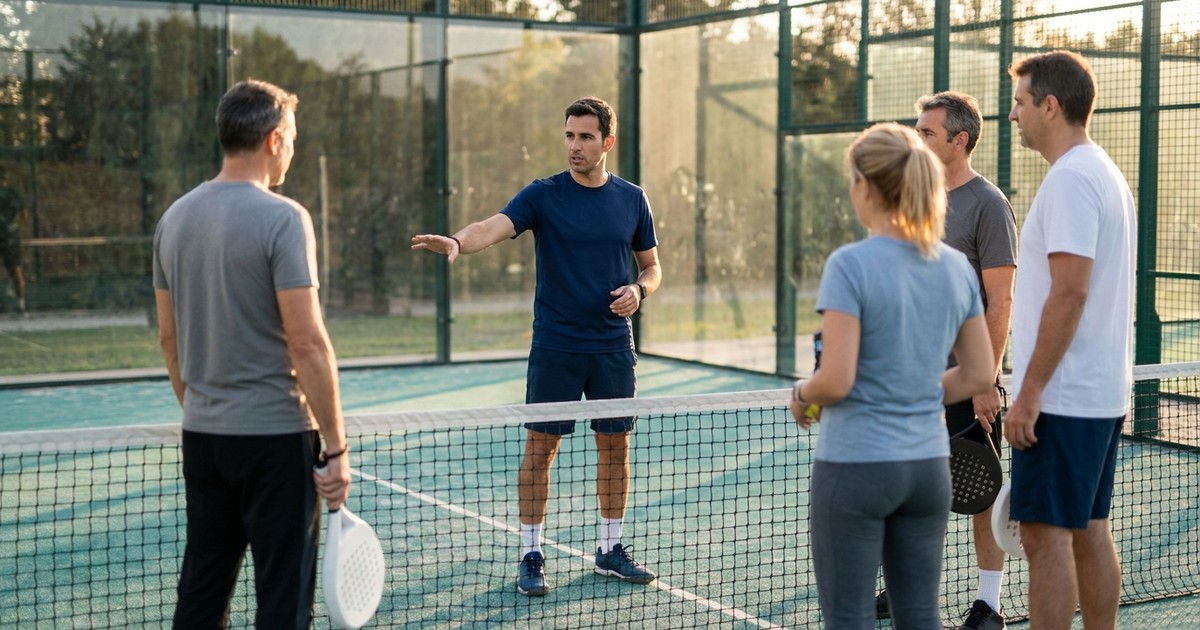
Aziz Karimov, our coach with a 6.0 rating and experience with the national team who specialises in doubles play, puts it like this: "On my sessions, pairs don't lose because they hit badly — they lose because they go quiet. Two words at the right moment are worth more than a perfect smash once every ten rallies."
Pair chemistry is inseparable from where you stand: if you haven't sorted out the basic formation yet, start with our piece on court positioning — communication is built on top of good positioning, not instead of it.
The language of the court: short words that decide everything
The first rule of padel communication: short and instant. You have a fraction of a second, so long sentences are useless — by the time you finish them, the ball is already down. What works is one or two words, said early and loud.
Here's the basic vocabulary worth drilling until it's automatic:
| Situation | What to call | Meaning |
|---|
| Ball flying between you | "Mine!" / "Yours!" | Who takes it |
| Ball heading out or into the glass with no bounce | "Leave it!" / "Out!" | Don't touch it |
| Lob flying over your partner's head | "Switch!" | Who covers it and swap sides |
| Time to lob the net-rushing opponents | "Lob!" | The plan for the rally |
| Short ball, time to take the net | "Up!" | We both move forward |
A few principles that make this vocabulary actually work:
- Call early. "Mine!" shouted at the moment of contact is useless. Announce the ball as soon as you read the flight — your partner needs time to pull the racket away.
- Call loud. A shy "mine" under your breath is exactly what causes the collisions. There's nothing awkward about speaking up on a padel court.
- One voice, not two. If you both shout opposite things, you both freeze and the ball drops. Agree in advance who has priority in 50/50 situations — usually the player with the better view, i.e. the one not playing the ball.
Who takes the middle
The ball down the middle is problem number one — and, once you've solved it, a source of free points. When the ball comes straight between the players, the pair has a split second not to freeze, and what decides it isn't reflexes but a rule agreed in advance.
Pick one of these rules and stick to it for the whole match:
- Forehand takes the middle. The most popular rule: the middle ball is played by whoever's forehand is in the centre (for a right-handed + left-handed pair this is especially neat — both forehands point inwards).
- The stronger overhead takes it. For a high ball or a lob down the centre, it's covered by the player with the more reliable bandeja or smash.
- The player moving forward takes it. Whoever is moving toward the net has priority over the one backpedalling: hitting on the move forward is simpler and safer.
Whichever rule you choose, say it before the match and still call "Mine!" on every ball. The rule sets the default; the voice confirms it in the moment. Silently hoping "my partner knows anyway" is exactly the gap in the middle through which opponents score the easiest points.
Lobs and overheads: whose ball is it?
A lob flying over your partner's head is the classic moment of chaos in an amateur pair. One swings, one switches, one stands still — and the ball drops into the empty space.
The most reliable solution is the switch:
- The partner the lob flies over lets the ball go and slides across to the other side.
- The second player takes the ball and loudly calls "Switch!" so the partner knows to rotate rather than scramble back to their old spot.
- After the rally you stay on the new sides — that's fine, no need to frantically swap back mid-point.
Backpedalling under your partner's lob, turning your back to the net, is almost always a bad idea: you lose both your position and the ball. For a central lob the same rule applies as for any overhead — it's covered by the player with the stronger shot over the head, agreed beforehand.
Playing the lob itself is a topic of its own: how to hit it without giving up the net is covered in detail in our article on the padel lob. Here the point is simply this: who takes the ball has to be decided in a split second, not while it's in the air.
Agree on a plan two minutes before the match
Most coordination errors can be removed before the first point. Two minutes of talking during the warm-up saves a dozen points over the match. Run through a short checklist:
- Serve and sides. Who serves first and who returns on which side (who plays the right, who plays the left). Ideally each player stays on their natural side.
- The middle rule. Who takes the centre ball by default (see the section above).
- Lobs overhead. Do we switch sides, and who calls the switch.
- The panic plan. What we do under pressure: don't force it — lob and take the net back. A shared plan B saves you from panicking at 30:40.
- Serve signals. Whether you use them and what your code is (more on this below).
These agreements don't make your game dull and "mechanical" — on the contrary, they free up your head. When the basic situations are settled in advance, you spend your attention on the rally itself, not on a frantic "who's got this?".
Hand signals on serve
Hand signals are the next level of communication. The net player puts a hand behind their back and shows the serving partner the plan: which way they'll poach and/or where to serve.
A simple code to start with:
- Fist — "I'm staying, no poach."
- Open hand — "I'm crossing to the middle after the serve."
- Finger pointing left/right — "serve to this zone."
The key is to keep the code simple and identical for both of you. A complex ten-gesture system causes more confusion than it's worth at the amateur level.
And honestly: signals are a nice upgrade, not a requirement. If you're just learning to play as a pair, start with two basics — call your balls and agree before the match. A quick word between rallies is plenty; add signals once the basic communication is a habit.
Emotions: how not to fall apart as a pair
The second half of communication isn't tactical — it's emotional. And this is exactly where amateur pairs either win together or fall apart over the course of a match.
A few rules that work better than any technique:
- Never blame your partner. No "how did you miss that?", no eye-rolls, no heavy sighs. One lost point doesn't decide the match — but a soured mood does.
- The next-point rule. Made an error? A short reset word ("Next!", "Move on!") and back to playing. The last rally isn't coming back.
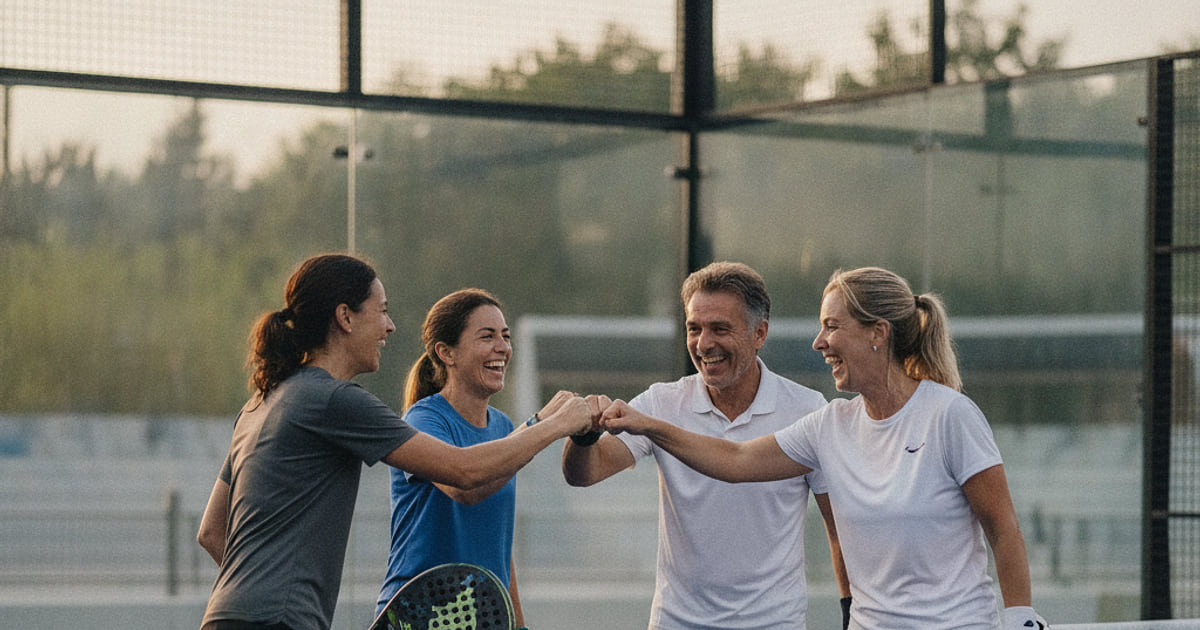
- Tap rackets after every point — won or lost. It's a free ritual that keeps the pair on the same wavelength.
- Praise specifically. Not a generic "come on", but "great lob", "good move forward" — that way your partner knows exactly what worked.
- Watch your body language. Slumped shoulders and a hung head are a message too — a destructive one. Between points, stand tall and turn toward your partner.
A pair that taps rackets after every point almost always finishes the match on the same wavelength — it costs nothing and works better than any serve.
Three communication mistakes that cost matches
Even when a pair knows it should talk, the same breakdowns keep recurring in practice. Here are the three most expensive — and how to fix them.
- Silent hope. Both think "my partner will get it" — and the ball drops right in the middle. Fix: make the call compulsory. Better to shout "Mine!" twice where it's obvious than to stay silent once on a 50/50 ball.
- The late call. "Yours!" said at the bounce is already useless — your partner can't pull the racket away in time. Fix: announce the ball at the opponent's contact, as soon as you read the flight, not when it's already at your feet.
- Post-mortems mid-match. Long debates about "you should have played that differently" between rallies throw both of you out of rhythm. Fix: during the match, short commands and support only; save the tactics for after the game or the next session.
How to find a partner and gel
No signals or words can replace time on court together. A pair that plays together regularly eventually understands each other without speaking: you know in advance where your partner will go and which ball they'll leave for you. So the first tip is not to change partners every week, but to find one or two people at your level and play with them consistently.
A few practical steps:
- Look for a partner at your level. Padel uses the international 1.0–7.0 scale; it's most comfortable to play with someone within half a point of you. We've written separately about where and how to look — how to find padel partners in Tashkent.
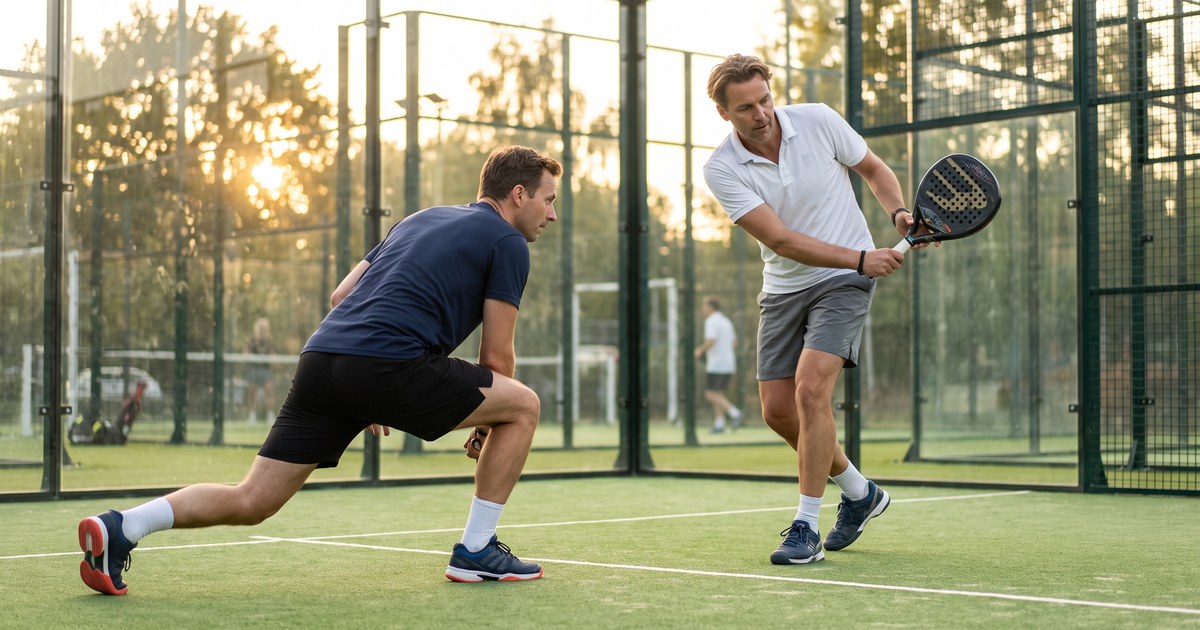
- Take a lesson together. An outside coach sees the silent gaps in your pair that you can't spot yourselves: who really hesitates in the middle, where the lane opens up. You can find a doubles-play specialist in the PlaySport coaches section.
- Test the pair in a tournament. Nothing builds chemistry like a few matches under pressure. Start with a friendly amateur format — what to expect is in our piece on your first tournament, and the current tournaments in Tashkent are kept up to date on the site.
- Play on proper courts. Get used to one or two clubs where you feel comfortable: a list of vetted venues is in the Tashkent courts section.
Padel is one of the fastest-growing sports in the world, and the standard of opponents in Tashkent rises every season. In that growth, the talking pair always has a head start: while your opponents are arguing about who should have taken the middle, you've already won the point — simply because you said one short word at the right moment.
Frequently Asked Questions
What should I call when the ball flies between me and my partner?
Short and instant: "Mine!" or "Yours!". Agree in advance who takes the middle by default (usually whoever's forehand is in the centre), but still call every such ball — the voice confirms the rule in the specific moment.
Who should take the ball in the middle of the court?
The simplest rule is that the middle is taken by the player whose forehand is in the centre. For a right-handed + left-handed pair this is especially convenient. If you're both the same-handed, agree in advance who has priority. The key is to pick one rule and always voice it.
What do I do with a lob over my partner's head?
Usually the partner lets the ball go and the second player covers it by switching sides. Call "Switch!" so your partner knows to slide across, and after the rally simply stay on the new sides. Backpedalling under your partner's lob is almost always a bad idea.
Do I need hand signals at the amateur level?
Not necessarily. They help, but a quick word between rallies is enough. First learn to call your balls and agree before the match; add signals later, once the basic communication is a habit.
How do I avoid falling out with my partner during a match?
Never blame your partner for an error, tap rackets after every rally — won or lost — and use a short reset word like "Next!". One lost point doesn't decide the match, but a soured mood does.
What's the fastest way to gel with a partner?
Play regularly with the same person at your level — time on court together can't be replaced by any signals. You can speed it up with a joint lesson from a coach and a couple of amateur tournaments, where the pair is tested under pressure.