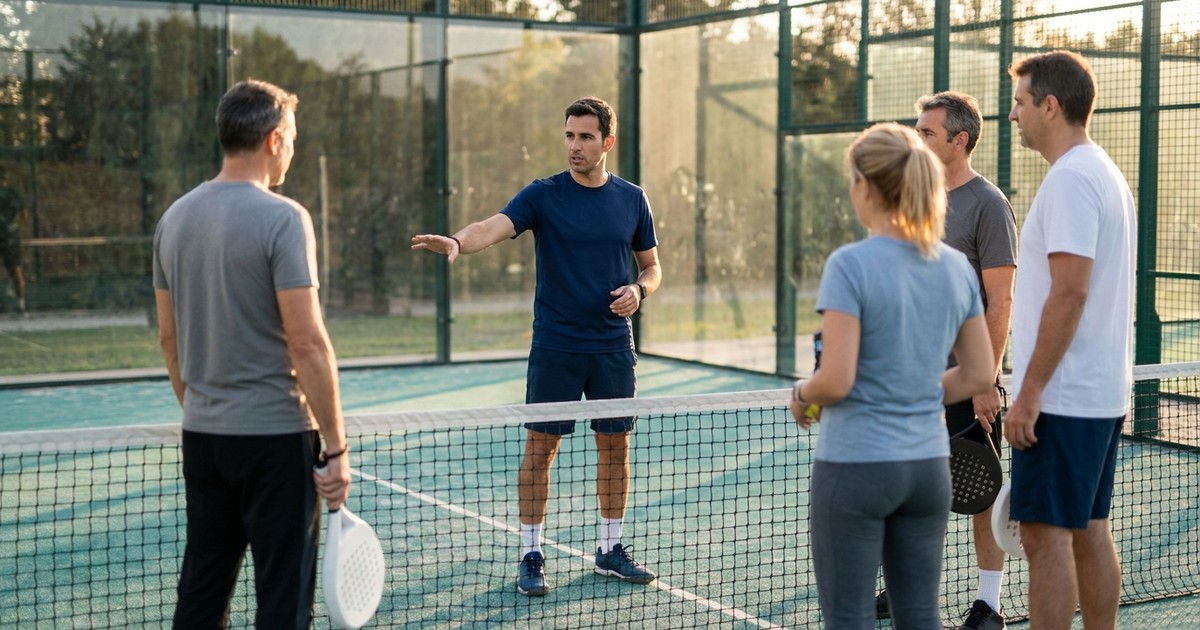
By July, Tashkent regularly hits 40°C (104°F) in the shade — and on an open-air court, under direct sun with no breeze, it feels hotter still. That's not a reason to shelve your racket until September; it just means playing a little differently. Here's how much and when to drink, what to wear, when to book, and which type of court actually makes sense once the heat sets in.
What heat does to your body on court
Padel is a sport of short, explosive bursts — a sprint to the net, a step back for a lob, a pivot into a bandeja. In cool weather your body recovers easily between points. In the heat it's a different story: your heart is already working overtime just to cool you down, leaving less in reserve for the explosive stuff.
Here's what's actually happening while you play set after set in the sun:
- Sweat rate climbs sharply. Under heat and exertion, the body can lose anywhere from 0.5 to 1.5–2 liters of fluid per hour — the exact number depends on the player, humidity and intensity.
- Your heart rate runs higher for the same effort. More blood gets diverted to the skin for cooling, so your pulse sits higher than it would at the same intensity in mild weather.
- Reaction time and coordination slip before your muscles even feel tired. Losing just 2% of body weight in fluid measurably dulls focus and reaction speed — exactly what a clean volley or bandeja depends on.
- Cramp risk goes up — not only from heat itself, but from the electrolytes lost along with all that sweat.
The good news: nearly all of this is manageable with three things — water, timing, and court choice. Let's start with water.
Hydration step by step: how much and when to drink
The most common mistake is drinking only once you feel thirsty. By then, mild dehydration has already set in, and it's hard to catch up in a single changeover. A simple sequence works far better.
- 2–3 hours before you play, drink 400–600 ml of water — enough time for your body to absorb it without stepping onto court with a full stomach.
- 15–20 minutes before your first serve, add another 150–250 ml, especially if it's a hot day or you've come straight from work without drinking much all day.
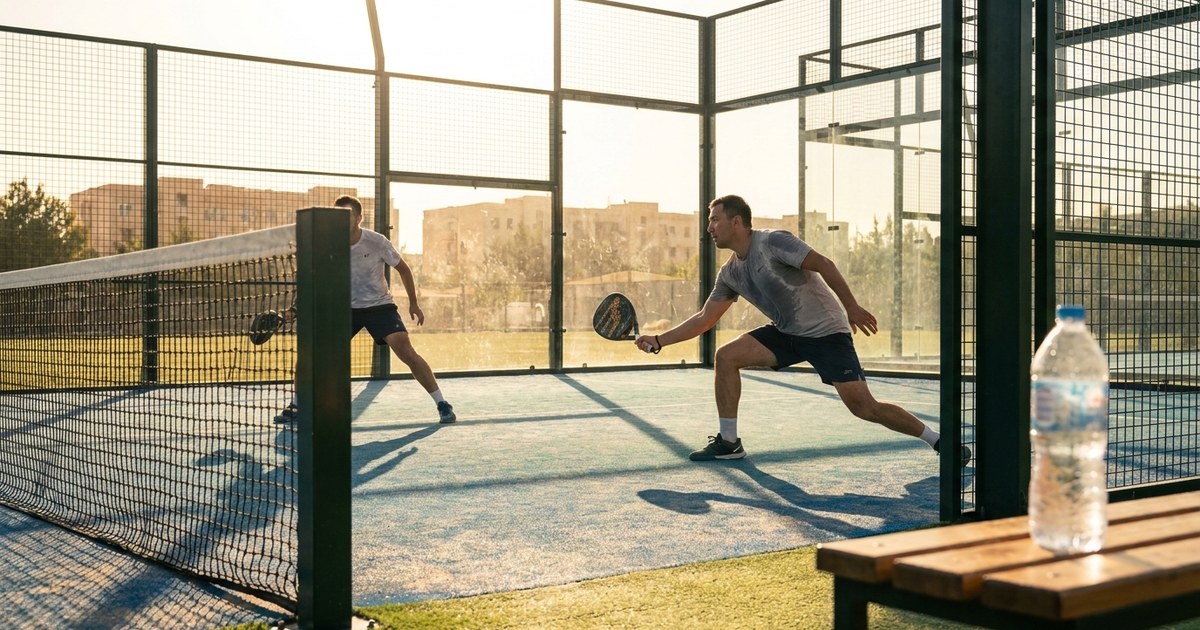
- Every 15–20 minutes during play, take a few sips — 100–150 ml at a time. Don't wait for a changeover or the end of a set: small, frequent sips absorb better than one big gulp on a break.
- In long matches (over an hour) in the heat, switch to an electrolyte drink for at least the second half — plain water alone doesn't replace lost salt.
- After the match, drink roughly 1.2–1.5 times what feels like enough — adrenaline and sweat's own cooling effect mask a chunk of the dehydration you don't notice in the moment.
- Check yourself the next morning by urine color: pale yellow is normal; dark yellow means you need to drink more throughout the day, not just before training.
Keep a bottle courtside and agree with your partners to drink on every changeover — the habit sticks after a couple of sessions and works better than any phone reminder.
Electrolytes and light food: keeping the balance
Sweat carries away more than water — sodium, potassium, magnesium go with it. For short sessions under 45–60 minutes in mild weather, plain water is genuinely enough. But once you're playing in peak summer for over an hour, back-to-back matches at a weekend tournament, or you simply sweat heavily — water alone won't cut it.
- An isotonic drink, or water with a pinch of salt and lemon, before a long session in the sun is a simple, effective fix.
- A banana or a handful of dried apricots between matches gives you fast potassium without weighing down your stomach.
- Don't eat a heavy meal an hour before playing. Digestion pulls blood flow that your skin and muscles already need for cooling in the heat — playing on a full stomach at 38°C is doubly hard.
- Go easy on caffeine. A morning coffee is fine, but loading up on energy drinks right before a match in the heat only speeds up fluid loss through their diuretic effect.
What to wear and bring to a summer court
The right kit doesn't win points, but it lightens the load on your body's cooling system — which leaves more energy for the actual game.
- Light-colored, breathable, loose-fitting clothing. Dark, tight fabrics heat up faster in direct sun.
- A vented hat — a visor or a light cap protects your eyes and cuts down heat buildup on your head, especially on open courts with no shade structure.
- Sport sunglasses if the court is open and the sun's in your eyes — this is a technique issue too: you don't want to be squinting through a lob or a bandeja.
- Water-resistant sunscreen, applied 20–30 minutes before you step on court, not one minute before.
- A towel and a spare shirt if you're playing two matches back to back — changing into something dry between games genuinely helps.
- A wide-mouth bottle, so you can top it up with ice quickly on a changeover.
For rackets, shoes and summer accessories, take a look at our guide to padel gear shops in Tashkent.
Cooling down between games
A changeover or a break between sets isn't just a pause in the score — it's a working tool against overheating, if you use it deliberately.
- A wet towel on your neck and wrists. Large blood vessels run close to the skin there, so cooling those spots works faster than splashing your face.
- Ice in the bottle, not just cold water. Melting ice keeps your drink cold through the whole match, not just the first ten minutes.
- Shade between games isn't a small thing. On an open court, stepping into the shade of a bench or umpire chair for even 20–30 seconds between games noticeably cuts your heat load.
- Take your cap off and let your head breathe while you switch sides — a constantly covered head tends to trap heat rather than block it.
- Don't be afraid to call a water break. Most club games and amateur tournament rules allow a short stop if you're not feeling right — that's basic safety, not weakness.
One small habit that helps a lot of pairs: agree in advance that a change of server is also a cue to take a sip of water, not just switch sides.
When to play: mornings, late evenings, and why noon is off the table
The simplest way to cut your heat risk is to shift when you play, not fight the sun through willpower.
- 12:00–17:00 — the sun sits highest and both air and court-surface temperature peak. On open artificial turf, the surface can run noticeably hotter than the air itself — you'll feel it through your soles within a few minutes.
- Early morning, before 9:00 — the air hasn't heated up yet, and while the low sun creates its own problem (more on that below), it's genuinely the most comfortable window for a long session.
- Late evening, after 19:00–20:00 — the second most popular option: the heat has broken, and most Tashkent clubs stay open late precisely because of demand at this hour.
If a session or match does land in the middle of the day, shorten the gaps between points, rotate roles within your pair more often, and don't hesitate to call a water break if you feel light-headed or weak.
Indoor, covered, or open-air: choosing a court in the heat
Tashkent has all three court formats, and in the hot season the difference between them matters far more than it does in mild weather.
| Court type | What heat does to it | Trade-off |
|---|
| Open-air (fully outdoor) | Full sun and a hot surface by day; cools fastest in the evening | Best in the evening and morning, worst at midday |
| Covered (shaded, no walls) | No direct sun, but air barely moves without open sides | More comfortable by day for sun exposure, but can feel stuffy without a breeze |
| Indoor (enclosed, with or without AC) | Stable temperature, sun isn't a factor at all | The safest bet for midday — check whether the club actually runs air conditioning |
If you're set on training during the hottest hours, an air-conditioned indoor court is the safest option by far. For sunset or early-morning games, an open-air court is often more pleasant than a covered one — fresher air, less stuffiness. You can browse courts filtered by surface type and shade in our Tashkent venues guide.
Court orientation and sun glare: how to check ahead of time
Heat isn't the sun's only problem. A separate issue — nothing to do with temperature — is low sun shining straight into your eyes on open and covered courts without solid side walls, especially in early morning and just before sunset when the sun sits low on the horizon.
We covered the mechanics in detail in how we predict sun on court: every club page shows, right next to the schedule, which hours the sun will actually glare on that specific court, based on its orientation and the season. This is purely about safety and playability, not temperature — a lob lost in the glare can cost you more than a point if the ball hits you in the face. Before booking an evening game on an open court, it's worth checking that forecast the same way you'd check the weather.
Warning signs: heat exhaustion and heat stroke
Telling fatigue apart from overheating matters, and stopping in time is far smarter than pushing through a set.
Heat exhaustion is the milder, more common condition. Signs: heavy sweating, weakness, dizziness, headache, nausea, pale and clammy skin. Stop playing immediately, move to shade or a cool space, sip water slowly, and cool the body down — a wet towel on the neck and wrists works fast.
Heat stroke is far more serious and needs urgent medical attention. Warning signs: a sharp rise in body temperature, hot and dry skin (sweating may actually stop), confusion, seizures, loss of coordination. If a playing partner shows these symptoms, don't wait — call emergency services and cool them down with whatever's available (shade, ice, wet cloth) until help arrives.
The rule is simple: any dizziness, nausea or confusion on court in the heat means stop, not finish the set.
Heat acclimatization: adjusting in a week or two
Your body adapts to heat, and faster than you'd think. With regular play in hot weather, after 10–14 days it starts sweating more efficiently and earlier, retains electrolytes better, and handles the same workload with less strain.
- In the first week of the hot season, deliberately cut the length and intensity of your sessions by 20–30%.
- Ease back up to your normal load as the heat stops feeling so draining.
- Coming back from a cooler climate — treat it as starting acclimatization over, even mid-summer.
Looking for partners who play during the comfortable early-morning or evening slots? Check out our guide on finding padel partners in Tashkent — plenty of players are already shifting their own schedules around the heat, so finding company for a 7am or 9pm game isn't hard. And if you'd rather work on technique with a coach during those comfortable hours, browse availability in our PlayPadel coaches section.
Heat is no reason to shelve your game until autumn. With the right drinking routine, sensible timing and the right court, padel in Tashkent stays comfortable year-round — and summer brings exactly the kind of evening air and long sunsets worth stepping onto court for. For more on technique, gear and life in the local padel community, browse the PlayPadel blog.
Frequently Asked Questions
How much water should I drink playing padel in the heat?
Aim for 100–150 ml every 15–20 minutes, plus 400–600 ml beforehand and extra afterward. The exact amount depends on intensity, humidity and how much you personally sweat — checking your urine color the next morning is a useful gauge too.
Can I still play padel when it's over 35°C outside?
Yes, but it's smarter to shift to early morning or late evening, pick an air-conditioned indoor court, or shorten the match. Playing 12:00–17:00 on an open court in that heat only makes sense with good acclimatization and mandatory water breaks.
What's the difference between heat exhaustion and heat stroke?
Heat exhaustion means heavy sweating, weakness, dizziness and nausea — stop, get to shade, sip water. Heat stroke means hot, dry skin, confusion and seizures — a medical emergency that needs urgent help.
Is plain water enough, or should I use an isotonic drink?
For short sessions under 45–60 minutes in mild weather, water alone is fine. For long matches in serious heat, especially back-to-back games, an isotonic drink or electrolyte water replaces lost salt more effectively.
How do I know if a court is safe from sun glare at the time I want to play?
Check the sun forecast for that specific court on the club's page before booking — it factors in court orientation and season and shows exactly which hours the sun will glare, separately from the temperature question.
How long does it take to acclimatize to the heat?
Usually about 10–14 days of regular play in hot weather is enough for your body to start cooling more efficiently and losing fewer electrolytes at the same intensity. Coming back from a cooler climate, expect to acclimatize again.


 Training
 Training