
Sun on the court: when it blinds you and when it is too hot
A step-by-step look at how PlaySport predicts the sun on every Tashkent court: NOAA astronomy, court orientation, a glare score, heat by WBGT, and a check against real venues.
Contents
- What we actually compute
- The Sun's two angles: azimuth and elevation
- Where the Sun is: the NOAA algorithm
- Step 1. Julian Day and Julian century
- Step 2. Solar declination
- Step 3. Equation of time and the hour angle
- Step 4. Elevation and azimuth
- When the Sun is in your eyes: court geometry
- Scoring the discomfort: "low × aligned"
- Shade from the roof and walls
- Heat and direct sun: the second factor
- How we score the heat
- Thresholds
- What the badge shows
- A check against real courts
- And in winter?
- How to use it when booking
- Frequently Asked Questions
- Does the calculation depend on the time of year?
- Does it account for heat, not just glare?
- Does it account for both players (both ends)?
- Why can a court be "green" all day?
- Where does the court orientation come from?
- How accurate is the astronomy?
- Does it work for indoor courts?
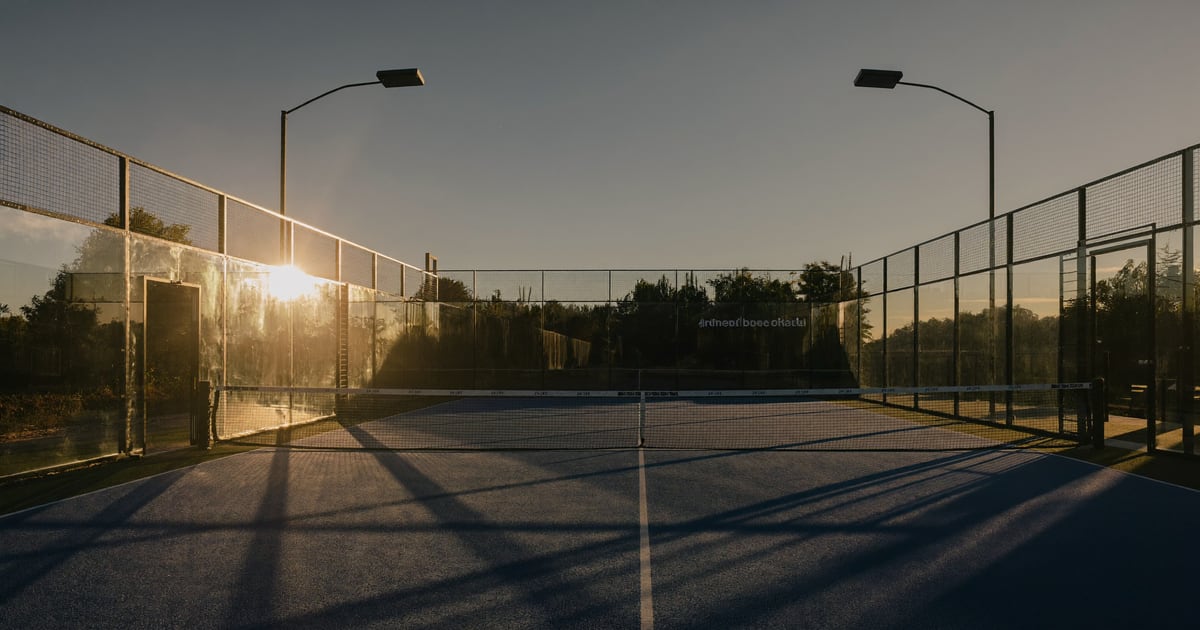
That bandeja you shanked at seven in the morning may not have been your fault. Sometimes the sun sits dead in the end of the court and fires straight into your eyes, and every overhead becomes a coin flip. And sometimes the problem is not the light but the heat: in direct sun on an open court at a July noon you wilt faster than under a canopy. That is why every court page on PlaySport carries a "Sun on the court" block: it shows which hours are comfortable to play today, when a low sun rakes down the court, and when it is simply too hot. Below is an honest breakdown of exactly how it works — from the Sun's position in the sky to the final "comfortable / moderate / glare" verdict. No magic, just astronomy, geometry and an hourly weather forecast.
What we actually compute
The block answers a simple question: at each moment of the day, where is the Sun in the sky, and does it bother a player on this specific court? Answering it needs just two ingredients:
- The Sun's position — two angles: which compass direction, and how high above the horizon. This is pure astronomy and depends on the date, latitude, longitude and time zone.
- The court's geometry — which way its long axis points. A low sun down the axis blinds you; the same sun from the side does not.
Everything else follows from those two. The calculation is fully dynamic — it recomputes for today's date and the venue's real coordinates, so summer and winter look different. You can see it live on any of the courts in Tashkent.
The Sun's two angles: azimuth and elevation
The Sun's position at any instant is two numbers.
- Azimuth — the compass bearing to the Sun: 0° is north, 90° east, 180° south, 270° west (clockwise from north).
- Elevation — the angle above the horizon: 0° on the horizon, 90° straight overhead.
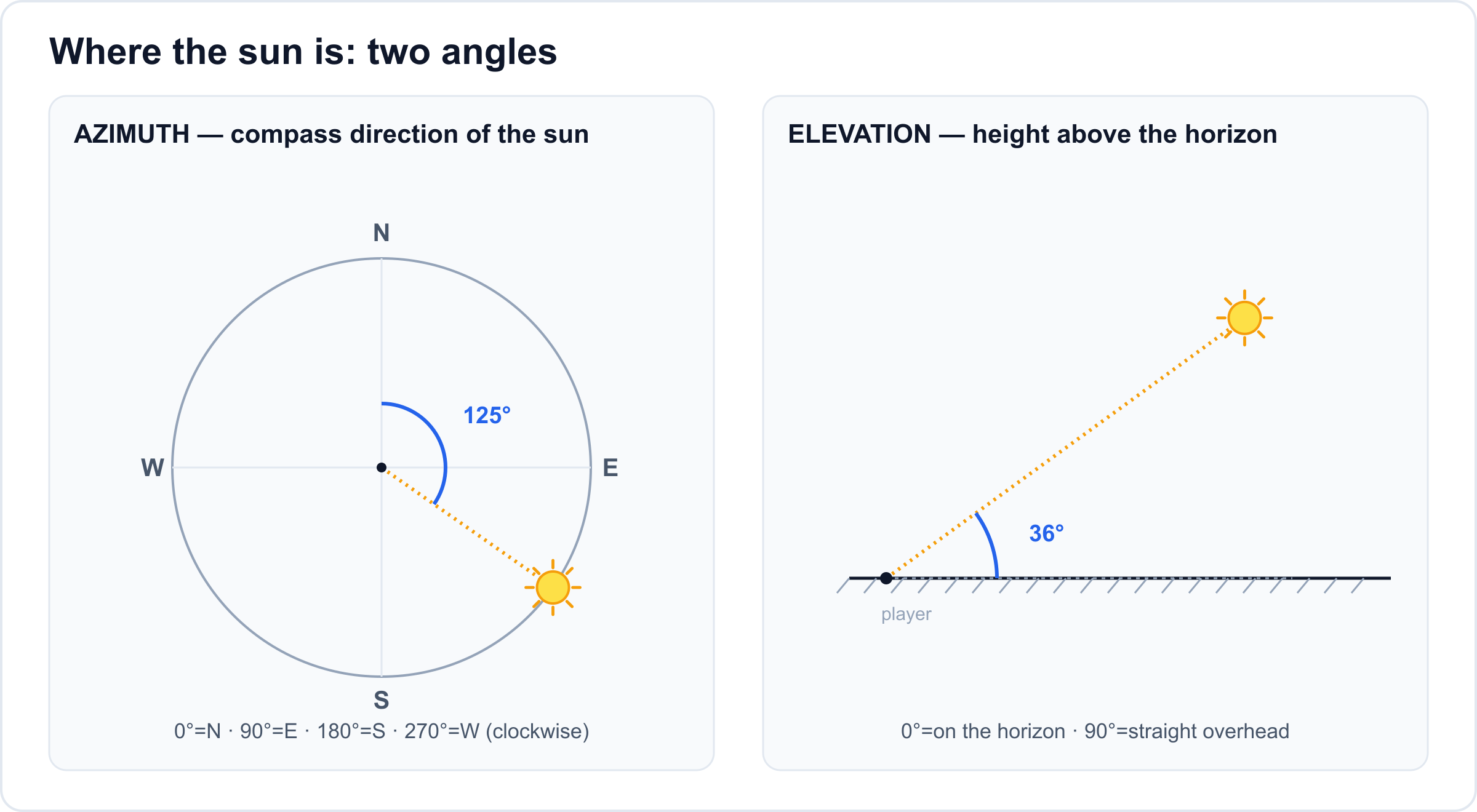
What blinds you is not "bright sun" in general but a specific combination of these two angles: the sun has to be low (small elevation) and sit in the end of the court (azimuth along the long axis). So first we need both angles, accurately.
Where the Sun is: the NOAA algorithm
To get azimuth and elevation we use the standard NOAA solar-position algorithm — the same one behind the U.S. National Oceanic and Atmospheric Administration's Solar Calculator. It is accurate to a fraction of a degree, which is far more than a "glare or not" question needs. Inputs: the date, latitude lat, longitude lng and time-zone offset. Then a chain of conversions.
Step 1. Julian Day and Julian century
The calendar date first becomes a Julian Day (JD) — a continuous day count astronomers use — and from there the number of Julian centuries since the J2000.0 epoch:
T = (JD − 2451545.0) / 36525T is the "clock" for everything that follows: the Sun's apparent motion drifts slowly over centuries, and almost every coefficient depends on T.
Step 2. Solar declination
Declination δ is the "latitude" of the point the Sun sits directly over. It is what drives the seasons: in summer δ ≈ +23.4°, in winter ≈ −23.4°. It comes from the mean longitude L0, the mean anomaly M, the equation of center C, and the obliquity of the ecliptic ε:
λ   = the Sun's true longitude (corrected for the orbit's ellipticity)
ε   = obliquity of the ecliptic (≈ 23.44°)
δ   = arcsin( sin(ε) · sin(λ) )
Step 3. Equation of time and the hour angle
A real solar day is not exactly 24 hours — because of the orbit's tilt and ellipticity. That difference is the equation of time (EoT), which wanders between roughly −14 and +16 minutes across the year. Using it, local clock time becomes true solar time, and that becomes the hour angle ha (how far the Sun is from due-south noon; 0° is solar noon):
true_solar_time = local_minutes + EoT + 4·lng − 60·tz   (mod 1440)
ha = true_solar_time / 4 − 180        // degrees, −180…180
Step 4. Elevation and azimuth
Now some spherical trigonometry. From latitude, declination and the hour angle we get the zenith angle (and therefore elevation), then the azimuth:
cos(zenith) = sin(lat)·sin(δ) + cos(lat)·cos(δ)·cos(ha)
elevation   = 90 − zenith
azimuth     = from arccos( (sin(lat)·cos(zenith) − sin(δ)) / (cos(lat)·sin(zenith)) ),
              signed by whether ha is before or after noon
The same block of formulas also gives sunrise, solar noon and sunset — sunrise and sunset as the moment the Sun's elevation crosses −0.833° (the standard horizon allowing for refraction and the disc's visible radius), and solar noon as the Sun's highest point of the day (the meridian transit, corrected by the equation of time). All of it is pure functions with no network calls, so the block runs identically on the server and in your browser.
When the Sun is in your eyes: court geometry
Astronomy told us where the Sun is. Now: does it bother you? The court's key property is its long-axis orientation (a bearing in degrees from north: 0° is a north–south axis, 90° east–west). A padel court has two ends, and any pair faces down the axis for at least half of a rally — so both directions are dangerous: orientation and orientation + 180°.
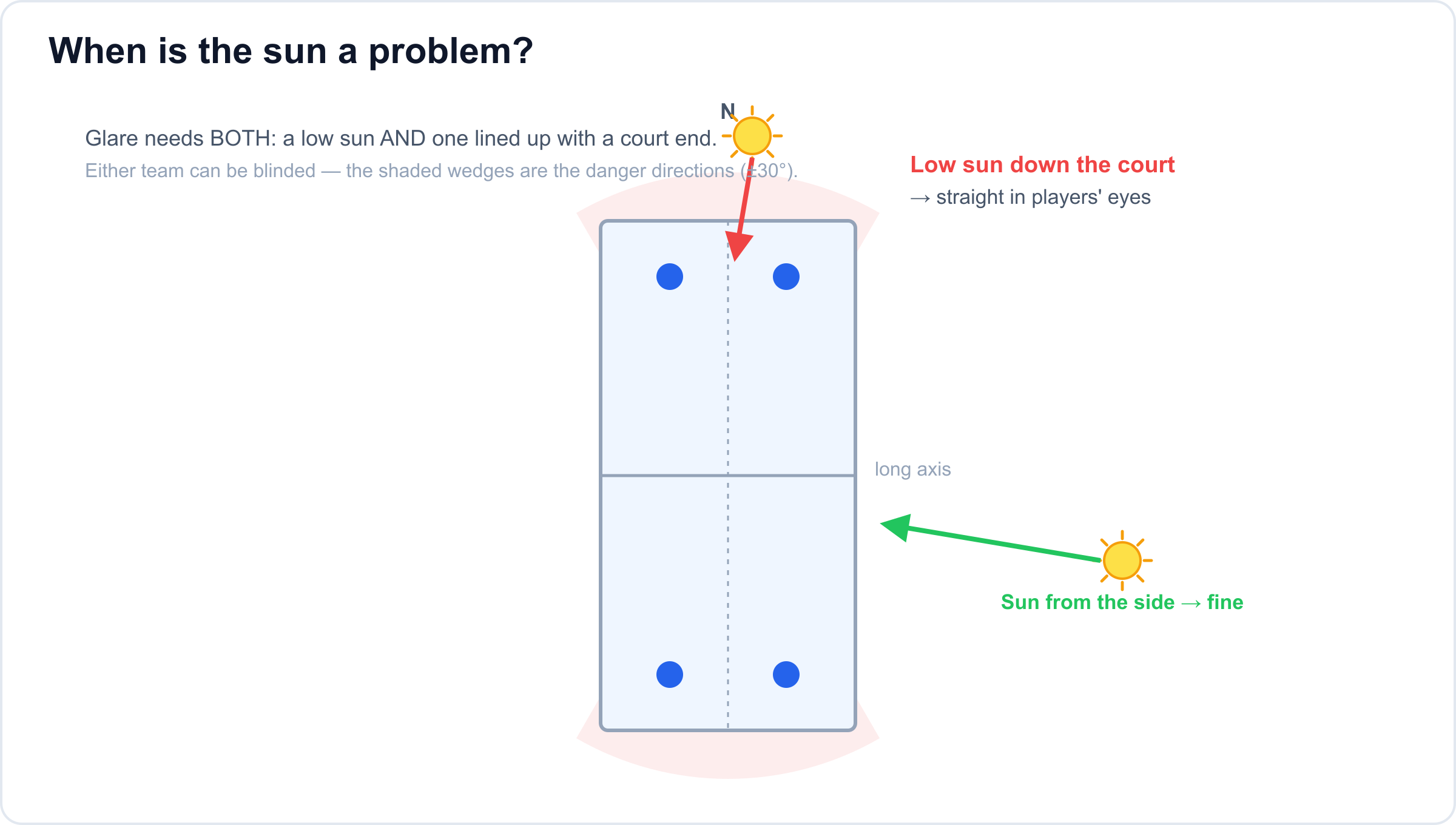
Hence the rule: the sun is a problem only when both conditions hold at once — it is low AND within ±30° of an end. A high sun (overhead) does not glare even straight down the axis; a low sun off to the side is fine too. A court whose axis is close to north–south is almost ideal: the low sun rises in the east and sets in the west — i.e. it arrives from the side.
Scoring the discomfort: "low × aligned"
To turn the geometry into a single number we compute two factors between 0 and 1 and multiply them.
alignDiff   = angular distance from the azimuth to the nearest court end (0…180°)
alignFactor = max(0, 1 − alignDiff / 30°)      // 1 = straight down an end, 0 = ≥30° off
lowFactor   = max(0, 1 − elevation / 30°)       // 1 = on the horizon, 0 = above 30°
glare       = alignFactor · lowFactor           // 0…1
The product — not a sum — is the whole point: a high score happens only when it is low AND aligned at the same time. Let either factor fall to zero (the sun is high, or it has moved off to the side) and glare collapses to zero. Then three thresholds:
glare score | Verdict | What it means |
|---|---|---|
| ≥ 0.45 | Glare | Low sun straight down an end — in the eyes |
| ≥ 0.15 | Moderate | Near the axis, but not critical |
| otherwise | Comfortable | High, or off to the side |
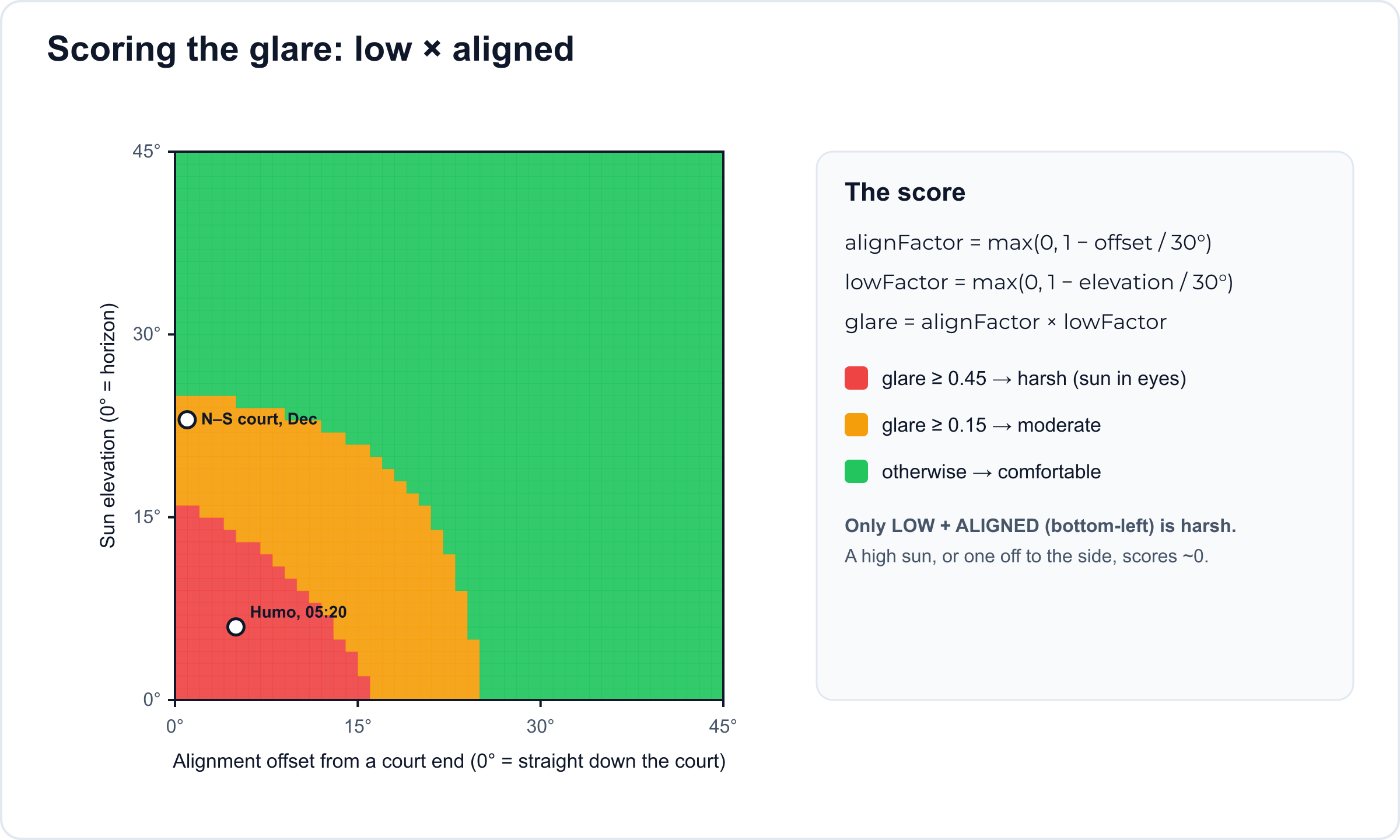
In the map above, "glare" (red) occupies only the bottom-left corner — low elevation plus a small offset from an end. The whole rest of the field is comfortable. That is exactly why most hours on a court's timeline are green: the sun is either high enough or far enough to the side.
Shade from the roof and walls
For covered and canopied courts we also draw the shade on the floor. The geometry is the same — shadow length depends on the obstacle's height and the Sun's elevation:
L = obstacle_height / tan(elevation)- A canopy (roof ≈ 6 m) shades from above: a high midday sun is almost entirely blocked by the roof, while a low sun ducks under the eaves and lights the floor. Shaded fraction = the shaded rectangle's area ÷ the court area (20×10 m).
- An open court has no roof, so only the glass walls cast shade — thin strips along the lit edges (we cap them, because in reality such a court is mostly in sun).
So a venue with mixed courts, like Padel.uz — Humo Arena, gets a separate diagram per type: covered and open courts behave differently in the sun, and you can see that at a glance when booking.
Heat and direct sun: the second factor
Glare is not the only reason play can get hard. In summer the air in Tashkent climbs to 40 °C and above, and in direct sun on an open court the load is heavier still — while on the covered court next to it things feel noticeably easier. So we added a second factor — heat — and the final verdict takes the worse of the two: sun in the eyes or heat. These are independent: a roof saves you from the direct beam but not from the air temperature; on a cool evening a low sun still blinds you.
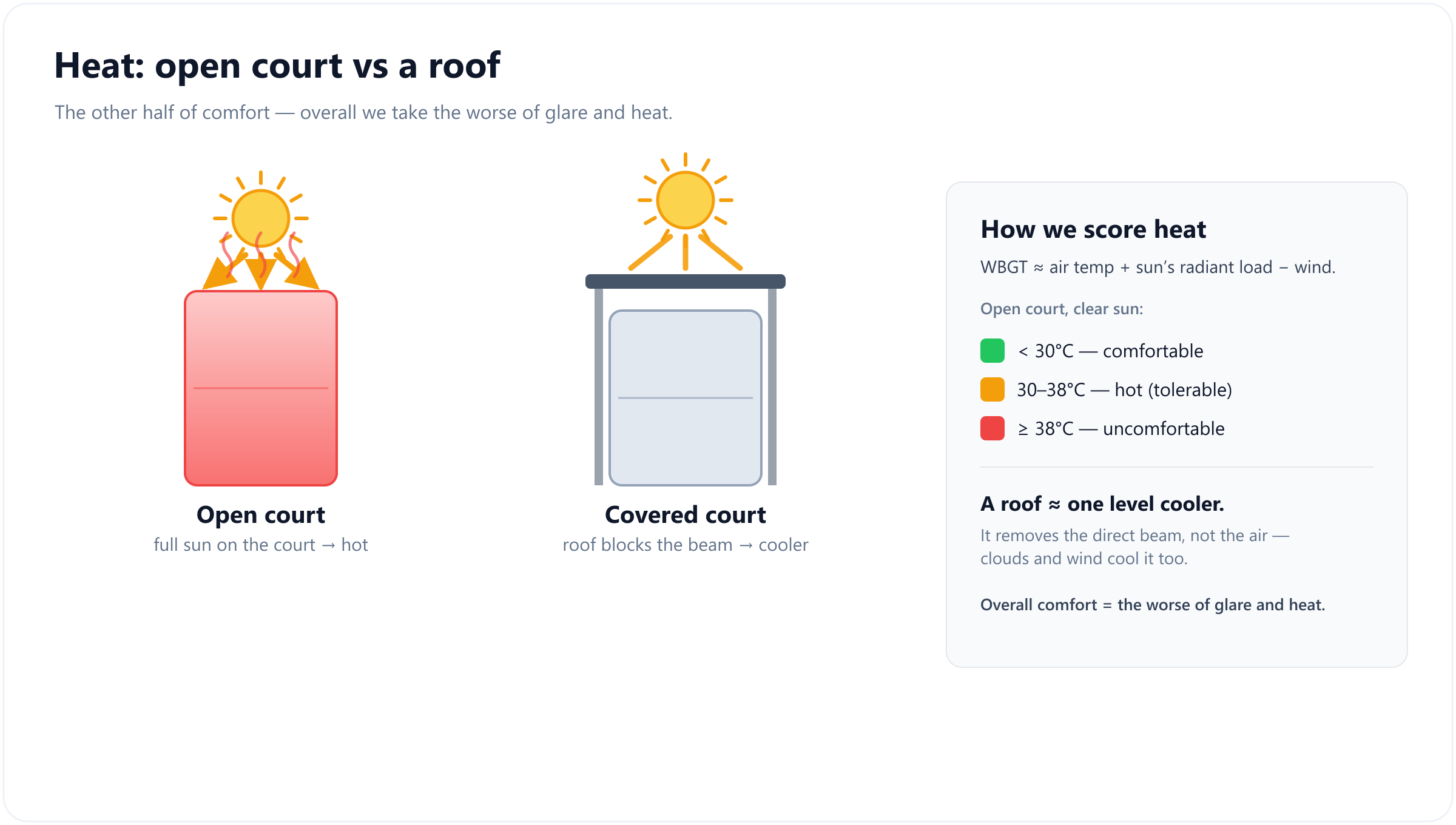
How we score the heat
For outdoor sport the standard measure is WBGT (the wet-bulb globe temperature). What makes it good is that it accounts for not just air temperature but the solar radiant load — the very heat from the direct beam that a roof removes. In Tashkent's dry climate the humidity contribution is small, and the solar component is the main one.
We take the hourly forecast for Tashkent (Open-Meteo, no key needed): air temperature, humidity, incoming shortwave radiation (W/m², already corrected for clouds) and wind — and assemble an approximate WBGT:
WBGT ≈ 0.7·Tw + 0.2·Tg + 0.1·Tair
Tg = Tair + k·(solar radiation) − wind cooling- An open court catches the full solar beam —
Tgrises, and play gets hotter. - A covered court: the roof removes the direct beam, leaving only the diffuse sky — worth about −4 °C WBGT, i.e. one level more comfortable.
- Clouds and wind soften the score on their own: the forecast radiation already accounts for cloud cover, and wind cools things a little.
Thresholds
Tashkent players are used to the heat, so we keep the bar higher than the "European" one. In practice, for an open court under clear sun, it's roughly:
| Air temperature | Verdict |
|---|---|
| < 30 °C | Comfortable |
| 30–38 °C | Hot (tolerable) |
| ≥ 38 °C | Uncomfortable (heat) |
Under a roof the bar is about one level higher — the canopy blocks the direct beam; clouds and wind nudge it up too.
If the forecast is unavailable, the heat factor simply switches off and the block works as before — glare only.
What the badge shows
The "Now" badge now names the reason: "Sun in your eyes", "Too hot" or "Hot + sun glare" — and shows the air temperature alongside. If the venue has covered courts and it is those that rescue the hour from the heat, a "Covered court is better" hint appears. And in a very sunny but heat-comfortable hour, an unobtrusive reminder about high UV and sunscreen.
A check against real courts
The best test of the model is real Tashkent venues. Take two courts on the same summer morning.
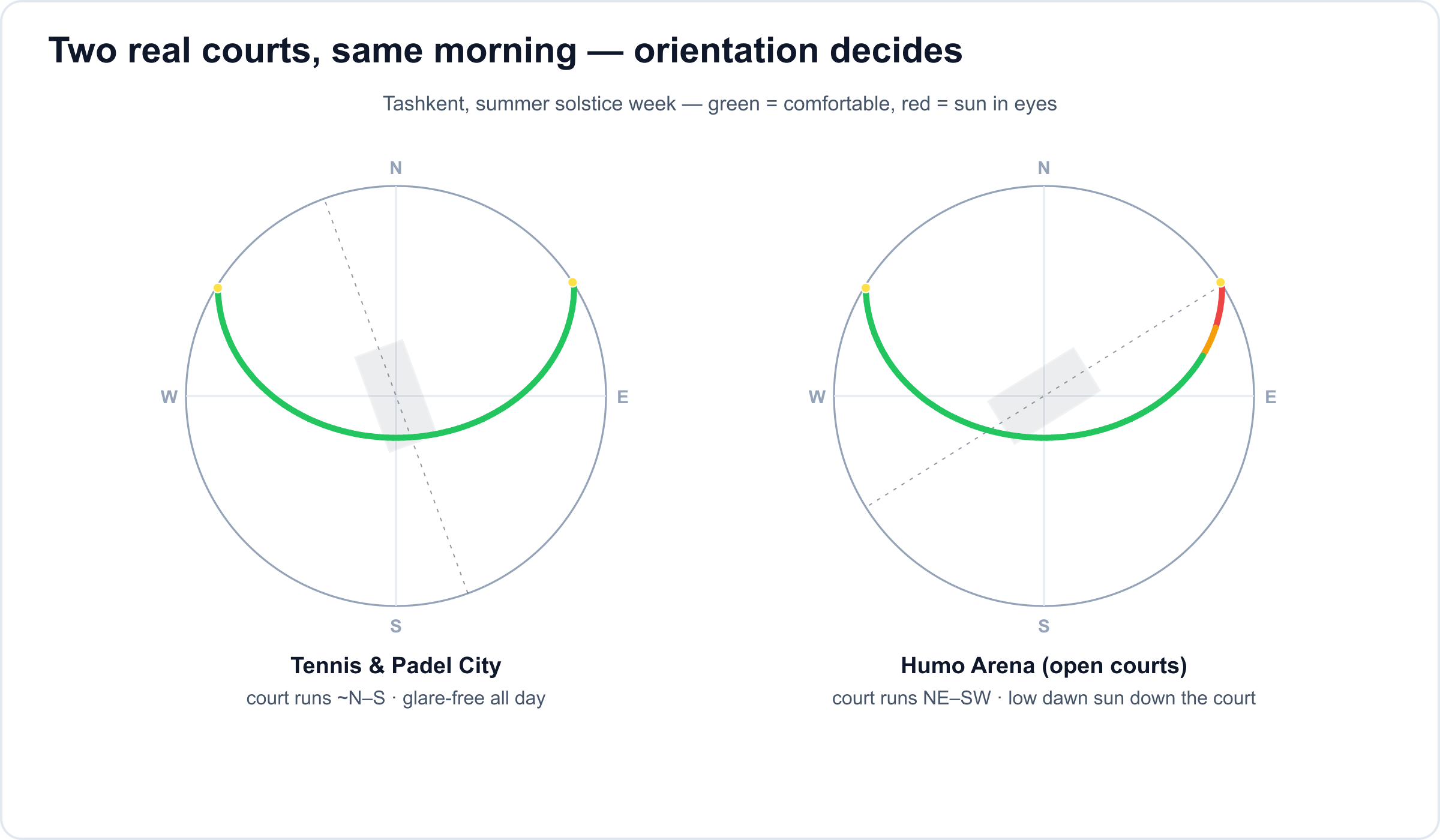
- Tennis & Padel City — axis ≈ 160° (almost north–south). Today: sunrise at 04:51 with an azimuth of ≈ 58° (ENE), sunset at 20:00 with ≈ 302° (WNW) — the low sun arrives from the side. And when the azimuth does line up with the axis (≈ 162° around noon), the Sun is already at ≈ 71° elevation — far too high to blind. Result: green all day.
- Humo Arena (open courts) — axis ≈ 58° (NE–SW). At dawn the Sun rises almost straight down the axis and sits low — hence the red "sun in eyes" window from roughly 05:01 to 05:51.
One city, one day — the only difference is orientation. That is not a bug, it is physics: a court that faces the sunrise catches the low sun in its end.
And in winter?
The calculation is tied to the date, so the season changes everything. The same Tennis & Padel City on 21 December: the Sun tracks low and further south, and around 11:05 it sits in the end (azimuth ≈ 161°) at only ≈ 23° elevation — that is now moderate (a couple of amber hours), though it never reaches "glare". So the green summer timeline looks different in December — open the court page in the cold season and compare.
How to use it when booking
The real value of the block is practical. Before you play:
- Open the venue page under courts and find the "Sun on the court" block.
- Read the timeline: green hours are comfortable, amber tolerable, red is sun-in-eyes. Drag the handle to your booking time and check.
- At a mixed venue, check the court numbers: the block shows which courts (by number) are covered and which are open. If you want shade during a red hour, take a covered court.
- If you do play into the sun, make it tactical: you are not the only one at a disadvantage — so is the pair facing the sun. For how to exploit that, see our breakdown of court positioning.
Good sunglasses and a cap help too — you can find some in the shops. And if you want to dig deeper into your game, drop in on the PlaySport coaches or the upcoming tournaments.
Frequently Asked Questions
Does the calculation depend on the time of year?
Yes, completely. The Sun's position is computed for today's date and the court's real coordinates, so summer and winter differ: in winter the Sun is lower and further south, and "sun in eyes" windows appear where summer has none.
Does it account for heat, not just glare?
Yes. Besides sun in the eyes, we score the heat load with an approximate WBGT from the hourly forecast (air temperature + solar radiation + wind). The final verdict is the worse of the two factors, so a court can turn "uncomfortable" purely from heat on a clear noon. An open court heats up more; a covered court is about one level more comfortable. With no forecast, only glare counts.
Does it account for both players (both ends)?
Yes. A court has two ends, and the model checks the direction to the Sun against both orientation and orientation + 180°. Whichever pair is facing the low sun, it counts as discomfort.
Why can a court be "green" all day?
If the long axis is close to north–south, the low sunrise and sunset light arrives from the side (east and west), and the Sun only lines up with the axis around noon — when it is already high. Then the two conditions for glare are never met at the same time.
Where does the court orientation come from?
A venue admin sets it — the long-axis bearing in degrees from north. We read it from the satellite geometry of the build and, where possible, double-check it on site with a compass.
How accurate is the astronomy?
The NOAA algorithm gives the Sun's position to a fraction of a degree — much finer than a "glare or not" answer needs. The discomfort threshold is deliberately soft (±30°), so a small uncertainty in court orientation barely changes the result.
Does it work for indoor courts?
A fully indoor hall gets no direct sun on the floor, so the block shows a note saying as much. For canopied and open courts we draw the roof/wall shade separately — see the shade section above.
The blog's deepest column: advanced shots (bandeja, víbora), positional play, periodised training and honest gear breakdowns — grounded in the experience of Tashkent's playing coaches.
Related articles
 Courts
Padel Court Surfaces: How Turf and Sand Change Your Game
Artificial turf, sand infill, drainage and carpet age — what a padel court is actually made of, and why the same surface plays differently from club to club.
 Courts
Indoor vs. Outdoor Padel Courts: What Actually Changes
Ball bounce, wind, light and tactics: what really separates an indoor padel court from an outdoor one — and how to pick the right court in Tashkent.
 Technique
Both Back: How to Defend as a Pair in Padel
When pressure forces you away from the net, both players must retreat together. Learn when to switch, where to stand and how to win the net back.