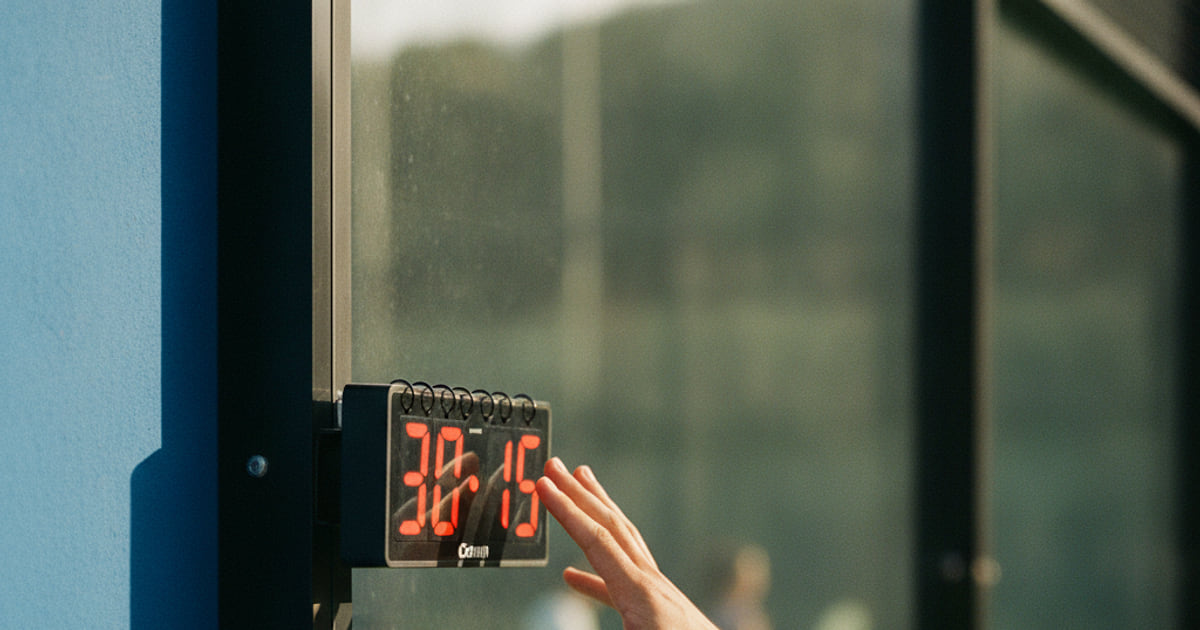
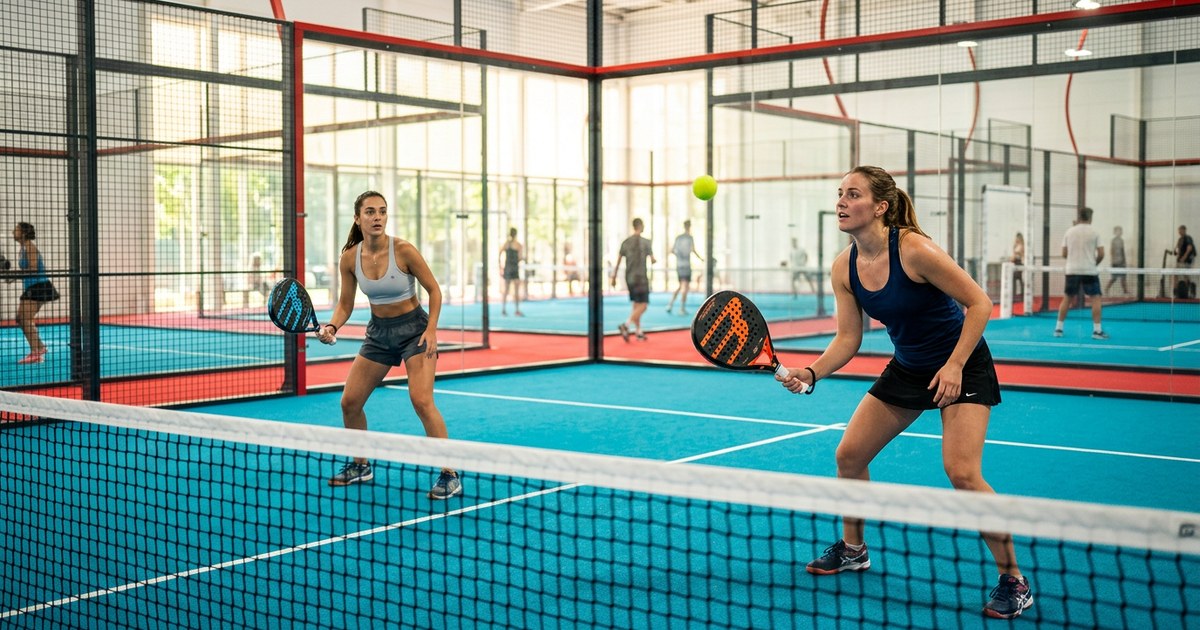
Your first padel match in Tashkent ends the same way for everyone: someone shouts "forty-forty", the other pair nods, somebody adds "golden!", and you stand there with your racket trying to figure out whose serve is next and which side it goes to. Padel is played four-up and uses tennis numbers, but it has three or four scoring quirks of its own that confuse every newcomer on the very first set. The good news: all of it can be unpacked in fifteen minutes. This guide walks the score step by step — from the first rally to the final tiebreak — so that on your second outing you can confidently call the score yourself.
Where padel got its scoring from
Padel uses the tennis scoring system almost one-for-one: inside a game you count 15, 30, 40, game; a match is typically best of three sets to six games; at a tied set you play a tiebreak. Anyone who has ever watched a tennis match recognises it, and that is on purpose — padel grew out of tennis in the 1960s and never tried to reinvent the wheel. What padel did add are a handful of amateur-friendly conventions that speed the match up and prevent a stronger pair from grinding a match into pure attrition.
The most important differences from tennis are the golden point at deuce (instead of endless "advantage in/advantage out"), the underarm-only serve (so aces are essentially unheard of), and the fact that you can play the ball after it bounces off your own back wall — that last one doesn't change the scoreboard directly, but it changes when a rally is over. At amateur level in Tashkent you'll almost always play with the golden point, in a best-of-three format to six games per set with a tiebreak at 6-6. That's the format you'll meet in your first booking, and it's the one this guide unpacks.
One more thing that surprises first-timers: rallies in padel are usually longer than in tennis. The walls keep returning the ball to play even from what looked like a lost cause, so a single "15" on the scoreboard often represents fifteen or twenty seconds of four-player work, not three seconds between serve and out. That changes how the score feels from the inside: 40-30 isn't "one more shot", it's "another long rally about to start".
The four levels of a match: rally, game, set, match
To stop the score feeling abstract, keep four levels in your head. Each nests inside the next, and understanding the pyramid is half the job.
| Level | What it is | When it ends |
|---|
| Rally (point) | One sequence of shots from serve to a miss or an out | When the ball bounces twice on the floor, lands out, hits the net or touches a player |
| Game | A run of at least 4 points won by one pair | When one pair reaches 4 points with a 2-point lead (or 1, with golden point) |
| Set | Six games won with a 2-game lead | Usually 6-0, 6-1, 6-2, 6-3, 6-4. At 5-5 you play to 7-5. At 6-6 you play a tiebreak |
| Match | The majority of sets | At amateur level in Tashkent that's usually best of three, sometimes a pro set to nine |
The rally is the atomic unit. Rallies stack into a game, games into a set, sets into the match. You'll rarely say the words "rally" or "match" out loud, but in your head it's worth separating them: one error is just a rally, not "I'm playing badly". That simple distinction saves a lot of nerves in the third set.
Scoring inside a game: 0, 15, 30, 40, game
The most famous tennis quirk is the four non-sequential numbers: 0 → 15 → 30 → 40 → game. On amateur courts in Tashkent you'll hear English ("fifteen-love"), Russian and Uzbek versions all evening. "Love" instead of "zero" is the official call, but in mixed-language amateur games people simply say the number.
The count always starts from the serving pair. That's the detail beginners miss. If you're serving and the score is 30-15, your pair has 2 points, the opponents have 1. If they're serving and the score is 30-15, they have 2, you have 1. The server calls the score out loud before every new serve, starting with their own number. That's both etiquette and a built-in dispute-prevention mechanism.
When both pairs reach 3 points each (the famous 40-40), padel takes a turn most tennis matches don't: "deuce" in padel is almost always played as a golden point.
What the golden point (punto de oro) is
The golden point is a Spanish invention, and in Tashkent you'll sometimes hear it called by its Spanish name: punto de oro. The rule is simple: at 40-40 you don't keep playing "advantage in / advantage out" forever. You play one decisive point that settles the game. Win it, take the game; lose it, hand it over.
Before the golden point is played, the receiving pair chooses which side will receive the serve: one of the two players decides whether the serve will come into the right or left half of the court. That little ritual is the one place where you, as the receiver, openly influence tactics before a ball is hit. In casual matches it's usually decided on instinct ("I'm stronger from the left"); in tournaments it's calculated.
The golden point makes the match faster and turns every 40-40 into genuine drama. It's standard at almost every amateur level and at most professional tournaments, which is why you'll hear someone yell "golden!" during your very first match in Tashkent — it means the score is level, and the next point takes the game.
How a set is won: six games, two-game lead
A set is six games won with a lead of at least two. So 6-0, 6-1, 6-2, 6-3 and 6-4 are all valid set scores. But 6-5 isn't a win yet — you have to take it to 7-5. If the score reaches 6-6, you play a tiebreak (see the next section).
A standard match is best of three sets: first pair to two sets wins. If each pair wins a set (say 6-3 and 4-6), you play a deciding third set. On 90-minute amateur bookings in Tashkent, that third set is often replaced by a super tiebreak — a tiebreak to 10 points instead of 7 that stands in for the whole set. That's a negotiated convention, and you should always agree on it before the first serve.
Players change ends between sets. They also change ends after every odd-numbered game inside a set (so after the 1st, 3rd, 5th and so on). That habit is automatic for experienced players, but for the first few matches it's worth saying out loud so nobody gets confused.
Breaks and changing ends
In amateur padel nobody is timing breaks with a stopwatch the way WPT umpires do, but the basic etiquette is: 60 seconds to grab water and have a quick word with your partner when you change ends, and 90 seconds between sets. Don't stretch it longer — there's another pair waiting for the court behind you.
Tiebreak at 6-6: first to seven
The tiebreak is a "mini-game" that closes a set tied at 6-6. Its rules are slightly different from a normal game, and this is where beginners most often get tripped up.
- Points are counted using natural numbers: 1, 2, 3, 4… not 15-30-40. Each point won is worth one point.
- The tiebreak winner is the pair to first reach 7 points with a lead of at least 2. So 7-5 wins; 7-6 doesn't — you'd play on to 8-6, 9-7 and so on.
- The player whose turn it was to serve first in this set serves the first point only, from the right side.
- After that, each next player serves two points in a row, starting from the left side and finishing from the right. The receivers stay on their sides.
- Players change ends every 6 points (after 6, 12, 18). It's easy to forget in the heat of a long tiebreak.
- The winner of the tiebreak wins the set 7-6.
A real tiebreak usually lasts five to ten minutes, and the entire emotional arc of an amateur season can come down to one of them. If you want to train your nerves and focus, look for partners who regularly take their sets to a tiebreak. It beats any mental-game course.
Super tiebreak instead of a third set
In a best-of-three match the deciding third set can be replaced by a super tiebreak. The rules are almost identical to a normal tiebreak, with one difference: you play to 10 points with a 2-point lead. So 10-8 wins, 10-9 means you play on to 12-10. That's a compact, fast-moving format that fits comfortably inside a 90-minute booking.
Serve and return: scoring details that matter
The score is inseparable from who's serving, from which side, and into which box. These details aren't optional — without them, you'll be debating every game.
Always underarm, two attempts
There is no overhead serve in padel like in tennis. You serve underarm, and the ball has to bounce on the floor on your side first, then be struck by the racket. Contact has to be below waist level. That single rule levels the playing field between server and receiver: aces are essentially nonexistent, and the returner gets a real chance on every point.
The server gets two attempts at each serve. If the first one hits the net or lands outside the service box, you get a second. If the second one also faults, that's a double fault, and the point goes to the receiving pair. Double faults are a beginner's most expensive mistake — that's one point out of the four it takes to win a game.
Which side to serve from
The server starts each game to the right of the centre line, and serves diagonally into the opponent's far receiving box. After each rally the server switches sides: from the left into the right-hand far box, and so on, until the end of the game. The logic is identical to tennis.
Who serves the next game
A new pair serves each game. Inside a single pair, one player serves first; the next time that pair serves (two games later), the partner takes over. So inside a pair, the two players serve every other one of "their" games. On amateur courts this is often agreed out loud at the start: "I serve first, you serve third", so nobody loses track.
These details look like bureaucracy, but they directly determine the score. If you don't know who's serving, you'll be arguing instead of playing, and you'll lose your partner fast. The mechanics of the return itself we cover in detail in our serve guide.
What padel doesn't have: differences from tennis
It's worth flagging what padel doesn't have. That stops you reaching for tennis habits where they don't belong.
- No overhead serve, and no aces from it. The underarm serve is its own technique — closer to a volley than to a classic tennis serve.
- No "advantage in / advantage out" at amateur level. The default is the golden point, which keeps matches short.
- No "out" after the first floor bounce if the ball then hits the wall. If the ball bounces on the floor and then into your back glass, it's still in play. That's why rallies last longer and why the score feels different psychologically.
- No standard singles format. Padel is always doubles: four players on the court. Single-player formats exist as a curiosity, but they're rare.
- No line judges and no chair umpire. At amateur level the players call the score themselves, and how disciplined a court culture is depends entirely on its etiquette. We have a dedicated piece on court etiquette — read it before your first match.
One of those points deserves its own section: what the walls do to scoring.
The walls and the score: when a rally is actually over
The walls are the most obvious visual difference from tennis, and they directly affect when a rally ends. The basic rule: the ball has to bounce on the floor first, and only then can it touch the wall. If the ball flies straight into the wall without touching the floor, that's an out — point lost. But if the ball bounces on your floor and only then hits your wall, the ball is still in play and you can return it.
So to win a rally, your pair needs to engineer one of four situations on the opponent's side:
- A double bounce. The ball bounces on the opponent's floor, comes up, and lands on the floor a second time before either of them returns it. This is the most common way points are won.
- An out. The opponent hits the net, the glass behind their court, the ceiling (on indoor courts), or any structure outside the playable area. Also very common.
- A serve fault. A double fault on the opponent's serve.
- A player touch. The ball hits the opponent or their clothing or racket in mid-air before touching the floor. At amateur level this is rare but it does happen.
Rallies that use your own back wall are a deep subject of their own, and they completely change the rhythm of a match. The full breakdown is in our back wall guide. Learning that one skill is arguably the most valuable thing a beginner can do after their first serve — it's the wall, more than anything else, that turns a "lost" position into a calm counter-shot.
Etiquette: how to call the score without annoying anyone
Amateur padel is self-officiated: there are no umpires, and disputed calls are settled between pairs. That's exactly why court etiquette around scoring builds a reputation fast in Tashkent — players who keep score cleanly get invited back, players who argue get dropped. A few simple habits save you hours of friction.
- The server calls the score out loud before every new serve: their own number first, then the opponents'. "30-15." That's not a formality, it's insurance against arguments five rallies later.
- A genuinely disputed ball gets replayed. If you're not sure the ball was out, don't insist. In a friendly match the disputed point is replayed without anyone losing face — that's the etiquette norm. Tournaments have umpires; amateur games have common sense.
- Don't count "in your head". It's easy to lose track of how many games you've won in a set under pressure. If you're not sure, ask the opponents before the next game. That's not weakness, it's good practice.
- Don't serve until the receivers are ready. A serve into an unprepared receiver is a point won technically and lost psychologically. That's how partners are lost.
- At the end of each game, briefly call the running total: "4-3 to you". Then nobody drifts.
That basic discipline becomes a reflex inside half a dozen matches, and it stops being a thing to remember.
On bookings of 60 to 90 minutes in Tashkent you'll mainly see three formats. Always agree on the format before the first serve, not at 5-5.
| Format | When it's played | Notes |
|---|
| Best of three + super tiebreak in the third | 90-minute booking | The amateur classic. Third set = a tiebreak to 10 |
| Pro set to 9 games | 60-minute booking | One long set to 9 games, tiebreak at 8-8 |
| Practice games on rotation | Open practice sessions | No match score — each game served by a different pair |
If you're stepping onto a court with a brand-new pair, the safest opening line is to suggest a pro set or "best of three with super tiebreak in the third". That packs all the match drama into around an hour and almost always resolves the format question. For a list of padel venues in Tashkent — including which are best suited to 90-minute slots — we maintain a separate page.
If you ever decide to try a tournament — and most amateurs do, sooner or later — the scoring there can be slightly different. The most common formats at amateur tournaments in Tashkent are:
- Pro set to 8 games with a tiebreak at 7-7. The most common group-stage format: compact, clean, fits inside 50-60 minutes with warm-up.
- Best of three with super tiebreak in the third. Standard for knockout rounds: longer, but gives both pairs a real chance to "find" the match.
- Classic best of three with a full third set. Rare, more "semi-pro" format. You'll only meet it in finals of serious tournaments.
Before your first tournament, read our dedicated piece on preparing for your first padel tournament. It covers regulations, warm-up and psychology. To see what's actually on the calendar in Tashkent right now, our events page is updated daily.
On-court checklist: keep score without arguments
Before a match — especially with new partners — run through a quick checklist. It saves ten minutes of pre-match haggling.
- Match format. Best of three with super tiebreak in the third? Or a pro set? Decide before the warm-up.
- Golden point. Are we playing golden point at deuce, or classic advantage? In Tashkent the default is golden.
- Serve order. Who of the four serves first? Inside each pair, who serves first and who second? Say it out loud.
- Change ends. After which games? After every odd game (1, 3, 5) is the standard.
- Disputed calls. Agree in advance: do we replay, or do we trust whoever was closest? That removes 80% of future arguments.
This takes 30 seconds and prevents most of the conflicts amateur courts produce. After five or ten matches it's pure reflex.
Padel is a social game, and scoring isn't really maths — it's how you talk to your partners. Once "fifteen-thirty" stops being a puzzle, the spare brain capacity goes straight into tactics and reading your opponents. That's the moment you stop being "new on the court" and become a proper player. If you want to accelerate that transition, book an hour with one of PlaySport's coaches — they'll polish the serve, return and tiebreak nuances that take months to figure out on your own.
Frequently Asked Questions
How is padel scoring different from tennis?
Inside a game it's almost identical: 0, 15, 30, 40 just like tennis. The main differences are the golden point at deuce (instead of "advantage in / advantage out"), the fact that the serve is always underarm (so there are essentially no aces), and that the third set in amateur play is often replaced by a super tiebreak to 10 points.
What is the golden point and why does it exist?
The golden point is the decisive point played at 40-40 instead of classic advantage scoring. Before it's played, the receiving pair gets to choose which side will return the serve. Win the point, take the game; lose it, lose the game. It keeps matches short and turns every 40-40 into a real moment.
How many serves do you get in padel?
Two. If the first serve hits the net or lands outside the service box, you get a second. If the second is also a fault, that's a double fault and the point goes to the receivers. Padel serves are always underarm, with the ball struck below waist level.
How does the tiebreak work?
Points are counted with natural numbers: 1, 2, 3, 4… The first pair to 7 points with a 2-point lead wins. The serve passes after the first point, then every two points after that. Players change ends every 6 points. Winning the tiebreak closes the set at 7-6.
What is a super tiebreak?
A super tiebreak is a shortened replacement for a deciding third set. Same rules as a regular tiebreak, but you play to 10 points with a 2-point lead (so 10-8 wins, 10-9 means you play on to 12-10). On 90-minute amateur bookings in Tashkent it's basically standard.
Who calls the score on court?
The server, out loud, before every new serve, starting with their own number. It's both etiquette and insurance: if anyone hears a different number, the disagreement gets resolved before the serve, not three rallies later.
Can you play padel as singles?
There is technically a one-on-one format on a narrower court, but it's a rare practice or exhibition variant. Standard padel is always four players. If you're trying to find partners at your level, we have a separate guide on finding padel partners in Tashkent.