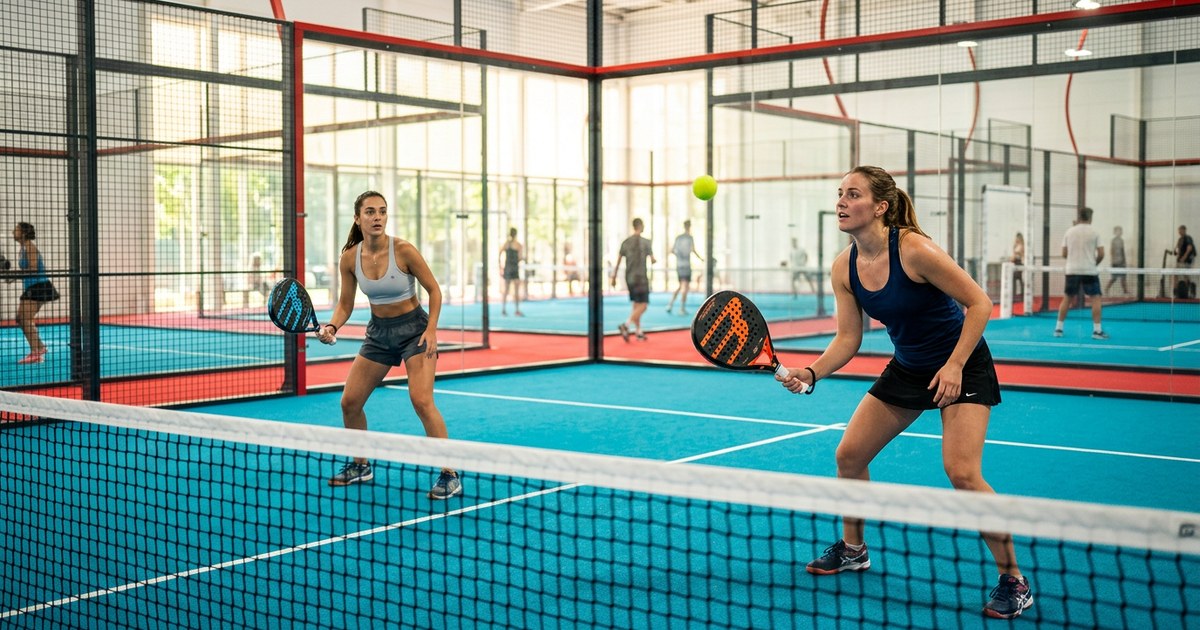
"How much is this going to cost me?" is almost always the first question people ask us after their first trial session. It's a fair one — padel isn't the cheapest sport to get into, but it's not nearly as expensive as it looks from the outside either, especially compared to individual sports like tennis or golf. Let's walk through what actually makes up your bill in month one, how costs shift over your first year, and where you can genuinely cut spending without losing any of the fun.
What padel costs actually break down into
A beginner's padel spending splits into three buckets, and mixing them up is the main reason a budget "unexpectedly" balloons by month two:
- One-off startup costs — a racket, shoes, occasionally protective glasses and a bag for your gear.
- Recurring costs to actually play — court rental, lessons, balls that everyone shares the cost of.
- Optional costs for progress — memberships, private lessons with a coach, entry fees for tournaments and social games.
Month one is almost always the priciest: you're buying gear and figuring out how many lessons you actually need to feel comfortable on court, all at the same time. After that, spending settles into something predictable — like a gym membership, except you usually leave court a lot happier than you leave a solo workout.
It helps to think of these as two separate baskets from the start: one is an investment (racket, shoes) that pays off over months, the other is a recurring operating cost (court time, balls) that repeats every single week.
Court rental: the most frequent expense
A padel court is booked whole, by the hour, and split between four players — a key difference from tennis, where a single court is sometimes shared by just two people, splitting the cost far less favorably. In practice, that means your personal share of an hour's rental is simply the court price divided by four, give or take if someone in the group covers a friend.
Court prices in Tashkent depend heavily on a handful of factors:
- Time of day. Weekday evening slots (after work hours) and weekends are usually pricier than daytime hours — demand is higher, and clubs price accordingly.
- Court type. A climate-controlled indoor court usually costs more than an outdoor one during hot months; in winter, heated outdoor courts can flip that logic.
- Club location. Courts in the city center and newer, more upscale neighborhoods tend to cost more than ones in outlying residential areas — the same logic that governs any real estate rental.
- Season and weather. In summer, air-conditioned indoor courts get booked up during the day; in winter, it's evening slots that fill up fastest since outdoor courts get cold.
Mornings versus evenings: the gap is real
If your schedule is flexible, weekday daytime slots are the single clearest way to save: the price gap between off-peak and peak hours can be significant, even though it's literally the same court. Groups that can meet on weekday afternoons consistently pay noticeably less than those who only ever play evenings and weekends.
The easiest way to see current prices and open slots is the venues page — it shows court type and time together, and lets you book directly online instead of calling clubs one by one.
Racket and gear: what to spend on at the start
If you've been to a few trial sessions on a club racket and decided padel is here to stay, the next logical step is your own racket. This is where it's easy to overspend: you don't need a top-tier professional model in your first few months — the performance gap between an entry-level and a premium racket is barely noticeable for a beginner, while the price gap is enormous.
Rent or buy
Many clubs lend rackets for free or for a token fee during your first few sessions — a smart way to figure out whether the standard shape and weight suit you before spending money on your own. Buying your own racket makes sense once you're confident you'll keep playing at least a couple of times a week on a regular basis.
Early on, it's reasonable to stick to entry- and mid-level rackets — they're more forgiving on off-center hits and usually lighter than top-end models, which matters while your arm and forearm haven't yet adapted to net play. We covered the full picture in a separate guide — read how to choose your first racket for a breakdown of racket shapes (round, teardrop, diamond) and what to prioritize.
Shoes and small gear
Beyond the racket, shoes are another one-off cost worth planning for. Regular gym or running shoes just don't hold up to the sharp lateral movement padel demands the way purpose-built padel shoes do, and they wear out faster against artificial turf. We wrote a dedicated guide on choosing padel shoes — this is exactly the case where saving money upfront regularly means replacing them sooner.
Protective glasses aren't mandatory but are a sensible add for beginners: at close range near the net, the ball comes off the glass fast and unpredictably, and glasses are cheap relative to everything else on this list. A racket bag is a nice-to-have, not a priority — a regular sports backpack works fine until your gear outgrows a single racket.
Group versus private lessons: where the price gap comes from
Lessons are the most flexible part of your budget, because you decide how much one-on-one attention you actually need at this stage.
| Format | Best for | Price-to-attention ratio |
|---|
| Group lesson | Beginners learning basic technique and rules alongside others | Lower per-session cost, less individual attention |
| Private lesson | Fixing a specific fault fast, or tournament prep | Higher per-session cost, coach works with you alone |
| Semi-private (2 students) | A middle ground — bring a playing partner along | Mid-range cost, coach splits attention between two |
We compared these formats in detail in Group vs. Private Padel Lessons — the short version: for your very first month, group lessons are almost always the better deal, in money and in experience alike. Watching other beginners make the same mistakes you do tends to calm nerves better than one-on-one correction ever does at the start.
Private lessons are worth adding selectively — say, if one specific shot (a serve, or play off the back glass) just isn't clicking and a group class doesn't give the coach time to break it down for you individually. You can browse all coaches with their schedules and lesson prices on the site — each has their own specialty and rate, so it's worth comparing a couple before committing to a month of lessons.
Memberships: when they actually pay off
A membership makes sense once you're sure you'll be playing regularly at the same club. The logic is simple: the club sells you a bundle of hours or lessons at a discount to the pay-as-you-go price, in exchange for paying upfront — a win for the club (guaranteed bookings) and for you (a lower rate).
A membership usually doesn't make sense if:
- you play less than once a week and aren't sure that's about to change;
- you haven't settled on a club yet — proximity, court surface, and evening availability all still matter;
- your schedule shifts often, making it hard to plan slots weeks ahead.
A membership usually does pay off if:
- you've been playing two to three times a week at the same club for a month or two already;
- fixed slots at a convenient time matter to you — weekday evenings fill up fast without a standing booking;
- you've already compared a few clubs on price, surface, and location and made a deliberate choice.
Before buying a membership, count honestly how many times a month you actually made it to the court over the last two months — not how many times you planned to. That's the number to trust.
Hidden costs beginners tend to overlook
Beyond the obvious lines — court, racket, lessons — a few costs tend to surface only after your first month of regular play:
- Balls. Padel balls lose their bounce faster than tennis balls because of constant contact with the glass and side walls, and a group typically buys a fresh can every few weeks — an easy cost to split evenly among regular partners.
- Grip replacement. A padel racket is a single solid piece with no strings to re-tension, but the grip wraps around the handle wear down from sweat and friction over time and get replaced separately from the racket itself, usually for a small amount at any gear seller.
- Late-cancellation fees. Many clubs deduct part of the court fee if a booking is cancelled too close to the slot — this isn't a hidden charge so much as a standard rule worth knowing in advance, so always check the cancellation terms before you book.
- Getting to the club. It sounds obvious, but if the nearest court with convenient free slots isn't the closest one to home, transport costs over several months of regular play add up to more than most people budget for upfront.
How to actually save in your first few months
A few practical ways to cut costs without losing quality of play or progress:
- Play with a steady group of four. Court cost splits between everyone — the more reliable your four, the easier your budget is to plan, and the less risk of a booking going to waste over a last-minute cancellation.
- Grab daytime slots when your schedule allows. Weekday mornings and early afternoons are almost always cheaper than peak evening hours — and courts are less crowded, so it's easier to find a good time.
- Start with group lessons. Add private sessions selectively — for a specific shot, or ahead of a tournament — rather than from day one.
- Skip the top-tier racket for now. An entry-level model gives you enough time to figure out what balance, weight, and shape actually suit your playing style.
- Look for partners instead of playing solo or without a steady group. The community section and a club's group chat are usually faster ways to find a fourth than waiting for a group to form on its own.
- Track ball freshness and grip condition instead of chasing a new racket. A fresh grip and bouncy balls change how a session feels far more than a new racket every few months does.
- Compare clubs on availability, not just hourly price. A slightly pricier court where you can always find a convenient slot can end up cheaper in practice than a bargain court that forces you into inconvenient times.
Tournaments and social games: a separate budget line
Once you're settled into a routine, an interest in amateur tournaments and social formats like americano is almost inevitable. The entry fee usually covers court rental for the whole event, sometimes a small prize pool or merchandise for participants, and is paid upfront at registration.
Your first tournament doesn't need a separate financial plan — the fee is typically comparable to one or two regular lessons, nothing more. We covered what to expect from your first tournament in detail, including how to pick one at the right level so you don't overpay for a bracket above your skill. The current list of upcoming tournaments and social games lives on the events page.
How costs shift over your first year
The overall pattern is fairly predictable, even if the exact numbers differ for everyone. Month one carries the highest spend, since you're buying gear and trying different lesson formats to figure out what works for you at the same time. By month two or three, spending tends to drop: gear is already bought, you've settled on a club and a lesson format, and regular play becomes the main line item. After six months to a year, most budgets settle into court time with a steady group, occasional private lessons, and tournament entries here and there — with gear costs only reappearing when shoes or a racket naturally wear out.
The bottom line: what not to skimp on
If it all comes down to one rule — don't cut corners on shoes or on a court with the right surface. An injury from the wrong shoes or a slick court costs far more than any price gap between clubs, and recovering from it wipes out all your progress. But cutting back on lesson frequency, racket model, or memberships in your first few months is completely fine — how regularly you play affects your progress far more than the price of a racket or how often you book a private lesson does.
For the full list of guides on getting into padel without overspending, check out the PlayPadel blog.
Frequently Asked Questions
How much does an hour of padel cost in Tashkent for four players?
Court cost is split among all players, and each person's share depends on time of day, court type (indoor or outdoor), and the specific club — check current prices and available slots on the venues page.
Do I need to buy my own racket in the first month?
No. Most clubs lend rackets for trial and early group sessions — buying your own makes sense once you're confident you'll keep playing regularly.
Which is cheaper — group or private lessons?
Group lessons are almost always cheaper per session, since the coach's fee is split between several students. Private lessons are worth it for targeted work on a specific fault or tournament prep.
Should I buy a club membership right away?
Only if you've already settled on a club and plan to play there at least two or three times a week. If your schedule is unstable or you're still comparing clubs, pay-as-you-go bookings are almost always the better deal.
What costs do beginners underestimate most often?
Usually balls (they lose bounce faster than expected), grip replacement, and late-cancellation fees — each is small on its own, but they add up to a noticeable amount over a few months.
Can I start playing padel with zero upfront cost?
Yes — most clubs lend rackets for your first sessions, and the one thing you'll genuinely need right away is comfortable, closed sports shoes that won't slip during sharp lateral movement.