

Your First Padel Lesson: What to Expect
What to bring, how to choose between a group and private lesson, and the mistakes almost every beginner makes at their very first padel lesson in Tashkent.
Contents
- What to bring to your first lesson
- Feeling nervous beforehand is completely normal
- Group or private: how to choose
- Warm-up: how every lesson starts
- How a typical lesson runs, minute by minute
- Grip and your first shots
- The walls: the rule that breaks every tennis habit
- Five mistakes almost every beginner makes
- How your coach rates your level
- How much a first lesson costs in Tashkent
- Frequently Asked Questions
- Do I need my own racket for a first lesson?
- How long does a first lesson last?
- Will I be sore after my first lesson?
- What if I've never held a racket before?
- How quickly will I actually be able to play?
- When can I sign up for my first amateur tournament?
You've booked your first padel lesson — and you're probably a little nervous about it. That's completely normal: the game looks simple on video, right up until you're standing on court with a racket in hand and the ball is bouncing in ways you didn't expect. The good news is that a first lesson is built to take the edge off exactly that anxiety: nobody expects clean shots from you, and the format is designed so that in one hour you get the basics and want to come back for more.
Here's what actually happens at a first padel lesson: what to bring, how to pick a format, what the drills look like, how the hour is structured minute by minute, and which mistakes are so common they're basically guaranteed — so there's no reason to stress about them.
What to bring to your first lesson
You don't need a full kit for your first session — most clubs in Tashkent rent out rackets, and it's smart to start with a rental rather than buying the first racket you see online.
The short list worth bringing yourself:
- Non-marking court shoes with good lateral grip. Tennis or multi-sport court shoes work well; running shoes don't — they lack the tread and side-to-side support padel's sharp direction changes demand.
- Clothes that let you move freely — padel involves a lot of lunges, pivots and short sprints.
- A water bottle. Even a one-hour session in the heat — a real factor in Tashkent summers — is more dehydrating than it looks.
- A towel — not a luxury on outdoor courts or during the hot season.
- If you're already thinking about buying a racket, browse our shops directory — but hold off on the purchase for 3–4 sessions, until you have a feel for the grip and your own playing style.
Clubs usually hand out a loaner racket at check-in — confirm this when you book so you don't show up empty-handed.
Feeling nervous beforehand is completely normal
Almost everyone walking into their first padel lesson thinks the same thing: "everyone else here already knows how to play, and I don't." In reality, it's the opposite — beginner group lessons are full of people exactly like you, and coaches plan the whole session around a true zero level.
A few things worth keeping in mind:
- Nobody is timing your shots or comparing you to anyone else — a first lesson is built around getting a feel for the game, not producing results.
- Padel is specifically designed so that even a weak or mistimed shot often stays in play — the small court and the walls forgive things that would be an obvious error in tennis.
- Almost every confident player you see on the next court over once stood exactly where you're standing now.
If the nerves don't fade on their own, that's not unusual, and there are concrete ways to work through it rather than just white-knuckling it — our guide to the mental side of the game for beginners is useful for a first lesson and for your first matches against strangers alike.
Group or private: how to choose
Beginners usually get a choice between a group lesson and a private (or semi-private) one, and it's the first decision worth making deliberately.
| Group lesson | Private lesson | |
|---|---|---|
| Coach's attention | Split between 4–6 players | Fully on you |
| Speed of progress | Steady, with a bit of friendly competition | Faster — the coach adapts to your pace |
| Atmosphere | Relaxed, easier to meet people | More intense, no pauses for others |
| Cost | Lower per person | Higher, but some players value the faster progress |
| Best for | Players who also want to meet a playing crowd | Players who want to nail the basics quickly |
If you're genuinely unsure where to start, a group lesson is the honest option: you'll see everyone around you making the same mistakes, which takes the pressure off fast. A private lesson makes more sense if you've already played a related racket sport (tennis, squash, badminton) and want to skip ahead through the fundamentals.
Many beginners start with one trial group class, then decide whether to stay in a group or move to private lessons — you can browse formats and schedules on our coaches page.
Warm-up: how every lesson starts
A good coach never opens with shots. The first 5–10 minutes are warm-up: light jogging, ankle and shoulder mobility, a few hip-opening drills. It's not a formality — padel is full of sudden stops and starts, and ankles and knees are the first thing to suffer if you skip it.
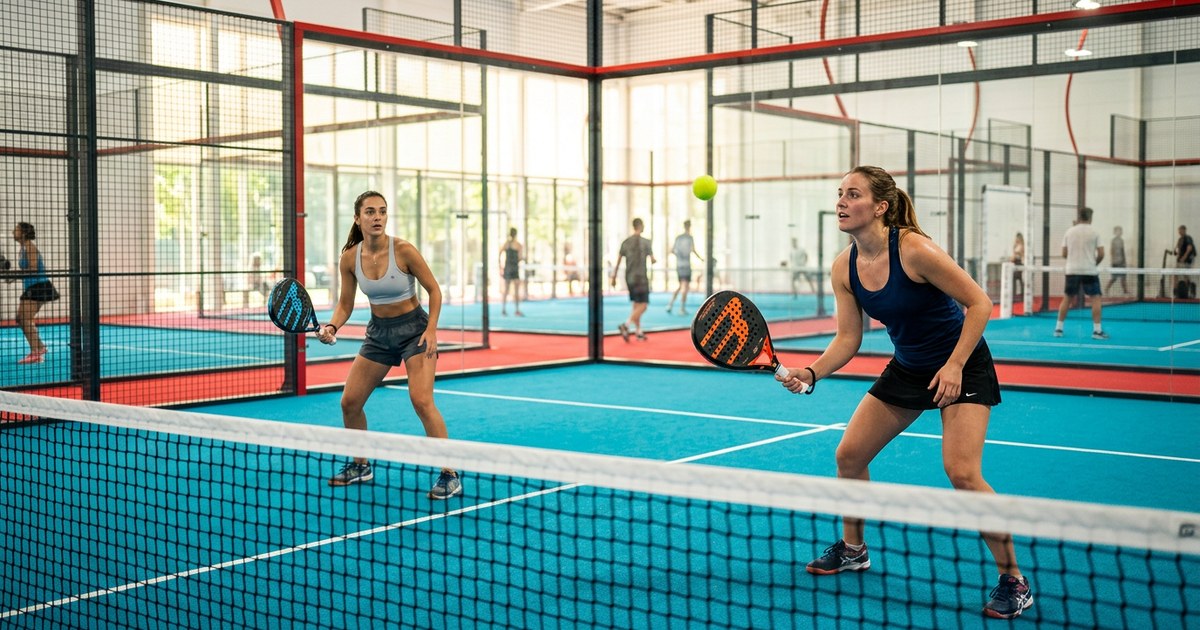
Next usually comes an orientation to the court: the coach will point out the dimensions (20×10 metres, split by a net), explain that the walls are part of the game rather than an obstacle, and give you a few minutes to just bounce the ball by hand and feel how it comes off the glass and the mesh fencing. It looks a little odd from the sidelines, but it's the fastest way to strip beginners of their fear of the walls.
How a typical lesson runs, minute by minute
The exact format varies by club and coach, but the shape of a one-hour lesson is fairly consistent, and it helps to know it in advance so you don't burn energy in the first ten minutes or fade before the finish:
- 0–10 minutes — warm-up and court orientation. Light jog, joint mobility, an explanation of how the walls come into play.
- 10–25 minutes — grip and technique against a wall or feeding net. Practising the continental grip, first controlled shots with no scoring involved.
- 25–40 minutes — paired or coach-fed drills. Simple 2–3 shot rallies, volleys at the net, first attempts at playing the ball off the back glass.
- 40–55 minutes — a mini game or a free rally. This is usually when a beginner first "feels" padel — a rally of several shots in a row without the ball hitting the ground.
- 55–60 minutes — feedback. The coach briefly sums up what went well and what to work on next, and often gives you a rough level estimate.
If your lesson is structured differently, that's fine too — the core elements (warm-up, technique, drills, play) show up in some order at almost every club.
Grip and your first shots
After the warm-up, the coach will show you the continental grip — the "hammer grip": you hold the racket as if you were driving a nail, not the way you'd hold a tennis racket with a palm-under classic grip. It's the base for nearly every shot in padel, and it will likely feel awkward at first — that's completely normal, muscle memory forms over several sessions, not one lesson.
From there, drills stay simple, with no score involved:
- Groundstrokes fed from close range by the coach.
- Volleys at the net — short, blocking contact, no backswing.
- First attempts at playing a ball after it bounces off the back wall.
Nobody expects a clean shot on the first attempt. The point of a first lesson isn't results — it's getting a feel for the ball and the court.
The walls: the rule that breaks every tennis habit
If you've played tennis, be ready to "unlearn" one reflex: in padel, a ball that bounces off the back or side glass is still live — you can, and often should, play it after it comes off the wall. Beginner tennis players instinctively stop when the ball heads toward the wall — and lose points that could have turned into good shots.
The good news: that reflex fades quickly, usually within 2–3 sessions, if the coach specifically drills wall play — and on a first lesson, it's almost always part of the program, even in a simplified form.
Five mistakes almost every beginner makes
If any of these show up in your first lesson, don't worry — it's the statistical norm, not a sign that padel "isn't for you":
- Swinging too hard. Padel rewards short, controlled contact, not the power swings of tennis. The instinct that "harder is better" usually works against beginners — the ball flies into the fencing or out of the court, and control is the first thing lost.
- Playing with the arm only, not the legs. The court is small, but you still need to move — many beginners plant their feet and reach with the racket instead of taking a step to meet the ball in a comfortable spot. Good footwork does more for your game than a hard swing ever will.
- Flinching at the glass. See above — it fades with practice, but almost everyone hesitates for a split second the first time a ball heads for the back wall.
- Gripping the racket too tightly. A clenched hand kills control and tires out your forearm fast — by the end of the first hour, that's usually the reason your arm feels tired, not the shots themselves.
- Forgetting your partner. Padel is always 2 v 2, and from the very first lesson it's worth getting used to thinking about positioning as a pair, not just for yourself — who covers the net, who holds the back line, who takes the middle ball.
If your coach corrects the same thing several times in one lesson, that's not a sign you're a slow learner. It's what normal learning looks like: your body is rewriting old movement habits for a new sport, and that takes repetition.
How your coach rates your level
At the end of a lesson (or after a few sessions), coaches usually give a rough estimate on the international 1.0–7.0 rating scale — the standard system for padel, and the same one used on player profiles across the site. On a first lesson, this rating is a starting point, not a verdict: the scale moves, and after a month of regular training the number will almost certainly change.
As a benchmark: a beginner after one or two lessons usually lands somewhere around 1.0–2.0 — a perfectly normal starting point, not something to worry about. Progress isn't linear either — the first half-point often comes quickly, as the roughest technical errors disappear, and after that gains come more gradually and depend more on tactical understanding than on raw stroke technique.
If you'd like your level formally verified later on, coaches on the site can confirm it directly, and you can track your progress against the leaderboard to see how the 1.0–7.0 scale plays out in practice.
How much a first lesson costs in Tashkent
Prices for group and private lessons vary noticeably across clubs in Tashkent depending on the venue, time slot and format — we've broken this down in detail in our guide to what padel actually costs in Tashkent, covering court rental, memberships and lesson pricing honestly. In short: a trial group lesson is usually noticeably cheaper than a private one, and many clubs and coaches offer a separate introductory rate for a first lesson — ask about it when you book through a coach's profile.
If you haven't picked a place to train yet, check our guide to courts and clubs — it flags which venues run beginner programs and group classes.
Frequently Asked Questions
Do I need my own racket for a first lesson?
No. Most clubs in Tashkent rent out rackets for free or for a small fee — confirm this when you book. There's no point buying a racket before your third or fourth session; you need to get a feel for the grip first.
How long does a first lesson last?
Usually 60 minutes — enough time for a warm-up, grip and shot basics, and a short game at the end.
Will I be sore after my first lesson?
Most likely your forearm and legs will feel it the next day — padel is more demanding than it looks from the sidelines, thanks to constant starts and stops. It fades within a day or two and gets less noticeable with each session.
What if I've never held a racket before?
That's the most common starting point in beginner group classes — coaches build the whole program around a zero level, and nobody expects you to have an athletic background.
How quickly will I actually be able to play?
Most beginners need anywhere from a few weeks to a couple of months of regular training before they can hold their own in a rally with confidence — we cover this in more depth in how long it takes to get good at padel.
When can I sign up for my first amateur tournament?
Not before you've got solid control of the basics and wall play — usually a few months of regular training. When you're ready, beginner-friendly tournaments are easiest to find in our events section.
A first lesson isn't an exam — it's an introduction to the game. Give yourself permission for awkward first swings and mistimed shots: a month of regular training from now, you'll laugh at how nervous you were before that first lesson. The easiest way to start is to pick a coach or find a club near you and book the next available slot. For more beginner guides, browse the PlayPadel blog.
An honest diary for absolute beginners: first lessons, the mistakes nobody warns you about, choosing your first racket and your first steps on court. Thinking about your first game? Start here.
Related articles
 For beginners
Left or Right? How to Pick Your Side in Padel
Not sure which side to play in padel — left or right? We break down how your hand, forehand and confidence decide the right position for you.
 For beginners
How to Book Your First Padel Court in Tashkent
Schedules, payment, check-in and canceling politely — a step-by-step guide to booking a padel court in Tashkent so your first game goes smoothly.
 For beginners
How Much Does Padel Cost in Tashkent? A Beginner's Budget Guide
Court rental, a racket, lessons, memberships — an honest breakdown of what it actually costs to start playing padel in Tashkent, and where you can save.