You dump an easy ball into the net — and the next five minutes you play worse than on your very first day on court. Same racket, same legs, different result: your head is stuck on one mistake and it's dragging three more behind it. This happens to players at every level, but it hits beginners hardest, because in padel you're almost never alone. Your partner is two meters away, your opponents are watching through the net, and the glass walls don't let you hide even physically. The good news: what happens in your head after a bad shot is a skill, exactly like the bandeja or the serve, and it can be trained.
Why one bad shot in padel hits harder than it should
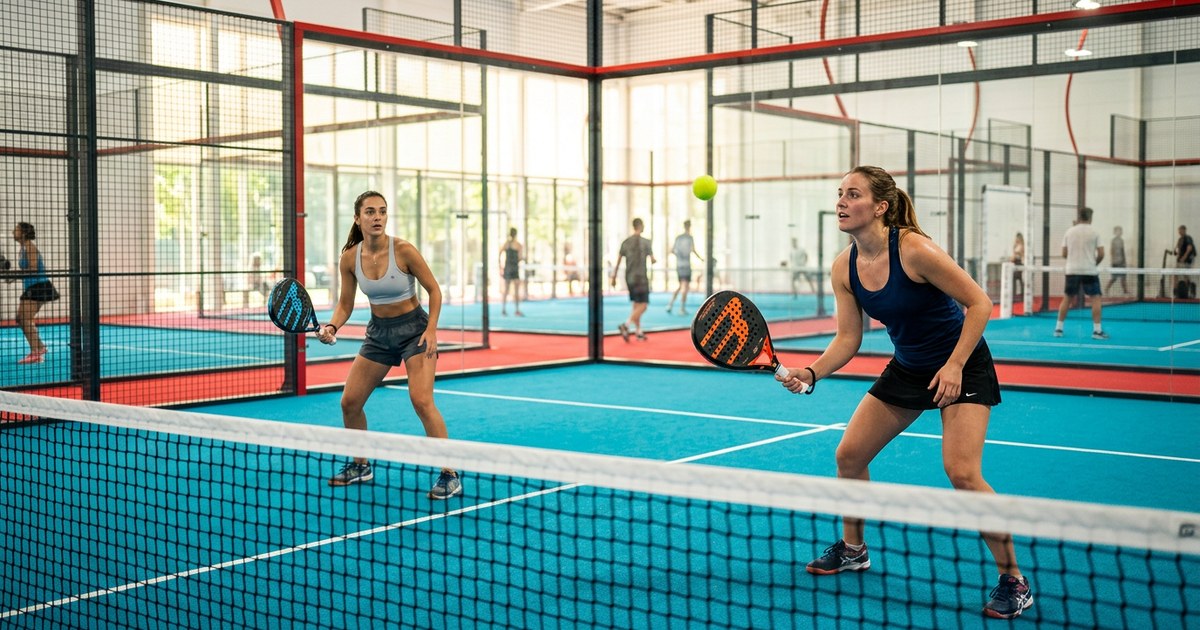
Padel is built so that a mistake rarely goes unnoticed. The court is only 20×10 meters, and you share it with three other people who are a few steps from you at every moment of the rally. Miss, and it's not just your opponent across the net who saw it — your partner right beside you saw it too. On a big tennis court, playing singles, a miss can almost disappear. On a padel court, it can't.
The second factor is the glass. Walls keep rallies alive longer — the ball bounces back into play instead of ending the point — so you spend more time "inside" a tense moment before it resolves. A tennis player gets a 20–25 second changeover to exhale between points; a padel player often goes straight from one long rally into the next.
The third factor is simple newness. An experienced player automatically knows that one net ball means nothing across a match of 60–70 points. A beginner doesn't have that internal statistic yet, so every mistake feels like a verdict instead of a routine event. Just understanding this mechanism is half the fix — knowing why it happens makes it easier to not follow the automatic reaction.
The effect is even more visible in Tashkent's fast-growing scene: amateur games often mix very different skill levels in the same foursome, and a newer player frequently ends up on court with people who've been playing for a year or two. In that mix, your head reacts not only to the ball itself but to an imagined judgment from more experienced players — and that extra layer of worry usually costs you more points than the actual skill gap does.
Tilt: how one mistake turns into a streak
Poker and esports players call it "tilt" — a state where one setback throws off every decision that follows it. On a padel court, tilt is easy to recognize: you net a ball, grip the racket a little tighter than usual, rush the next shot, and miss again. Three misses in a row, and it feels like "the game just isn't there today," when really only one thing broke: your reaction to the first mistake.
The mechanism is simple and predictable:
- The miss — the ball goes into the net or long.
- The grip tightens — your hand involuntarily squeezes harder, the swing gets jerkier.
- The rush — you try to make up for it immediately, going for a shot you should have just kept in play.
- The second miss — the forced shot doesn't land, and the cycle repeats.
The key insight: tilt doesn't break your technique, it breaks your decisions. Your hands remember the stroke just as well as they did five minutes ago — you've just started picking the wrong balls to gamble on. So the fix isn't the swing. It's the gap between points.
The 10-second reset: what to do between rallies
Professional players have a short, almost mechanical routine they run after every point, win or lose. Here's a version that works for amateur level and takes about 10 seconds:
- One exhale longer than the inhale. Physiology is simpler than psychology: a longer exhale lowers your heart rate and muscle tension on its own, no "mindset work" required.
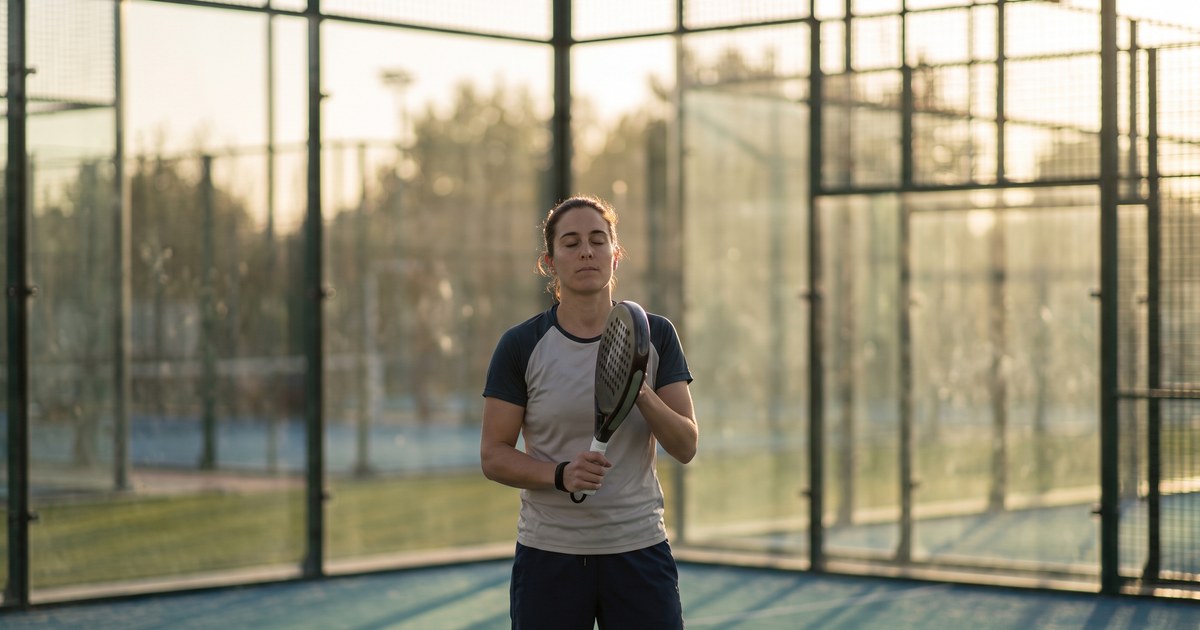
- A small physical reset gesture. Run your fingers across the strings, adjust your grip — any short mechanical action that signals to your brain "that point is over, a new one starts now."
- One word, out loud or silently. "Next," "Reset," "OK" — any short word you use every single time trains your brain to close the previous point instead of chewing on it.
- Look at the next ball, not the last one. Glance at your partner or your opponents' position — shift your attention to what's coming, not what already happened.
This isn't mystical, it's just a habit, like a warm-up before you play. The first few times it will feel forced — that's normal, every new skill goes through that stage before it becomes automatic.
How to talk to yourself on court
Your inner monologue on court affects your game as much as your grip does — you just can't see it from outside. The gap between "I always shank this shot" and "lower contact point, next one goes in" looks small, but it's exactly what decides whether you rush or play calmly on the next ball.
A few useful swaps:
- Instead of "I always do this" → "One ball, not a pattern." One mistake doesn't predict the next one.
- Instead of "Don't mess this up" (your brain processes negatives poorly and latches onto the action itself) → "Calm, to the target," naming what to do instead of what to avoid.
- Instead of silent frustration → a short neutral phrase said out loud. A thought you say takes less energy than a thought you replay ten times in your head.
This works not because the words are magic, but because you physically can't form a constructive phrase and spiral at the same time — your brain picks one or the other.
Your body gives away your head — watch your shoulders and racket
What's happening in your head is almost always visible in your body — and it runs both ways: posture doesn't just reveal your mood, it shapes it. Slumped shoulders, a racket dangling by your leg, a slow walk with your head down between points — it doesn't just look defeated, it physically slows your reaction on the next ball, because your body has already settled into "pause" mode instead of "ready."
A simple set of habits to keep between points:
- Hold the racket up in front of you, not loosely at your side.
- Walk back to position at a normal pace with your shoulders up, even right after a miss.
- Look at the net or your partner, not at the ground.
This isn't about pretending everything's fine. It's that a body that's ready to play genuinely reacts faster to the next ball, regardless of what you're feeling underneath.
Your partner is a teammate, not a jury
In solo sports, tilt is your own problem. In padel, it's contagious: one player starts getting frustrated with themselves, the other reads it as tension in the pair, and suddenly both of you are playing tight. Your partner isn't a judge scoring every shot — they're another player who also shanks balls and also gets nervous.
A simple, effective habit: a quick racket tap between points, win or lose. It costs nothing, but it keeps the pair on the same page and stops one mistake from turning into silent tension for the rest of the set. For the fuller picture of syncing up with a partner — what to call, who takes the middle, how to keep the emotional side from falling apart — we covered it in depth in our piece on doubles communication.
Count small wins, not just the score
Beginners almost always measure a match by one number — the final score. That's a poor metric for your mental game: the score depends on dozens of factors, including your opponent's level, and it doesn't reflect your personal progress. It's far more honest to track process goals — how many times you actually ran the reset routine, how many balls you played with your feet set instead of stretched out, how many times you held back from a forced shot under pressure.
That lens matters most in the early months, when the result is still unstable but the progress in your head is already real. We covered other common early-weeks traps in first-month padel mistakes — the underlying mechanics there are largely the same: it's rarely the technique that fails first, it's the reaction to it.
A simple way to see the progress: one line jotted down after a session — not about your technique, just about how you handled mistakes. A month of those notes shows a pattern no scoreline ever will.
Train this the same way you train a stroke
You can't switch on the mental game through willpower alone in an important match if you've never practiced it in training. A common beginner mistake is putting off the mental side "until the technique is better." In practice, it works the other way: the sooner you start reinforcing your reaction to mistakes, the sooner it becomes automatic, regardless of your stroke level.
A few ways to build this into a normal session, no extra equipment or time required:
- Play practice sets that count. The feeling that "this matters" is what triggers the same reactions as a real match — and practice lets you get it wrong without real consequences.
- Deliberately force a rough patch. Agree with your partner to play three rallies in a row right after a missed ball on purpose — you're rehearsing the recovery, not just the stroke.
- Say the routine out loud in practice. What should happen silently in 10 seconds during a match is worth saying out loud once or twice in training — it speeds up the automation.
- Play with different partners. Every new person in the pair is a slightly new social situation, which means extra practice for exactly the resilience we're talking about.
Nerves before your first tournament or league match
If tilt after one mistake is already a challenge, a first tournament or amateur league adds another layer: a set date, an audience, and the sense that "this one counts." Being nervous before your first official match isn't a sign you're not ready — it's a normal reaction to a new social situation almost everyone goes through.
The same 10-second routine works here too, only start it earlier — not on the first rally, but during your warm-up. For the fuller picture of what to expect and how to prepare logistically and physically, see your first padel tournament. If you want to test yourself in a lower-stakes setting first, check current amateur events on the PlaySport events page — many formats are built specifically for newer players.
When it's worth talking to a coach
If tilt keeps you from actually enjoying the game regularly, not just occasionally, that's a reason to ask for help rather than push through it. Working on your head is a normal part of coaching, the same as fixing a swing, and an experienced coach will spot quickly exactly where in a rally you lose control — before contact, during it, or right after. You can find someone who works on both technique and match mindset in our PlaySport coaches directory — and practice the new routine calmly, away from tournament pressure, at one of the courts in our Tashkent venues guide.
The mental game in padel isn't a separate discipline reserved for pros — it's a practical tool you can build in a few weeks of regular practice. Start with one simple piece, the 10-second routine after every point, and layer the rest on gradually. For more for players just starting out, browse the PlaySport blog.
Frequently Asked Questions
What is padel tilt?
Tilt is when one mistake sets off a chain of worse decisions — a tighter grip, rushed shots, and repeat misses. It doesn't break your stroke technique; it breaks the quality of your decisions on the balls that follow.
How do I calm down quickly after a bad shot on court?
A short physical routine right after the point helps: a longer exhale, a small mechanical action like touching the strings, the same reset word every time, and shifting your gaze to the next ball instead of the last one. The whole routine takes about 10 seconds.
Is it normal to be nervous before your first padel tournament?
Yes, it's a normal reaction to a new situation, not a sign you're underprepared. The same reset routine helps here too — start using it during your warm-up, not on the first point of the match.
How do I avoid taking it out on my partner during a match?
Remember your partner also misses shots and also gets nervous — they're a teammate, not a jury. Tap rackets after every point regardless of the outcome, and use neutral words like "next" instead of criticism.
Can you train mental resilience in padel the same way you train a stroke?
Yes. Like any technical skill, your reaction to a mistake gets reinforced through repetition. Start with a simple routine after every point in practice, and within a few weeks it becomes as automatic as your grip.
When should I talk to a coach about focus problems on court?
When head trouble is stopping you from enjoying the game regularly, not just once in a while. A coach can pinpoint exactly where your focus breaks down in a rally and build work on it into your regular technical training.