

Padel vs Tennis: The Real Differences and Why Padel Is Easier to Start
Padel and tennis only look alike from a distance. We break down the court, racket, rules and scoring — and explain why padel is so much easier to pick up from zero.
Contents
- Padel and tennis: what they share and the core difference
- The court: glass changes the whole game
- Racket and ball: why padel forgives beginners
- Rules and scoring: what to keep from tennis and what to forget
- Why padel is easier to start
- What's harder in padel than it looks
- If you're coming from tennis: what to unlearn
- How to start in Tashkent
- Frequently Asked Questions
- Is padel the same as tennis?
- Which is easier for a beginner — padel or tennis?
- Do I need to know tennis to start padel?
- Can you play padel one-on-one?
- How is a padel racket different from a tennis racket?
- How much does it cost to try padel in Tashkent?
Almost everyone who hears the word "padel" for the first time reacts the same way: "Oh, that's like tennis, right?" Yes and no. From a distance it looks similar — a racket, a ball, a net, a court. But the moment you step onto the court, it becomes clear these are two different sports with different logic, different physics, and a completely different barrier to entry. And the key thing for a beginner to know: padel is almost always easier to start than tennis. In this guide we'll cover exactly how padel differs from tennis and why it hooks people who insist they're "not athletic at all."
Padel and tennis: what they share and the core difference
Let's start with an honest admission: they do have a lot in common. In both sports you hit a ball over a net with a racket, you keep score with the tennis system (15–30–40, games, sets), and you try to stop your opponent from returning the ball. If you've ever held a tennis racket, your basic feel for the ball will carry over.
But then the differences begin, and they're fundamental:
- Padel is always played four-up — it's a doubles game, four people on court, and singles padel in the usual sense doesn't exist.
- The court is enclosed, with glass walls, and the walls are in play. A ball that rebounds off the glass is still alive.
- The racket is solid, with no strings — short, perforated, forgiving.
- The serve is underarm, below the waist, after the ball bounces on the floor.
- The court is smaller — you run far less than in tennis.
Each of these differences seems minor on its own. Together they turn padel into a game you can show up to on a Wednesday evening with zero experience — and already enjoy your first rally. Let's go through them.
The court: glass changes the whole game
The biggest visual and tactical difference is the court. Padel is played on an enclosed court measuring 20×10 metres, surrounded on all sides by glass and topped with metal mesh fencing. A tennis court is almost twice as long (around 24 metres) and open — a ball past the line is simply out.
In padel it's the opposite: the walls are in play. A ball that flies past you and hits the back glass hasn't gone anywhere — it bounces back into the court, and you're fully entitled to play it after the rebound, exactly as you would after a bounce off the floor. The only thing you can't do is let the ball bounce on the floor twice.
For a beginner this changes everything for the better. In tennis, a deep ball at the baseline means panic: get there before the bounce, stretch, don't hit it out. In padel that same deep ball is often the most comfortable one: step back, let it rebound off the glass, and calmly play it at a convenient height. The glass kills the pace, and a hard-driven ball becomes slow and playable after the wall.
Getting used to the wall is a skill of its own, and at first it scares almost everyone. If you want to dig into it, we have a dedicated guide on how to play off the back wall and stop fearing the glass. But even a general grasp of "a ball off the glass is a second chance, not a lost point" instantly makes the game calmer.
Racket and ball: why padel forgives beginners
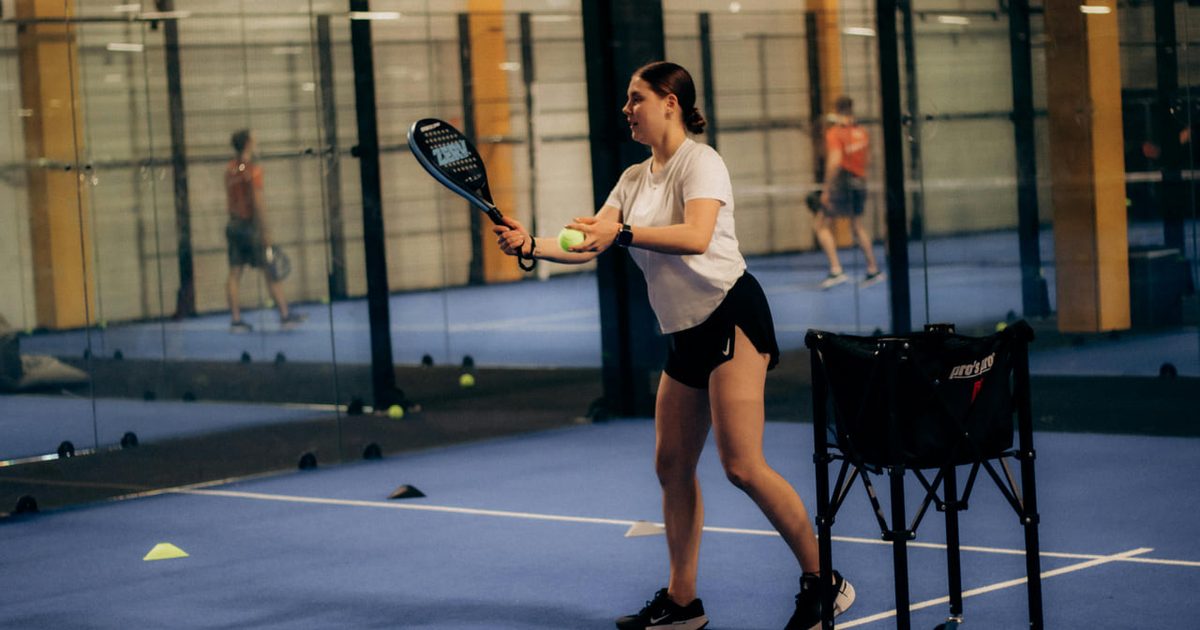
Hold a tennis racket and a padel racket side by side and the difference is obvious. A tennis racket is long (around 68–69 cm), strung, with a big swinging head. A padel racket is short (up to 45.5 cm), solid, stringless, perforated — holes across the whole face.
Why does that matter to a beginner? A short, solid racket makes it far easier to make clean contact. There's no long lever, no complex swing, no "string window" you have to feel. You're essentially hitting the ball almost like an extension of your palm — which is where the name comes from (padel, from paddle). On the very first session most people confidently get the ball over the net, something that's much harder to achieve in tennis from cold.
The ball in padel looks almost identical to a tennis ball but has slightly lower internal pressure — it bounces a touch lower and slower. Combined with the small court and short racket, that gives you the famous "forgiving" game: you simply have more time and less space to go wrong.
Good news for a beginner's wallet: you don't need an expensive racket to start. We covered how to choose your first one without overpaying in our guide on how to choose your first padel racket. To begin with, a soft, light, round-shaped model is ideal — and at nearly every one of Tashkent's courts you can rent a racket for your first session.
Rules and scoring: what to keep from tennis and what to forget
If you've played tennis, you can skip relearning half the rules. The scoring is identical: points 15–30–40, deuce, advantage, games, sets. The net is roughly the same height (in padel it dips slightly lower at the centre). The ball may bounce only once on your side.
But there are differences you'll have to accept:
| Element | Tennis | Padel |
|---|---|---|
| Players | 1v1 or 2v2 | Always 2v2 (four people) |
| Court | ~24×8–11 m, open | 20×10 m, enclosed by glass |
| Walls | None, ball goes out | Walls in play, ball alive after rebound |
| Racket | Long, strung | Short, solid, perforated |
| Serve | Overhead, powerful | Underarm, below the waist, after a bounce |
| Physics | Lots of running and power | Less running, more control |
The serve deserves a special mention. In tennis it's a complex, powerful overhead shot that beginners spend months learning. In padel the serve is deliberately simple: you hit the ball after it bounces off the floor, striking it below waist level, diagonally into your opponent's box. No toss to the ceiling, no power windup — which is why the serve stops being a problem from your first session.
And once more on padel's golden rule: padel is always doubles. You're never alone on the court. That changes not just the tactics but the whole atmosphere of the game — more on that below.
Why padel is easier to start
Now to the heart of it. Why do coaches unanimously say padel is easier to get into than tennis? It comes down to several things at once:
- A low technical barrier. A short racket makes contact easy, the serve is underarm, the court is small. From your first session you're playing rallies, not just learning to hold the racket.
- Less physical demand. The court is half the length of a tennis court, and there are four of you — you run noticeably less. Padel is accessible to people with no athletic background and to anyone returning to sport after a long break.
- The walls forgive mistakes. A ball that would be out in tennis stays in play in padel. Rallies last longer, which makes them more fun for beginners and spectators alike.
- It's always social. Four people on court is instantly a social story. Padel slots into an evening with friends or colleagues far more easily than one-on-one tennis.
That's exactly why padel is one of the fastest-growing sports in the world, and Tashkent is no exception: courts are opening one after another, and putting a foursome together has become a matter of a few messages. If you're short of partners for a full four, they're easy to find among the players on the platform or by simply joining an open game where someone is already looking for the missing pieces.
In our experience, beginners in padel progress remarkably fast: in tennis a person spends a month just learning to get the ball over the net, while in padel they play real rallies on the very first evening and leave the court happy. It's a completely different barrier to entry.
That contrast is the best illustration of how closely the two sports are connected and how differently they feel.
What's harder in padel than it looks
Let's be honest: "easier to start" doesn't mean "easy to master." Padel has its own depth, and a couple of things come harder to beginners than in tennis.
- Playing off the glass. Letting the ball pass you, rebound off the wall, and playing it on the way down contradicts the tennis instinct to hit early. The rewiring takes a few weeks.
- Doubles coordination. You share the court with a partner and have to move in sync, like a single elastic band. Who takes which ball, who covers the middle — you learn that together. There's a full guide on court positioning and how a pair moves.
- Touch, not power. In padel the winner isn't the one who hits hardest but the one who's more precise and patient. The lob, a soft ball under the glass, calm defence — it's all fine work, not muscle.
The paradox of padel is exactly that: easy to enter, high ceiling. The first wins come almost immediately, but mastery is built over years, and that's what keeps people hooked.
If you're coming from tennis: what to unlearn
Tennis experience is both a gift and a trap. Your feel for the ball, your footwork, your understanding of scoring — all of that works for you from day one. But a few habits will have to be consciously broken:
- Don't hit too hard. Tennis power usually hurts you in padel: the ball flies into the glass and comes straight back to your opponent. Learn to play softer and smarter.
- Don't chase the ball to the wall. The main tennis reflex is to run to the ball as early as possible. In padel it's the reverse: drift back with the ball, leave yourself room, wait for the rebound.
- Forget the powerful overhead serve. It's banned here. The underarm serve isn't a "watered-down version for the weak" — it's a distinct technical element with its own precision.
- Think as a pair, not for yourself. In singles tennis the whole court is yours. In padel half belongs to your partner, and the best player isn't the one who grabs everything.
In short: the sooner a tennis player stops trying to overpower the opponent and starts playing patiently, the sooner their advantage shows. And it's a real one — the coordination and the stroke are already there; only the head needs reprogramming.
How to start in Tashkent
The good news: to try padel you don't need to buy anything or understand anything in advance. Here's a simple first-step plan:
- Take one lesson with a coach. An hour with a coach at the start saves months of self-taught mistakes: they'll fix your serve, grip and basic movement straight away. You can find a beginner-friendly specialist in the PlaySport coaches section.
- Don't buy gear right away. Rackets are available to rent; all you need is comfortable sports shoes and clothes. Leave choosing your first racket for later — the racket guide will wait until you know what you like.
- Find a foursome. Padel is always four people. Short of partners? Join an open game or look for players at your level among the platform's players.
- Don't be afraid to make mistakes. Your first month in padel is full of normal, predictable mistakes that everyone goes through. We collected them in a separate piece on the beginner mistakes of your first month.
Don't treat your first session like an exam: what's great about padel is that the joy comes immediately, before the technique. First a person enjoys the game — and only then, once they're hooked, do they start polishing their shots. That's perhaps the best thing setting padel apart from tennis for a beginner: here you don't have to suffer first to enjoy it later. The enjoyment is there from your very first session.
Frequently Asked Questions
Is padel the same as tennis?
No. They share the scoring and the basic idea of "hit a ball over a net with a racket," but padel is played four-up on an enclosed 20×10 m court with glass walls, a short stringless racket, and an underarm serve. It's a separate sport with its own tactics.
Which is easier for a beginner — padel or tennis?
Almost always padel. A short racket makes contact easier, the serve is underarm, the court is smaller, and the walls keep the ball in play. Most people play real rallies on their first session, which is much harder to achieve in tennis from zero.
Do I need to know tennis to start padel?
No. Tennis experience helps with feel for the ball and footwork, but it isn't required. Plenty of people come to padel with no racket-sport background at all and settle in within a few sessions.
Can you play padel one-on-one?
In classic padel, no — it's always a doubles game, four people on court. There are one-on-one training formats, but competitive padel is exclusively 2v2.
How is a padel racket different from a tennis racket?
A padel racket is shorter (up to 45.5 cm), solid, stringless and perforated with holes. A tennis racket is long, strung and has a large head. A short solid racket makes it noticeably easier for a beginner to make clean contact.
How much does it cost to try padel in Tashkent?
To try it you don't need to buy gear: rackets are available to rent, and you pay for the court and, optionally, a lesson with a coach. That makes the first step cheap and low-commitment — just gather a foursome and book a court.
An honest diary for absolute beginners: first lessons, the mistakes nobody warns you about, choosing your first racket and your first steps on court. Thinking about your first game? Start here.
Related articles
 For beginners
Left or Right? How to Pick Your Side in Padel
Not sure which side to play in padel — left or right? We break down how your hand, forehand and confidence decide the right position for you.
 For beginners
How to Book Your First Padel Court in Tashkent
Schedules, payment, check-in and canceling politely — a step-by-step guide to booking a padel court in Tashkent so your first game goes smoothly.
 For beginners
Your First Padel Lesson: What to Expect
What to bring, how to choose between a group and private lesson, and the mistakes almost every beginner makes at their very first padel lesson in Tashkent.