

Padel Court Etiquette: 20 Rules That Make You the Partner Everyone Wants
Padel is a social sport, and your on-court manners decide whether you get invited back. The unwritten rules: before, during, and after the game.

Contents
- Why etiquette matters more than you think
- Before the game: arrive ready
- The warm-up: five minutes that save half an hour
- Scoring: one voice, no confusion
- Lines, outs and doubt
- With your partner: the one rule that matters
- Volume, aggression and emotion
- Moving between courts: only cross during games
- After the game: the 30 seconds people remember
- Online etiquette: chats, cancellations, late notice
- The Tashkent context
- When it's time to call a coach
- A short cheat sheet
- Frequently Asked Questions
- What if my opponent keeps breaking the rules on score or line calls?
- Can I give my partner advice during a match?
- What counts as a serious etiquette violation?
- How do I handle a partner who shouts at me after mistakes?
- Do I really have to give doubtful balls to the opponent?
- What do I do if a ball from the next court lands on ours?
People come to padel for two things: the movement and the people. You can sharpen your strokes with a coach in six months. Building a reputation as a good partner takes only one thing — manners. The player who shows up ten minutes late, argues over every ball and loudly comments on a partner's misses ends up without partners — no matter how cleanly they strike the ball.
The good news: padel etiquette is simple, and almost all of it boils down to respect. If you're just starting and want to quickly become the person who keeps getting invited back, read this guide once — and almost every "awkward moment" on court will pass you by.
Why etiquette matters more than you think
Padel is a doubles, close-quarters, social sport. The court is just 20×10 metres, four players are in constant contact inside it, and balls bounce off glass and fly toward the neighbours. In that format, one rude word or one ignored let ruins the atmosphere on the whole court — and often on the whole evening.
There's a practical side too. Amateur padel almost everywhere runs on the same system: you create a game, fill it up to four, and meet near-strangers. If someone remembers you after the match as a pleasant partner, they'll invite you back, add you to their chat, slot you into their regular four. If they remember you as "the one who argued at the net," they won't. Etiquette is, fundamentally, your long-term plan for steady partners.
Tashkent's community is small: across all clubs, roughly the same thousand active players, and many of them know each other by face. Reputation here is a real resource — and it disappears faster than you think.
Before the game: arrive ready
Respect starts before you pick up the racket. The basic minimum:
- Get there 10–15 minutes early. Not "on time" — early: time to change shoes, warm up, fill your water bottle. The court is paid by the hour — every minute you're late steals playing time from three other people.
- Message immediately if you're delayed. Five minutes of traffic is fine. A silent 20-minute delay with no text is not.
- Bring your own balls or chip in. The standard is a fresh can of three balls for the four of you. If you play every week, set up a rotation: you today, your partner next time.
- Check your gear at home. A cracked racket, holes in your court shoes, a forgotten water bottle — all small things that steal time and patience from everyone. If you're still picking your first racket, start with how to choose your first padel racket.
- Don't show up sick. Padel is a respiratory-contact sport: four people on a small court, no masks. Even a mild cold — skip the game, find a sub through the chat.
The warm-up: five minutes that save half an hour
Most matches start with 5–10 minutes of warm-up — a quick rally without keeping score. A few unwritten rules:
- Hit to your partner, not "into the wall for yourself." The point is for all four of you to warm up, not for you to drill your best strokes.
- Don't crush the first ball. Start soft, add pace after a minute. Wrists, shoulders and tendons are still cold in the opening minutes.
- Agree on what you're rallying. Volleys first, then groundstrokes from the baseline, then serves. Thirty seconds of planning prevents chaos.
- Don't teach anyone during the warm-up. Even if your partner is "holding the racket wrong." Warm-up is not a lesson, and it is not the place for unsolicited advice.
If you sense you're playing a noticeably weaker opponent, don't hit at full force during the warm-up. It's not "feeling them out" — it's just disrespectful.
Scoring: one voice, no confusion
Padel has no referee. The players keep score themselves, and this is where misunderstandings turn into conflict fastest. Simple rules:
- The server calls the score before every serve. Server's score first, then receiver's: "30–15." This is the standard and it removes 90% of arguments.
- Use a calm, clear voice — no sarcasm. Not "30–love, finally" — just "30–love."
- If the score is in dispute, sort it out right away. Not at the next game. Stop the rally, count together, agree. A lost minute is better than playing with two different scores.
- In doubt, give the point to the opponent. Old padel rule: "not sure — gave it away." Even pros do it, because it's faster and more honest than arguing.
A note on longer formats: if you're playing with a "golden point" (punto de oro — the deciding point at deuce), confirm that before the first rally so nobody says "we usually play ad" two games in.
Lines, outs and doubt
Each pair calls its own lines on its own side of the court. That's the foundational rule, and beginners break it most often. A few specifics:
- Call out loud and immediately. "Out!" — while the ball is still in the air or right as it lands. Calling an out two strokes later doesn't count.
- Don't call balls on the opponent's side. If a ball landed on their side, it's their call — even if it looked out from where you were standing.
- Doubt = in. Most of the padel world plays this way: if you can't tell, the ball is in. It's faster and more pleasant.
- Don't "take back" a call. If you called something wrong in the heat of the rally, own it and give them the point. The calmer you do it, the more respect you earn from your opponents.
There's no video review in padel and, in most clubs, not even lines on the wall. Trust is the only mechanism holding the game together.
With your partner: the one rule that matters
You spend two hours within half a metre of your partner. That's a small shared life. One rule overrides almost everything else: support your partner through mistakes, don't criticise them.
In practice:
- "No worries, next one." That's your default line after any partner miss. Not "you should have lobbed," not "where are you hitting," not silent eye-rolling.
- Never explain technique mid-match. Never. Even if you're a coach. Nobody learns in five seconds between rallies, but confidence collapses instantly.
- Praise more than you correct. Roughly 5 to 1. One "you should've lobbed" costs you five "great shot!"s.
- Tactical talk is a short conversation. "I close the middle, you take the diagonal" — fine, and useful. "You're always in the wrong place" — not fine.
For more on how a pair coordinates, who's responsible for what on court, and how to talk to each other between rallies, see our guide on how to play as a doubles pair. Etiquette is the in-the-moment expression of that same idea.
Volume, aggression and emotion
Padel is an emotional sport. Showing emotion on court is fine — pumping a fist, exhaling "vamos!" after a great rally — nobody objects. But there's a line.
- Don't swear out loud. Especially at yourself, especially loudly. Neighbouring courts might have kids, lessons, or first-timers in them.
- Don't smash your racket into the glass, the net or the floor. It's unsafe (tempered glass isn't immortal), it looks awful, and it's grounds for ejection at most clubs.
- Don't try to intimidate your opponent. Heavy stares after your own good points, theatrical groans at their misses — that's pressure that doesn't belong in amateur padel.
- Quiet opponents are still playing. If your pair likes to debate every rally — fine. If your opponents play silently, don't pull them into commentary across the net.
A simple test: if your behaviour would feel out of place in a café with friends, it's out of place on the court.
Moving between courts: only cross during games
Beginners break this rule the most, simply because nobody tells them. A club usually has several courts in a row, and sometimes you have to walk past somebody else's court to get to yours.
- Never walk behind a court during a rally. Even if it'll be quick. The ball can fly over the glass, players spin around in the heat of a point, and your silhouette behind the glass is a distraction.
- Wait for the end of the game. A game lasts 1–4 minutes — no longer. Wait at the entrance, hear the "game!" call and the side change, then walk through calmly.
- Same goes for balls from neighbouring courts. If somebody else's ball lands on your side, don't fling it back over the glass mid-rally. Wait for a pause and roll it under or through the door.
- Only players belong on the court. Friends, kids and spectators stay behind the glass, on the benches. A coach steps on court only if it's a lesson.
These aren't "polite niceties" — they're part of safety. A ball flying at 70 km/h plus an unexpected silhouette behind glass is a bad combination.
After the game: the 30 seconds people remember
How you finish the match is what sticks. A simple ritual:
- Meet at the net. All four of you. Don't wave a racket from the baseline — actually walk over.
- Shake hands or tap rackets. In Tashkent, both are equally normal.
- Say "thanks for the game." To everyone. Not "you guys were great, we were terrible" — just "thanks, that was fun."
- Don't dissect anyone else's mistakes. "If you hadn't missed that lob..." — that's not analysis, that's a complaint.
- Pick up your stuff. All four of you: put the balls back in a can, take your rubbish, grab your bottle from the bench.
Good sign: if all four of you walk away smiling — regardless of the score — you played the evening right.
Online etiquette: chats, cancellations, late notice
Half of modern padel life happens in messengers. The rules there:
- Respond to invites. "Yes, I'm in" or "can't make it" — within a few hours, not "saw it and forgot." The organiser is hunting for a fourth and can't wait a day.
- Cancel at least 24 hours out. If you drop out the day of, that's a force majeure: you find the sub yourself, not the organiser.
- Don't "park" yourself in multiple games. Don't write "maybe" in three chats at once. That blocks slots for people who can actually commit.
- Respect the level. If the post says "3.0–3.5" and you're a 1.5, don't sign up. And the reverse — a strong player in a beginner game is as bored as the beginners are uncomfortable.
If you're still trying to find people at your level, our separate guide on how to find padel partners in Tashkent walks through that system from the inside.
The Tashkent context
Most of this is universal, but a few local nuances are worth knowing:
- Be ready for mixed languages. On one court you might hear Russian, Uzbek and English — sometimes in the same sentence. Nobody minds; just call the score a bit more clearly.
- Heat and air conditioning. Indoor clubs in summer often run the AC or fans. Settle that before the game — some people want airflow, others freeze under it.
- Water breaks. In summer, especially on outdoor courts, take a short pause every 4–6 games. That's normal and expected.
- Lessons on neighbouring courts. If next door is a lesson, don't lob commentary over the glass. Coaches are often working with kids or beginners who need quiet.
If you're still figuring out which club fits your style, the list and map of Tashkent padel clubs is a good starting point. Some venues are quiet and sport-focused, others are louder and more social — the principles above apply equally to both.
When it's time to call a coach
Part of etiquette is being honest with yourself. If you notice you regularly:
- argue about the score,
- snap at your partner after misses,
- can't tell who should move where (and get annoyed that your partner is "in the wrong spot"),
- hit too hard at a clearly weaker opponent —
then the problem isn't manners; the game is missing structure. A few sessions with a PlaySport coach will fix more than any article: a pro will quickly show you where your responsibility ends and your partner's begins. Once the basic tactics click, there are far fewer reasons to argue or lose your temper.
The same goes for match experience. If you're ready to step beyond Saturday social games, amateur tournaments in Tashkent test not only your technique but your nerves. Good etiquette in a tournament is, effectively, a competitive advantage — opponents are quicker to invite you to the next event or training session.
A short cheat sheet
If you can't remember the whole article, keep four rules in your head:
- Arrive on time and ready.
- Support your partner, don't criticise.
- In doubt, the ball is in — the point goes to your opponent.
- After the game: meet at the net, say thanks, pack up your stuff.
With these four you're already in the top ten most-wanted partners at your club. The rest takes care of itself.
Frequently Asked Questions
What if my opponent keeps breaking the rules on score or line calls?
Start by calmly saying out loud: "I think we have different scores — let's recount." If it keeps happening, slow the pace, pause before each game, and call the score firmly. If someone is openly cheating — rare, but it happens — finish the match cleanly and simply don't sign up with them again.
Can I give my partner advice during a match?
Better not. A short tactical exchange at the side change ("I'll cover the middle") is fine, and so is encouragement after a miss ("next one"). Save technique notes ("you're gripping the racket wrong") for after the match or for a lesson.
What counts as a serious etiquette violation?
Smashing your racket into the glass or floor; loud swearing; walking behind another court during a rally; hitting at full power against a clearly weaker opponent; not showing up without warning. Those five are considered unacceptable in almost every club in the world.
How do I handle a partner who shouts at me after mistakes?
Calmly, once, tell them it doesn't work for you: "I play better when we back each other up." If the behaviour doesn't change, finish the match politely and don't pair with them again. It's not a fight — it's just two different ideas of what a game should feel like.
Do I really have to give doubtful balls to the opponent?
Yes — and it's standard. The old padel formula is "if you're not sure, the ball is theirs." It's faster, looks better, and over the long run costs you nothing.
What do I do if a ball from the next court lands on ours?
Pick it up, wait until their rally ends, and gently roll it back under the glass or through the door. Don't throw it onto their court mid-point — it's both unsafe and disrupts their game.
For players who are in it for fun: how to actually improve between lessons, find partners at your level, court etiquette, and what your first amateur tournament is really like.
Related articles
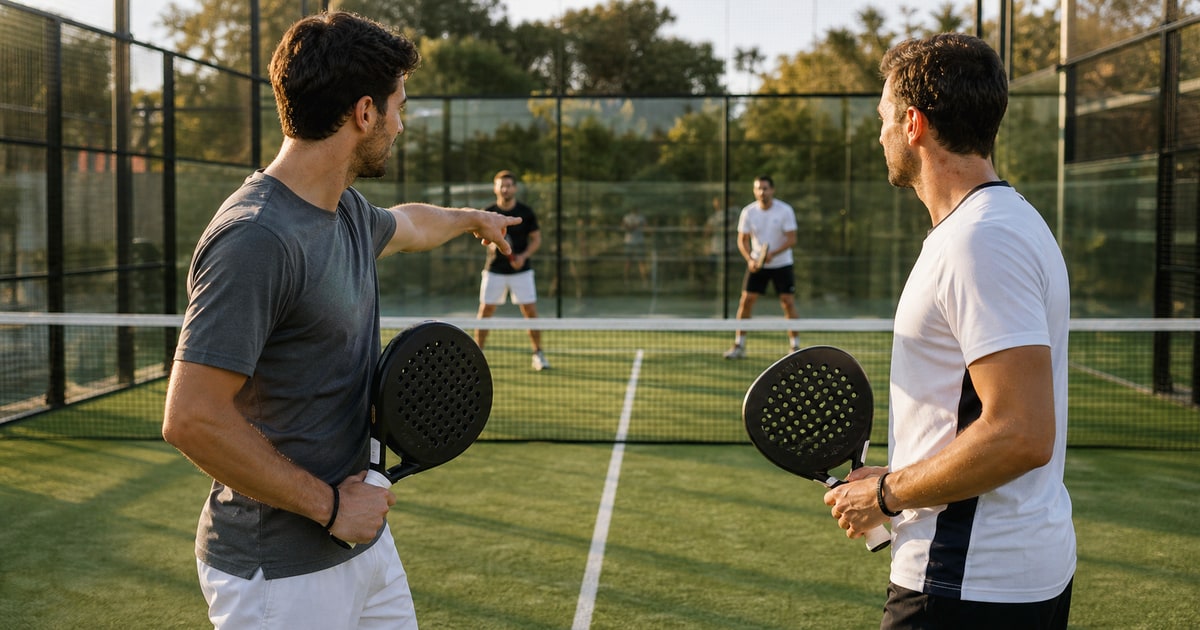 Padel culture
Padel Partner Communication: Calls That Save Points
Padel is always doubles. Learn to sync with your partner through clear calls and simple hand signals — habits that save more points than one big shot.
 Padel culture
How to Build a Padel Crew That Actually Sticks Together
A single match is a nice introduction. A standing four is a habit. Here's how to build a padel crew in Tashkent that lasts months, not one Saturday.
 Padel culture
Court Booking Etiquette: Cancellations, No-Shows and Splitting the Bill
Booking the slot is the easy part. Here's how to handle cancellations, no-shows, splitting payment for four, and playing as a guest at another club.