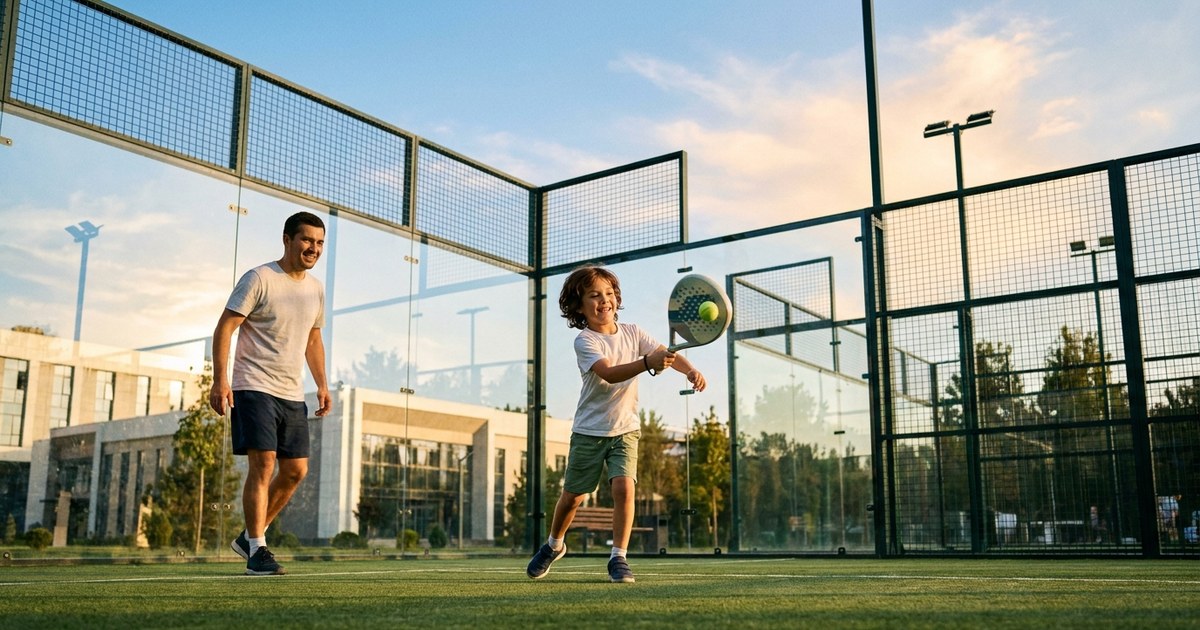
More and more Tashkent families are bringing their kids onto the court alongside them — not chasing a sports career, but because padel is easy to pick up, safer than many other racket sports, and turns into a genuine reason to spend a weekend together. If you're standing at that decision point and not sure where to start, here's a practical guide.
Why padel suits kids so well
The enclosed glass walls aren't just a tactical quirk of the adult game — they're a real practical advantage for a beginner of any age: the ball almost never rolls far away, so a child doesn't spend the whole lesson chasing it down and losing focus. The court is smaller than a tennis court, the racket is lighter, and the underarm serve forgives far more early mistakes than a full overhead toss.
There's a social side too. Padel is almost always played four-to-a-court, so from the very first lesson a child is learning to negotiate with a partner, let the easier-angled ball go to whoever's better placed for it, and share both the win and the miss with someone else. For many kids, it's their first real taste of a team sport where there's no corner of the court to hide in.
Finally, padel is movement without monotony. Unlike jogging laps or solo gym drills, every rally is different, which is exactly why kids tend to want to come back for more.
What age to start
There's no single hard cutoff, but in practice most Tashkent clubs take children from age 6–7 into mini-groups, and from 8–9 into standard junior groups with adapted equipment. Before that age, motor coordination and attention span are still developing, and general physical play does more good than locked-in stroke technique.
Instead of going purely by age, look for three signs of readiness:
- The child can hold focus on one task for 10–15 minutes at a stretch.
- They can run, stop and change direction confidently without falling.
- They're genuinely interested in hitting the ball — not just holding a new piece of sports gear.
If all three line up, age matters less than it seems. A good coach will see within the first session whether a child thrives in a group or is still more comfortable paired one-on-one with an adult.
The first lesson: what to actually expect
A first lesson rarely looks anything like a "real match" — and that's exactly as it should be. It typically runs through a few simple blocks:
- A warm-up built as a game, not a drill — relays, catching the ball by hand, short sprints with direction changes.
- Getting to know the racket: how to hold it, how to return a ball the coach feeds softly and accurately.
- First contact off the wall: nothing elaborate, just "receive the ball off the back glass and put it back in play."
- A mini-rally at the end — so the child leaves feeling like they already "played padel," not just did exercises.
Don't be surprised if progress feels slow in the first few weeks: eye-racket-ball coordination builds gradually in children, and the coach's priority is locking in the right movement habits rather than rushing results. To see what this looks like in practice, check the schedules on the coaches page — many have dedicated slots for kids' and family sessions.
Gear: what to buy, what to rent
For the very first lessons, you don't need to buy anything at all — nearly every club rents out rackets, which is a sensible way to find out whether padel actually clicks for your child before spending on equipment. Once they're on court regularly, though, it's worth matching gear to their age and height:
| Age | Racket length | Weight | Notes |
|---|
| 6–8 years | 36–38 cm | 300–320 g | As light as possible, often with a shortened grip |
| 9–11 years | 38–41 cm | 320–340 g | Transitional model, balance closer to the handle |
| 12–14 years | 41–45 cm | 340–355 g | Near-adult shape, but still lighter than standard |
| 15+ years | Standard (45 cm) | 350–375 g | Full adult racket, chosen by playing style |
A racket that's too heavy or too long for a child's build is a common reason kids tire out fast: it's hard to hold through the serve motion and slow to react with at the net. If you're unsure about sizing, ask the coach at the first fitting rather than trusting the age label on the box alone.
Shoes matter just as much as the racket: soles need to be built for padel or clay-style artificial turf, not general running shoes — running soles slide on sharp stops and turns and raise the risk of a rolled ankle. The good news is kids' padel shoes are almost always cheaper than the adult versions and easy to compare across the shops section.
Group lessons or private coaching
For most kids, group format works better than one-on-one — and not just because it's cheaper. In a group, a child sees peers succeed and struggle alongside them, handles their own mistakes more easily, and gets a competitive spark without the pressure of being alone with the coach. Private lessons make sense in two cases: when a child is just starting and feels shy in a group, or the opposite — when they've outgrown their age group and the group stops being a real challenge.
A solid strategy for many families is combining formats: one group lesson a week for match play and partners, plus a private session every two to three weeks to fix a specific technical habit that's crept in.
Choosing a club and coach for your child
Not every court is equally set up for kids' lessons, and not every coach who's great with adults will know how to reach a shy seven-year-old beginner. A few things worth checking:
- Does the club run a dedicated kids' or family group — rather than just slotting your child into an adult beginners' class.
- Does the coach work with children regularly — that's its own skill: holding a group's attention, pacing the load, explaining things in simple terms. You can browse coaching specialties on the coaches page.
- Scheduling — kids' sessions are usually run on weekend daytime slots or right after school; make sure the slot doesn't clash with a time your child is already worn out.
- Court surface and lighting, if lessons run in the evening or indoors — our piece on indoor vs. outdoor courts breaks down the differences.
- The overall vibe at the club — a club with an already-active community makes it much easier for a child to find peers to play with outside lessons too. Our piece on Tashkent's padel scene covers how the local community is organized.
If you're planning regular lessons, browse the venues page to compare courts by surface type, location and whether they run kids' programs before you commit.
What it costs and how it fits the weekly schedule
Kids' padel is usually cheaper than the adult version: clubs often set a lower rate for a spot in the junior group, and rental gear in kids' sizes typically doesn't add anything on top of the membership. Real costs break down into three parts: the group-lesson pass, occasional private sessions if you add them, and — sooner or later — a racket and shoes of their own. The steepest cost feels front-loaded at the start, but once a child sticks with it past the first month, further spending becomes predictable and fits an ordinary after-school-activity budget.
Scheduling is simpler than it looks: one lesson a week is already enough load to see real progress, and it slots easily between school and other activities without burning a child out. If they get hooked and want more, it's smarter to first add free play with peers or parents on weekends rather than doubling formal lessons right away — interest grows organically that way instead of turning into one more mandatory item on an already packed school schedule.
Seasonality is worth planning around too: in Tashkent summer, daytime slots on outdoor courts get uncomfortable fast, and clubs tend to shift kids' groups to early morning or evening. If you're planning lessons through the hot months, confirm timing in advance — a steady schedule matters more for a child's motivation than the raw number of sessions per week.
Safety and common risks
Padel is considered one of the safer racket sports precisely because of the enclosed walls and compact court, but a few things still deserve a parent's attention:
- Racket collisions happen when two kids reach for the same ball at once — the basic rule "whoever's closer to the net takes it" is worth spelling out from the very first lesson.
- Sliding near the walls — especially on outdoor courts after watering or in the heat, when the surface warms up and grip changes; proper shoes cut this risk the most.
- Wrist strain from a racket that's too heavy — if a child complains of arm fatigue after every session, that's almost always a sign to reconsider the gear's weight, not to push through it.
- Heat and dehydration in summer — kids overheat faster than adults; on outdoor courts in summer, water breaks and shade are non-negotiable, especially during the day.
None of this is a reason to skip padel — these are standard precautions that apply to any active outdoor sport. A good coach lays out these rules in the first few weeks rather than letting a child learn them the hard way after a collision or a fall.
Glasses deserve a separate note: if a child wears them full-time, a sports frame with a strap — or switching to contacts for the session — is worth considering. Regular glasses tend to slip or take a painful hit from a racket during a sharp turn or a low ball near the face.
Keeping it fun, not another obligation
Kids rarely quit padel because of the game itself — more often it's the pressure built up around it. A few things that help hold interest long-term:
- Praise specific moments ("you held your ground at the net that time, even though the ball came straight at you") rather than only the result of the point.
- Don't turn every match into an instant post-mortem — let emotions settle and leave the technical debrief to the coach at the next lesson.
- Let them just "hit against the wall" without structure sometimes — unstructured play holds interest just as well as a drilled session.
- If the club runs kids' tournaments or friendly meet-ups, they give a real goal worth training for. Check the events section to see if a junior or family format is coming up.
Playing together as a family
One of the most rewarding scenarios in padel is a mixed family pair: an adult and a child against another pair just like them. The gap in hitting power gets absorbed by the enclosed walls giving everyone extra time to react even to a missed shot, and the four-on-court format never leaves a child stranded alone against a stronger opponent the way tennis often does. If a family has two kids of different ages, padel is one of the rare sports where the older and younger one can actually play against each other, rather than one having to go easy.
Many Tashkent clubs run dedicated family slots on weekends — worth asking about when booking a court if that's the format you're after.
Frequently Asked Questions
At what age can a child start playing padel?
Most Tashkent clubs take children from 6–7 into mini-groups, and from 8–9 into standard junior groups. Age matters less than whether the child can hold focus for 10–15 minutes and move confidently on court.
Do I need to buy a racket right away?
No. For the first lessons, it makes sense to rent a racket at the club — that way you'll know whether padel clicks for your child before investing in gear of your own.
How long before a child plays reasonably well?
Most children build solid basics — returning a ball off the wall, a simple serve, court awareness — within 2–3 months of regular lessons (once or twice a week). More advanced shots come later, gradually.
Are group or private lessons better for a child?
Group format works better for most kids — it provides competitive motivation and takes the pressure off. Private lessons are worth it for fixing a specific error or easing in a shy beginner.
How safe is padel for children?
The enclosed walls and compact court make padel one of the safer racket sports. The main risks — racket collisions near the net and slipping in the wrong shoes — are managed with basic rules and the right gear.
Can a parent and child play on the same team?
Yes, and it's one of padel's most rewarding formats: the enclosed walls give everyone extra time to react even to a weaker shot, and playing four-to-a-court means a child is never left alone against a stronger opponent.


 Padel culture
 Padel culture