Padel is designed as doubles: four players on a 20-by-10-metre court, always pair against pair. That means many points you lose aren't decided by a shot — they're decided by what does or doesn't happen between you and your partner a split second before the rally. Two players lunge for the same ball and the point is gone. Both freeze, waiting for the other to move, and it's gone too. The good news: partner communication isn't a talent you're born with. It's a small set of habits you can build in a couple of sessions.
Why talking to your partner matters more than any shot
In singles, every decision is yours alone — you see the ball, you decide, you hit it. Padel adds another player with their own movement and decisions, and if you're not synced, no shot fixes that. In our experience, amateur pairs often lose points to a half-second of confusion: who takes the ball down the middle, who plays the lob, who stays by the back glass.
One difference between a 2.5 pair and a 3.5–4.0 pair can be less about technique and more about how cleanly they read each other. Good communication turns two separate players into one team that moves across the court as a single unit — the same idea we covered in our guide to the transition zone: you advance and retreat together, never alone.
"Mine!" / "Yours!" — the call that saves more points than any shot
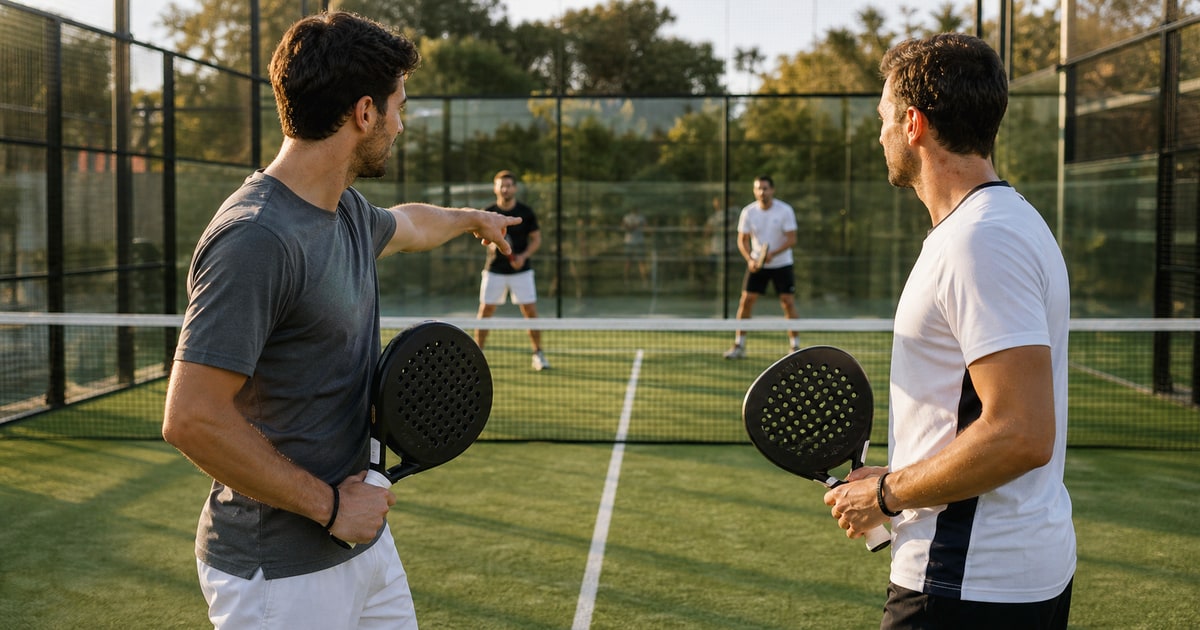
The simplest, most underrated tool in padel is your voice. When a ball drifts into a zone either of you could reasonably take — usually the middle of the court, or the space between you — whoever decides first should call it loud and short: "Mine!" — and play it. The other partner clears out immediately.
Three things make this actually work:
- Whoever has the better position calls it — not whoever's "in charge" of the pair, but whoever has the cleaner shot at that specific ball.
- The call comes early. Say "Mine!" while the ball is still in the air, not once both rackets are already reaching for it. Hesitate half a second and you're both there at once.
- The other partner follows the meaning of the call. Hear "Mine!" and clear the space immediately; hear "Yours!" and take responsibility for the ball. An argument mid-rally costs more than one missed ball ever will.
If your pair goes quiet on balls down the middle, that's exactly where opponents will start targeting you. Treat the short voice call as part of your positioning, just like the step you make toward the ball.
Set the plan before the serve: a ten-second briefing
The best decisions in a pair get made before the rally, not during it — while the ball is still in your pocket. Before every game, ideally before every serve, agree on a plan:
- Where the serve is aimed. The serving side is fixed by the score, but within the diagonal service box you can target nearer the glass, the body or the centre line. Name the target so your partner can anticipate the likely reply.
- Which reply you expect. If one of an opponent's shots is less reliable, the net player can be ready to move with the return without opening a gap too early.
- How you move after the serve. The server advances toward the net; agree whether the net partner holds position or crosses the middle for a planned interception, and who covers the space that opens.
This takes only a few seconds and prevents avoidable confusion that often looks like bad luck. It matters most with a new partner — say, someone you paired up with at the last minute for a tournament; check the calendar of upcoming events at events and leagues.
Non-verbal signals at the net
Here's the catch: if you say your plan out loud, the other pair hears it too. Before the serve, the net player can show the server a signal behind their back. These gestures have no universal meaning; they only work when a pair agrees on the code in advance. For example, you might use:
Keep the system simple:
- Open palm behind your back — "I'm poaching, cover my space."
- Closed fist — "Staying put, playing it straight."
- A finger pointing left or right — "Aim the serve toward this area."
You don't need a complex code — two or three consistent signals you've agreed on beat a clever system nobody remembers under pressure. The goal isn't secrecy for its own sake; it's making sure both of you see the same picture a second before the shot, not after it.
Who covers the lob, who poaches — splitting roles without talking
One of the most common sources of confusion is a lob over one partner's head. There is no universal rule that the player underneath must always take it: a lob toward the outside shoulder is often safest for the nearest player, while a ball through the middle or over an awkward shoulder may be easier for the partner with the cleaner overhead. Choose your default in advance, then confirm it early with "Mine!" or "Switch!"; the other player clears the space and rotates to cover.
The same applies to poaching: the net player crosses the centre line on your own side into the zone their partner would normally cover to intercept a weak reply. Without an agreed rule for who poaches and when, that move leaves the other player scrambling to cover the open space. The tactic only works if you both give the signal the same meaning and know the next movement.
| Situation | Who decides | How to agree |
|---|
| Ball down the middle | Whoever has the cleaner shot | Voice: "Mine!" before contact |
| Lob over one partner | Whoever has the safer overhead under your agreed default | Early "Mine!" or "Switch!"; the other player rotates |
| Poaching across the middle | The net player who spots a weak reply | Non-verbal signal before the point |
| Serve target and post-serve movement | Both, ahead of time | A short pre-serve briefing |
How to talk to your partner after a mistake
Communication isn't only about tactics — it's also about how a pair handles its own errors. That moment often decides whether a partnership breaks apart after one bad tournament or holds together for years. A few simple rules:
- No technical correction or blame right after an unforced error. Your partner already knows they missed; brief support is welcome, but analysis in that second reads as criticism.
- "Next ball" beats any on-court analysis. It pulls attention back into the game instead of the lost point.
- Save the real conversation for the changeover, not between points. If something genuinely needs discussing — position, a signal, a plan — do it briefly at the side change.
- Talk in "we", not "you". "We didn't get to the net in time" reads as a shared problem. "You didn't get to the net" reads as blame — and next time your partner is thinking about that comment instead of the game.
Pairs who can shrug off mistakes calmly tend to build lasting partnerships and a wider circle around them faster — if you're still playing with a different person every week, our guide to finding padel partners in Tashkent is worth a read.
Quiet pairs vs. talkative pairs: what actually works
On Tashkent's amateur courts you'll see both types: pairs who barely speak and play on pure instinct, and pairs who narrate every single ball. Neither approach is "correct" on its own — what matters isn't how much you say, it's how accurate it is.
A pair that's quiet but has built years of shared court sense often moves more in sync than any "talkative" pair — but that level of sync only comes from a lot of shared time on court. If you're playing with someone for the first time, or irregularly, betting on silent understanding almost always loses: you simply don't have the shared history to lean on yet. In that case, explicit, short signals — spoken or gestured — aren't a sign of a weaker pair. They're the fastest way to fake, temporarily, the sync that experienced pairs spent months building.
There's an opposite failure mode too: a pair that narrates every single move loses focus on the actual ball. If you notice you're commenting on the rally more than you're watching your opponent's racket, that's a cue to talk less, not more. A good rule of thumb: comments should cover the genuinely unclear moments — who takes the middle, who covers the lob — and nothing else. The rest should be handled by court position and the plan you already agreed, no words required.
The first ten minutes with a new partner
When you step onto court with someone you've never played with — at a tournament, an open session, or someone you met through the club community — use the first ten minutes for both a proper warm-up and a short conversation instead of hitting in silence:
- Ask about strengths and weaknesses. "Do you prefer the net or the back?", "How's your smash?" — a few questions here remove plenty of first-set misunderstandings.
- Agree on two words, minimum. One for "the ball's mine," one for "we're falling back."
- Warm up together, not in parallel. Hit a few balls diagonally to each other across the net, not each of you into your own wall.
- Don't be afraid to ask mid-match. "Are you staying back or are we both moving in?" — a quick question between games beats a silent guess that turns out wrong.
If you're still building a regular circle of partners, the club community and tournaments are the fastest way to do it — start with our coaches directory, where a shared session can break the ice before you head into a bracket together. If you need balls, overgrips or other basics for that first session, browse the local shops too.
If your partner isn't picking up on signals
Sometimes the issue isn't a missing system — it's that one partner isn't using it, either out of habit from playing solo or because talking or listening under pressure doesn't come naturally to them. A few practical steps:
- Check the volume and the timing first. Often "ignoring" is really "didn't hear" — the call came too quiet, or too late, after the decision was already made with the feet.
- Simplify the system. Too many signals and your partner can't process them under pressure. Keep two or three that matter most.
- Give feedback after the match, not during it. "Let's call balls down the middle out loud next time" reads as a suggestion. The same line shouted mid-rally reads as criticism.
- Accept that not every partner will be the right fit. Communication style is part of pair compatibility, just like skill level. If the system genuinely isn't clicking after a few tries, that's a reasonable reason to look for a partner whose style matches yours better.
Regular club meetups and open sessions are a good place to find that fit — the current list of Tashkent courts and clubs is in our venues section.
Communication is a trainable skill. Like a shot, it improves with repeated reps. Start with one simple rule — a clear "Mine!" on balls down the middle — and layer on the rest gradually rather than all at once. After a few sessions and tournaments together, you'll notice you've stopped thinking in words and gestures altogether: the pair just starts moving as one. For more on doubles tactics and court craft, browse the PlayPadel blog.
Give communication its own short practice block instead of hoping it appears during a match:
- Middle-ball drill. Have a feeder send comfortable balls between you. Call "Mine!" before the bounce or before the ball reaches volley height; the other player clears the swing path and keeps a balanced covering position.
- Lob-and-switch drill. Start together at the net and ask the feeder to alternate lobs toward the outside shoulder and the middle. Call "Mine!" or "Switch!" early, rotate without crossing into each other and recover as a pair after the shot.
- Serve-signal rehearsal. Before each practice serve, the net player shows one agreed gesture and the server quietly repeats its meaning. Begin without opponents so you can check the code before adding a live return.
- Pressure round. Play a short game in which the goal is not the score but making every unclear call early and using only constructive language after errors.
Finish with a two-minute debrief: each partner names one call that was clear and one situation that still felt late or ambiguous. Change just one rule for the next session so the system stays easy to remember under pressure.
Frequently Asked Questions
Who should take balls down the middle of the court?
Whoever has the cleaner shot at that specific ball — and the decision should be called out loud ("Mine!") before the ball arrives, not once both rackets are already reaching for it. The other partner clears out and doesn't argue mid-point.
Should we agree on signals before every match?
Yes, especially with a new partner. Briefly cover how you divide middle balls and lobs, what your calls and gestures mean, and how you'll move after the serve. That's more useful than assuming you both read the plan the same way.
What if my partner isn't responding to voice calls?
First check whether it's a volume or timing problem. If it isn't, simplify the system to two or three key words and raise it after the match, not during it.
Why use hand signals before the serve?
Because the opposing pair can hear your plan too. An agreed signal from the net player passes the decision to the server without giving it away; an open palm, fist or pointed finger has no universal meaning.
Do quiet pairs play worse than talkative ones?
Not necessarily — but their sync is built on a lot of shared court time. If you're playing with someone new or irregularly, short, explicit signals are more reliable than counting on shared instinct that isn't there yet.
How do I build fast communication with a stranger at a tournament?
Combine the conversation with your warm-up: cover strengths and weaknesses, agree on a couple of words for the middle and for falling back, and hit diagonally to each other rather than each of you into your own wall.


 Padel culture
 Padel culture