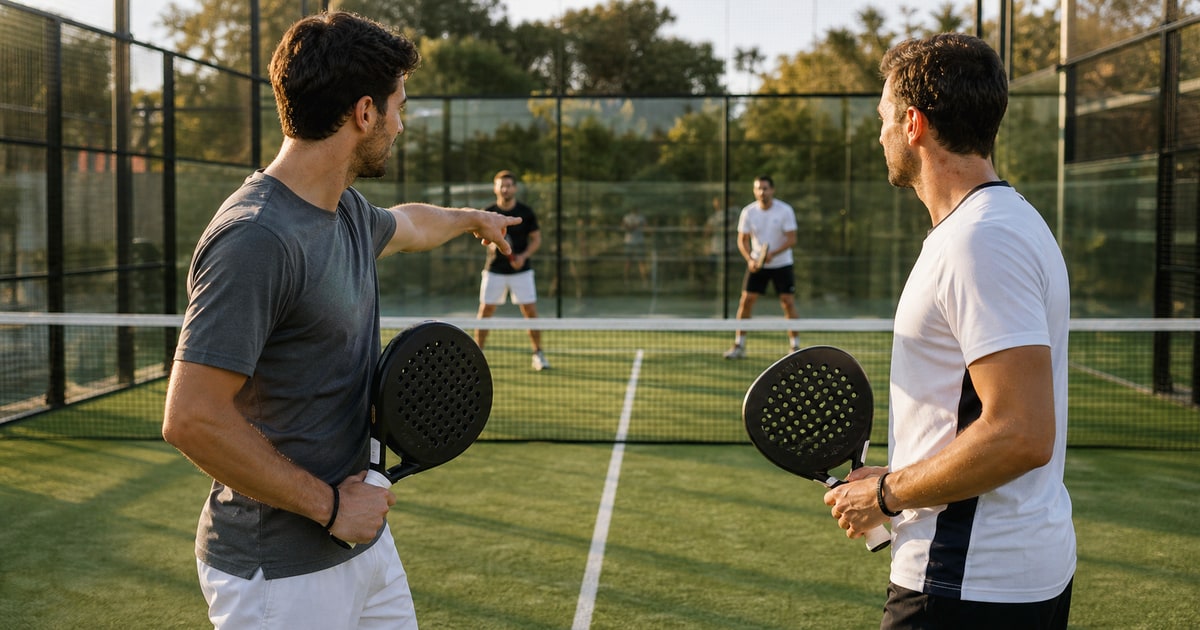
Mixed doubles is the most common lineup on Tashkent's amateur courts — far more often than in tennis, a man and a woman end up paired not by a tournament draw but simply because that's how the group came together. And too often that pair plays not as a team, but as two people politely trying to stay out of each other's way. Here's how a mixed pair that actually works is built: why roles should come from strengths, not gender, which mistakes kill mixed pairs most often, and how to find your own mixed partner.
Mixed doubles is a tactic, not a compromise
The first thing worth saying plainly: in padel, the physical gap between a men's and a women's serve or smash matters far less than it does in tennis. The court is enclosed by glass, the ball comes back into play off the wall, and rallies are decided more by position, timing and partnership than by raw power. That's exactly why a mixed pair at the amateur level isn't a "weaker" version of a same-gender pair — it's a different tactical model with its own real strengths.
The problem is almost never that the pair "isn't strong enough." The problem is that the pair is built around assumptions about gender instead of the actual skills of two specific players. On a 20×10 metre court with a net splitting it in half — we covered the basics in our piece on court positioning — every pair divides the court between two people, and it should be divided by what each of them can actually do, not by a default carried over from tennis.
Forget gender roles — count strengths instead
The most common (and most damaging) model for a mixed pair looks like this: the man takes every overhead and all the power shots, while his partner handles the "quiet" net game and rarely touches a smash. On paper it sounds logical. In practice it usually means one player is overloaded and the other is underused — the team is playing at less than half its real potential.
A model that actually works splits roles by three concrete factors instead of gender:
| Factor | What to look at | Who usually takes this role |
|---|
| Overhead shots (smash, bandeja, víbora) | Whoever's overhead is more confident and consistent right now | Whichever player has the stronger overhead — regardless of gender |
| Net reflexes | Who closes down passing shots and intercepts the middle ball faster | The player with quicker short-distance reactions |
| Baseline consistency | Who makes fewer errors in long rallies off the glass | The more patient player, not necessarily the more powerful one |
The point of this table isn't to lock roles in forever — it's to have an honest conversation about them together. A pair that has explicitly agreed "whoever's overhead is stronger takes the middle ball" plays with far more confidence than a pair where one player silently assumes the other "will just take it" because "the guy usually hits overheads."
Court positioning: side matters more than strength
Before talking about roles on specific balls, settle the basic question — who plays right, who plays left. The same rule applies to a mixed pair as to any other: pick sides by dominant hand and favourite shot, not by gender.
- A right-hander is usually more comfortable on the left side (their forehand faces the middle of the court, which helps them cut off crosscourt balls).
- A left-hander is typically better suited to the right side — that way both partners' forehands "face" the middle, and the pair loses fewer balls down the centre.
- If both partners are right-handed, which happens a lot in mixed pairs, pick sides by whose backhand is weaker: hide the weaker backhand in a corner, not in the middle where opponents will target it deliberately.
Don't keep swapping sides mid-tournament — a pair that's found a comfortable setup should play it consistently, so each player knows their zone without having to think. We covered choosing a side and the logic behind it in our piece on doubles court sides.
The middle ball: who takes it, decided before it happens
A ball flying straight down the middle between partners is the single biggest source of lost points for any pair, and mixed doubles is no exception. The difference is that mixed pairs often run on an unspoken assumption — "he'll get it" — or an apologetic "sorry, I thought you had it." Both scripts cost the same point.
The fix is simple and works for any pair, whoever's in it:
- The middle defaults to whoever's forehand is there. Whichever player's forehand ends up facing the centre in that moment plays the ball.
- On overheads through the middle, priority goes to whoever's smash or bandeja is more confident — that's the same factor from the table above, not an automatic "the man takes anything overhead."
- A call always confirms the rule. Even with roles agreed in advance, a short "Mine!" the instant you strike is non-negotiable — the rule sets the default, the call settles the specific point. For the fuller vocabulary of on-court calls, see how to gel with your partner.
Three mistakes that most often sink a mixed pair
Even when a pair understands the logic of splitting roles, the same failures show up in practice. Here are the three costliest — and how to fix them.
- "One-man show." One partner takes nearly every overhead and rarely hands over the initiative — often with good intentions, "so as not to let the team down." The result is the opposite: the other player checks out of the match and stops reading the game. Fix: agree on roles from the table above beforehand and stick to them, even when it feels easier to just take the ball yourself.
- Apologetic play. The less experienced partner starts playing timidly to avoid mistakes — and cautious, under-hit shots get read and attacked first. Fix: agree that each player hits full-commitment shots in their own zone; a half-hearted shot is almost always worse than a confident one, even a simpler one.
- Silent frustration after an error. A heavy sigh or an eye-roll after a lost point breaks a pair down faster than the error itself. Fix: a short reset word ("Next!") and move to the next rally — save the debrief for the warm-up after the match, not the middle of a set.
None of these three mistakes has anything to do with either player's physical ability — all three are fixed by a conversation before the match and a short word during it.
How to attack a mixed pair — and how not to get attacked
Opponents often pick a simple tactic against a mixed pair: target the partner who looks less confident on first impression. It's worth knowing this tactic from both sides of the net.
If you're playing against a mixed pair — don't build your whole game plan on a first impression of who's weaker. Spend the first two or three rallies actually reading both players: whose backhand sits lower, who's slower getting to net, who tenses up on a big point. Attack the facts, not the assumption.
If you're playing in a mixed pair — the best defence against that tactic is not giving opponents an obvious target. A pair where both players confidently cover their zone and their overhead doesn't hand the opponent an easy "hit it there" — because wherever they hit, they get answered with confidence.
There's also a mistake mixed pairs make against themselves: the player who feels stronger starts deliberately grabbing every tough ball "to cover" the partner. It looks caring, but it strips the opponent of real information about the pair's weaknesses and denies the partner the exact reps they need to improve. Each player fully committing in their own zone is the better strategy short-term (fewer errors right now) and long-term (the partner improves faster).
A physical gap isn't the same thing as a gender gap
It's worth separating two things that get conflated in mixed pairs: a gap in gender and a gap in fitness or experience. Sometimes partners genuinely differ in stamina or speed — but that's exactly the same situation as any other pair where one player trained harder for the season than the other, regardless of either partner's gender.
The fix isn't for the fitter partner to carry the match alone — it's smart load management:
- Shorter rallies, less running. A pair can deliberately play a more attacking style that shortens exchanges if one partner's legs go earlier in long rallies off the glass.
- Rotate serving more often in practice matches. If you're playing multiple sets outside a tournament format, there's no reason to rigidly hold serving order — give the more tired partner a couple of return games, where the physical load is lower.
- Warm up and stretch together, not just as a formality. A couple of minutes of dynamic warm-up together lowers the odds that the less-conditioned partner fades exactly on the deciding game.
None of this needs a special "mixed" method — it's ordinary load management within a pair, which just comes up more often in mixed pairs because of the wider spread in experience.
Warming up and preparing together
A mixed pair gets slightly more out of a short pre-match ritual than a same-gender pair does, simply because partners often bring different levels of playing experience, and a couple of minutes of syncing up closes that gap. Run through a short checklist during your warm-up:
- Who serves first, and which side each of you returns from.
- Who takes the middle ball by default, and who takes overheads through the middle (see the table above).
- How you respond to a lob over your partner's head — do you switch sides or not.
- What you do on a big point under pressure: play the lob and reset at net, rather than forcing a low-percentage shot.
That conversation takes two or three minutes and saves far more time than it costs: a pair that's settled the basics beforehand spends its attention on the rally itself, not on "wait, whose ball is that?"
Mixed play isn't only about a friendly weekend match. Many club tournaments in Tashkent run a dedicated mixed category, and the americano/mexicano format — where partners rotate every few points — is one of the easiest ways to try out different pairings and quickly figure out who you're most comfortable playing with. We covered the format and its rules in our piece on americano and mexicano.
If this is your first tournament in a mixed format, you don't need to aim for a serious level right away — start in the amateur category and treat it as pressure training rather than an exam. What to expect from a first tournament in general is covered in your first padel tournament, and the current tournament calendar, mixed categories included, is always up to date on our events page.
Finding your mixed partner
Chemistry matters just as much in a mixed pair as in any other — often more, since partners more often come in with different levels of playing experience, and syncing up takes time. A few practical steps:
- Look for a partner within about 0.5–1 point of your level on the international 1.0–7.0 scale — that way each player can answer the other's shot, and neither one drags on the game. For handling a skill gap within a pair, see our piece on when your partner is stronger or weaker.
- Try different pairings through your club's community and group chat — that's how most mixed pairs in Tashkent actually come together, rather than through deliberate matchmaking. We've collected practical tips in finding padel partners in Tashkent.
- Book a joint lesson. An outside eye quickly shows where a pair's real skill gap is, as opposed to the assumed one. You can find a coach who works with pairs on our coaches page.
- Play at the same courts. A familiar venue removes some uncertainty — you already know the glass bounce and the lighting, and your attention stays on your partner rather than a new court. Find venues on our venues page.
A mixed pair that splits roles by real skills, not by default, regularly beats same-gender pairs that are just running on autopilot. That's not a question of physical ability — it's a question of whether the two of you actually talked it through beforehand.
Frequently Asked Questions
Is a mixed pair weaker than an all-men or all-women pair?
No — a pair's strength comes from how clearly roles are split and how well the two players function as a team, not from the gender makeup. The court is enclosed by glass, and position and timing decide rallies more often than raw shot power.
Who should take all the overheads in a mixed pair?
Whichever player's overhead — smash, bandeja, víbora — is more confident and consistent right now, regardless of gender. Agree on this role in advance and stick to it, rather than deciding mid-rally.
How do you pick sides in a mixed pair?
By dominant hand and favourite shot, not by gender: a right-hander is usually more comfortable on the left, a left-hander on the right, so both forehands face the middle. If both players are right-handed, hide the weaker backhand in a corner rather than leaving it in the middle of the court.
What if one partner plays noticeably more confidently than the other?
Split roles by real strengths instead of trying to artificially even out the workload, and don't hit at half power "so as not to let the team down" — half-hearted shots get read and attacked first. A gap in experience closes through practice matches and lessons together, not silent accommodation.
Where can I find a mixed partner in Tashkent?
Through your club's community, group chats, and formats like americano/mexicano where partners rotate regularly — a fast way to find out who you play best with. A skill gap within about 0.5–1 point on the 1.0–7.0 scale usually gives the most even matches.
Do you need a special tactic for mixed doubles?
There's no separate "men's" or "women's" tactic — only tactics built on the concrete strengths of two specific players. The one real difference in mixed pairs is often a wider spread in experience, which a more thorough warm-up and a pre-match conversation take care of.