When you're new to padel, every gear conversation is about the racket and, if you're lucky, the shoes. Nobody asks about the ball — it's just sitting in the basket by the court, identical yellow spheres, grab one and play. Then one day someone opens a fresh can, and the ball suddenly behaves completely differently: sharper, higher, livelier. That's when it clicks — you've been playing with dead balls this whole time and never noticed.
This is an honest look at a topic we underrated for a while ourselves. None of it is complicated, but a couple of things are worth knowing from day one — they'll save you some confusion and explain why your game sometimes "just isn't there," through no fault of your own.
The ball nobody thinks about
People spend weeks picking a racket — shape, balance, stiffness — and choose shoes by sole and fit (we covered that in our guide to choosing padel shoes). The ball, by contrast, is almost always whatever's on hand: whatever the club has out that day.
The difference is that a racket and shoes are your equipment, while the ball is a consumable that changes every session — and its condition affects everything: pace of play, how it bounces off the glass, the feel on contact. The exact same bandeja, hit with the exact same technique, looks like two different shots depending on how "fresh" the ball is. If you recently worked through choosing your first racket, think of this as the third, usually skipped, part of the same kit.
What a padel ball is actually made of
From the outside, a padel ball looks nearly identical to a tennis ball: the same fluorescent yellow felt, a similar size, a rubber core filled with air. But there's a real difference worth knowing:
- Slightly lower internal pressure. Padel balls are tuned for a smaller, enclosed 20×10 m court with glass and mesh fencing in play — a ball as lively as a tennis ball would be uncontrollable in that space.
- Felt built to survive a harder surface. Most Tashkent courts use artificial turf with a sand infill, and that surface wears down felt noticeably faster than a clay tennis court would.
- Predictable bounce off the glass. This isn't a separate spec so much as a consequence of the pressure tuning — manufacturers balance it so back-wall play stays controllable rather than chaotic.
The practical takeaway: a tennis ball and a padel ball are not interchangeable, even if the difference feels subtle in your hand. If someone hands you a stray tennis ball mid-session, you can finish the point, but don't be surprised if your bandeja and víbora behave a little off.
The can, the pressure, and why a fresh ball feels "alive"
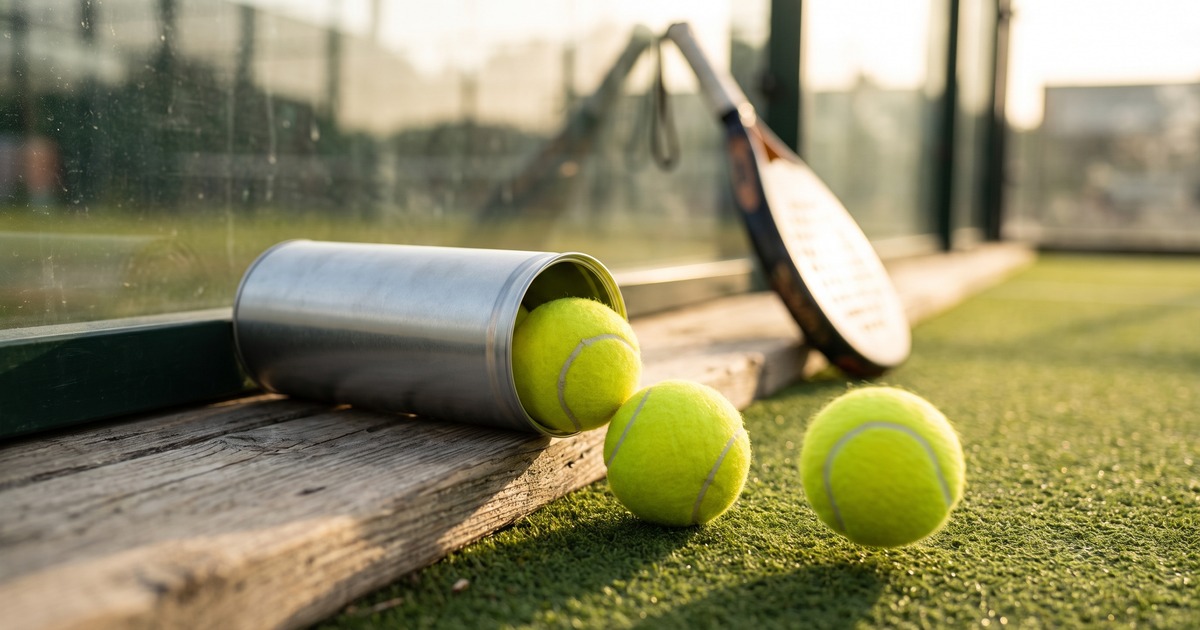
Here's the one technical fact worth remembering: padel balls, like tennis balls, ship in pressurized, sealed cans. The air inside the can is at higher pressure than the atmosphere, and that's what keeps the ball "charged" until you open it. The moment the can is opened, the clock starts — air slowly escapes through the rubber's pores, and the ball gradually loses its bounce.
This doesn't happen in one session, but it doesn't take months either. A ball straight out of a freshly opened can is noticeably livelier than one that's been sitting open for a couple of weeks, even if they look identical. That's the "the game suddenly feels alive" effect you notice whenever a club finally swaps the balls in the basket.
What speeds up the pressure loss
- Heat and direct sun — a can or an open ball left in a car trunk in summer loses bounce far faster than one stored properly.
- Play on a harder or more abrasive surface — friction against a sand-infilled artificial court both wears the felt and works micro-damage into the rubber, letting air escape.
- Simple time — even a ball that never gets played goes slowly flat.
There's a myth about altitude — but it doesn't apply in Tashkent
Tennis has a whole separate category of "high-altitude" balls: at elevation, thinner air lets the ball fly farther and faster, so those balls ship at a lower starting pressure to compensate. It's a fair question to ask whether Tashkent needs the same treatment.
The honest answer is no. Tashkent sits at roughly 450–470 meters above sea level. That's noticeably higher than a coastal city, but nowhere near the elevation where thinner air actually changes ball flight in any meaningful way — that threshold kicks in much higher up. If a ball feels "off" in Tashkent, it's almost always down to two far more mundane things: how fresh the can is, and the dry air discussed below — not the altitude. Don't fall for "high-altitude ball" marketing here; you don't need it.
Dry air and heat: what actually affects your game in Tashkent
Tashkent's climate does affect balls — just not the way people assume. Summer heat and low humidity do two real things:
- Felt dries out faster. In dry air, a ball's felt loses moisture and gets stiffer — the bounce starts to feel more "glassy" and sharp.
- Rubber softens in the heat. On a court baking under direct sun, a ball flies a touch faster right after warm-up, then noticeably "sits down" as temperatures drop in the evening.
- Sand infill dust settles into the felt. Fine sand from artificial turf works its way into the fibers and gradually smooths the ball's surface — which is exactly when you start losing control on cut shots at the net.
If you play a morning session and an evening session with the same ball on a hot day, don't be surprised if "the evening ball feels totally different" — it's probably the same ball, just different conditions. We've written separately about how the heat changes your game overall, and it's worth keeping in mind alongside the ball itself.
Club balls or your own — when it actually matters
Most Tashkent clubs keep a shared box of balls by the court and hand them out per session rather than issuing each player their own. For casual, once-a-week play with friends, that's completely normal, and you don't need to think about cans at all.
Owning your own balls is worth it in three cases:
- You train regularly — private or group lessons burn through balls faster, and it's easier on the coach or club if you bring some yourself.
- You're prepping for a tournament — familiar, predictable balls remove one variable from an important match. We've covered the broader mental side of tournament prep elsewhere on the blog.
- You care about consistent pace — if you're grooving one specific shot and want to judge your progress objectively, a box of mismatched club balls adds noise that has nothing to do with your technique.
Outside of those, buying your own supply isn't worth the expense — it's a consumable, and the shared club box does the job fine.
The simple bounce test: is this ball still alive?
You don't need any equipment to figure out whether a ball is still worth playing with, or ready to retire to wall-practice duty. Here's a simple sequence:
- Stand on flat, hard ground — not on sand-infilled turf, which will skew the result.
- Hold the ball at shoulder height and let it drop, no throw, just a clean release.
- Judge roughly how high it bounces back — you're comparing it by eye against a ball you know is fresh, not timing it with a stopwatch.
- If the bounce is noticeably lower than the fresh ball's, it's flat, and not worth using for serious play.
- Feel the felt — smooth, matted fibers are another tell that the ball is done, even if the bounce still seems okay.
The test isn't meant to give you an exact number — you just need a relative "this one versus that one" comparison, not lab precision.
How a dead ball quietly changes your technique
One of the sneakiest effects of an old ball is that it lies to you about your own progress. A flat ball flies slower, bounces lower, and forgives more timing errors. A shot that demanded a precise contact point on a fresh ball suddenly works for almost anyone once the ball's gone soft — and it creates a false sense that your technique has finally "clicked."
This shows up most clearly on shots where height and bounce speed matter: a smash or overhead becomes noticeably easier on a flat ball, simply because it comes off the opponent's racket lower and slower. The same goes for back-wall play — a fresh ball demands a quicker reaction and a steeper trajectory. If you've been working on your smash or your back-wall game and it suddenly "felt easier today," check whether the balls got swapped before you credit your own technique.
The upside: once you notice this, you can stop blaming yourself for an "off day" that was really just a ball problem.
How long a ball lasts, and when to swap it
Nobody can honestly give you a precise number of games or hours — there are too many variables: surface, temperature, how hard you're hitting, how long the can sat open before you started. But there are some reliable signs to go by:
| Sign | What it means |
|---|
| Bounce is noticeably lower than a fresh ball | The ball has lost pressure — time to swap it |
| Felt looks smooth and matted, fibers lying flat | Mechanical wear, losing grip on cut shots |
| The ball sounds "dull" on contact instead of crisp | Rubber has lost its bounce |
| Visible wear or cracking on the rubber under the felt | End of life — not safe to keep playing |
For a club where dozens of people rotate through the same balls in a day, the sensible practice is to refresh the box more often than it feels like it needs, especially during hot months when pressure loss speeds up. For your own supply, run the bounce test every few sessions rather than going by the calendar.
Where to buy balls in Tashkent, and how to store them
Padel balls are sold at dedicated sports gear shops — the same places that stock rackets and shoes — usually in small cans. When buying, check that the can is properly sealed (a light hiss or pop when you open it is a good sign the pressure held).
Storage follows the same logic as any pressurized gear:
- Keep sealed cans somewhere cool and dry, away from direct sun, and definitely not in a car trunk over summer.
- If you own a pressurized ball tube, use it for an opened can or spare balls you're not playing with constantly — it meaningfully extends their life.
- Don't leave balls out on the court between sessions — swings in temperature and humidity speed up both pressure loss and felt wear.
If you're just getting into padel and want to understand your gear and technique properly instead of piecing it together, the best next step is a lesson with a coach — they'll show you exactly what to look for in a ball, racket and shoes for your level. You can browse profiles and book in our coaches section. And if you're still early in the game and curious about the mistakes most beginners make in their first month, we've written an honest breakdown of that too.
Frequently Asked Questions
Can you play padel with a tennis ball?
Technically yes, but it's not ideal: a tennis ball's pressure and bounce are tuned for a different court and a different back-wall game, so your bandeja, víbora and glass play will all feel a little unpredictable.
Is it true you need special balls in Tashkent because of the altitude?
No. Tashkent sits at roughly 450–470 meters above sea level, which is nowhere near the elevation where thinner air meaningfully changes ball flight. Any difference you feel almost always comes down to how fresh the can is and the heat, not altitude.
How many balls come in a padel can?
Padel balls are typically sold in small cans, similar to tennis ball packaging — the exact count varies by brand, so check with the shop when you buy.
How do I know it's time to change balls without any equipment?
Compare the bounce against a ball you know is fresh on a flat, hard surface, and check the felt by feel — smooth, matted fibers and a noticeably lower bounce both mean the ball is done.
Should a beginner buy their own balls?
Not necessarily, if you're only playing casually every week or two — the club's shared box is enough. Owning your own makes sense once you're training regularly or prepping for a tournament and want consistent conditions.
Why does a ball sometimes feel different partway through the same session?
Usually temperature: the rubber softens in the heat, so the ball flies faster early in a hot session, then feels noticeably "heavier" and slower once the air cools in the evening.