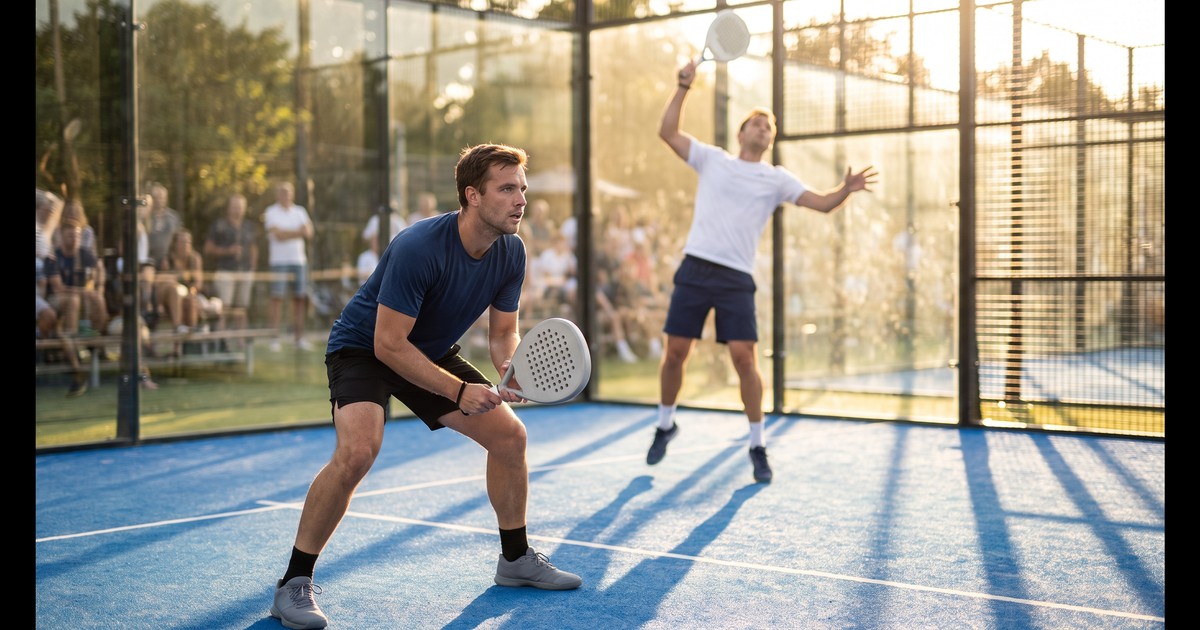
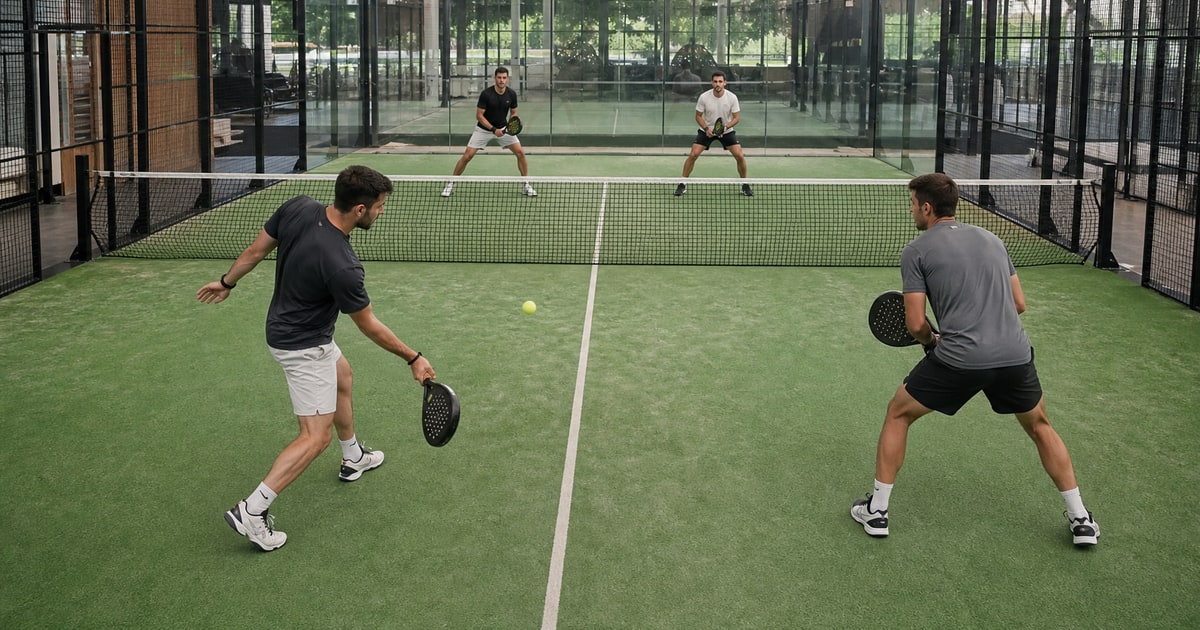
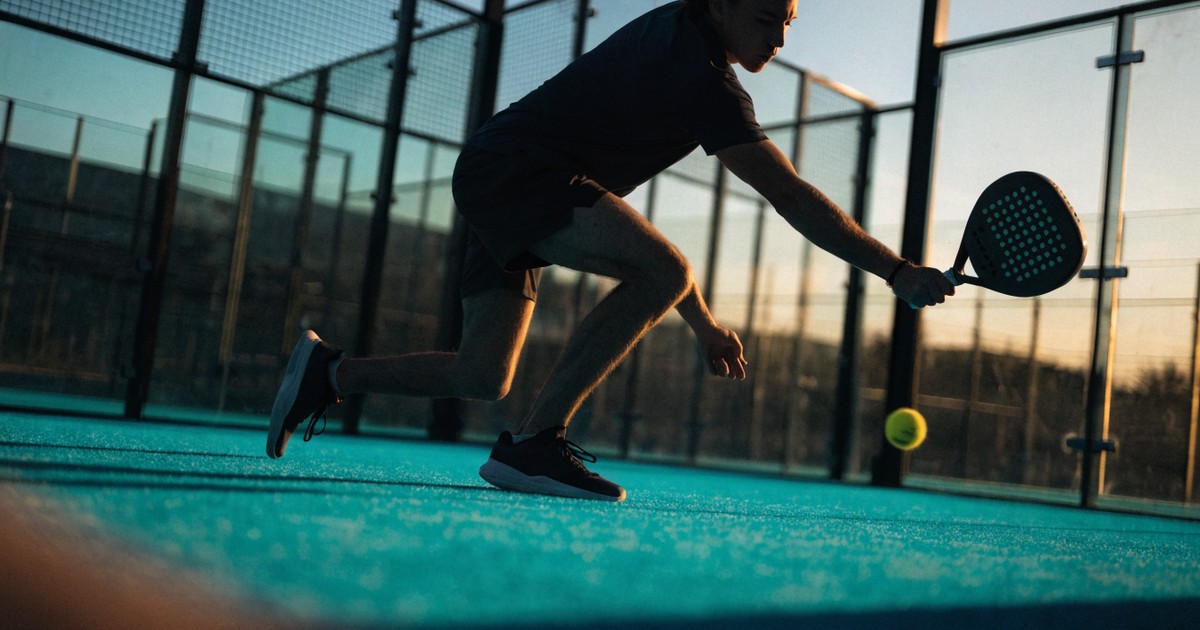
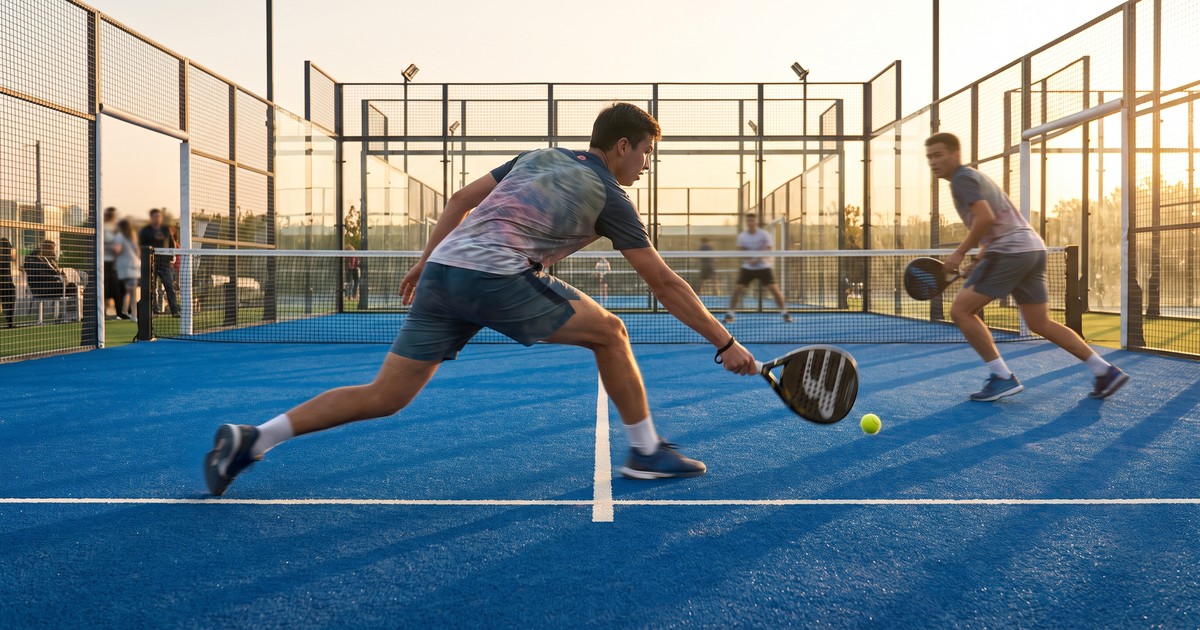
Good padel starts with your eyes, not your racket. While beginners track the ball, more experienced players are already reading their opponent's stance, racket angle, and weight transfer — and arriving in position a split second before the shot even lands. That's not talent, it's a skill called anticipation, and it trains the same way a bandeja or a víbora does. Here's what to watch for, what each cue actually tells you, and how to build reading the game into your own training.
Why anticipation beats raw reaction speed
On a court that's only 20×10 m, walled in glass on every side, there simply isn't time for pure reaction. Less than a second often separates your opponent's contact from your own next shot — nowhere near enough to react "after the fact," especially at the net. That's exactly why players who look fast are usually reading fast, not running fast.
Anticipation means starting your movement before the ball arrives, based on cues your opponent's body gives away whether they mean to or not. The good news: those cues are largely the same across skill levels — stance, grip, racket position and weight transfer all announce the shot before the ball ever leaves the strings.
None of this makes fitness irrelevant — it still determines whether you can act on what you've read. But all else equal, a pair reading the game half a step early consistently beats a pair with quicker feet and an empty stare.
What to read before contact: stance and grip
The first and most reliable source of information is how your opponent sets up before the swing even starts. Watch three things, in order:
Distance to the ball. If your opponent has to stretch, their options shrink fast — expect something low, defensive, and not very powerful. If the ball arrives comfortably, expect an attacking option instead.
How open the body is. A closed stance (the shoulder pointed toward the target) usually precedes a precise, down-the-line shot. An open stance (torso facing you) more often signals a cross-court ball or a bigger swing.
A grip change. Even at club level you can spot a player shifting to a continental grip for an overhead, or to a tighter grip for a volley. That last-instant grip change predicts shot type more reliably than the ball's flight ever will.
None of this requires special vision — it's a trainable habit. Start with one thing: in your next session, spend a full game watching only your opponent's stance and ignoring everything else.
The racket gives away the shot before the ball does
If stance sets the context, racket position in the final split second before contact is the sharpest signal of all. Three details do most of the work:
Face angle. An open face (tilted up) almost always means a drop shot, lob, or defensive ball. A closed face (tilted down, "covering" the ball) signals a flat, attacking shot or a short ball at the net.
Backswing height. A low backswing sets up something hit low to high — a lob, a bajada, or a defensive slice. A shoulder-height or higher backswing loads an overhead: bandeja, víbora, or smash.
Speed of preparation. A sharp, quick takeback usually means attacking intent. A slow, soft preparation more often ends in a controlled, low ball — the signature of a chiquita or a net-side slice.
Here's a quick reference table worth keeping in your head — even printing it out and reviewing it before a match — until reading these cues becomes automatic.
What you see
Likely signal
What usually follows
Open racket face, low backswing
Defensive ball
Lob or drop over the net
Closed racket face, shoulder-height backswing
Overhead attack
Bandeja, víbora, or smash
Sharp, short takeback at the net
Attacking drop shot
Volley punched down, at your feet
Slow, soft takeback at the net
Control, not attack
A short chiquita
Strong closed stance, eyes down the line
Directional shot
A ball into your far corner, down your sideline
One important caveat: under pressure, on big points, or late in a long match, these cues get more honest, not less. A tired or nervous opponent has less bandwidth to disguise their backswing — their preparation becomes more mechanical and predictable. On the points that matter most (30-40, break point), it pays to double down on reading rather than trust to luck.
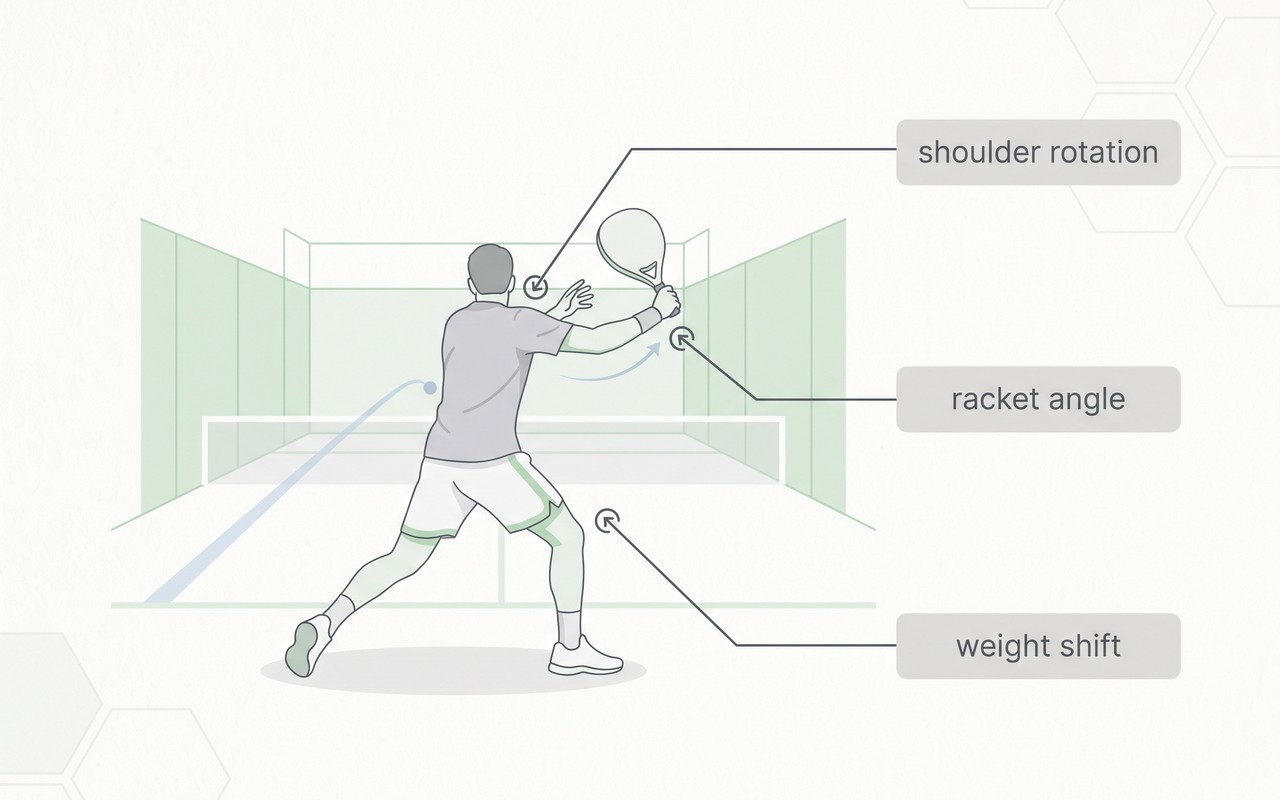
A diagram showing which visual cues to watch on an opponent before contact: shoulder rotation, racket angle, and weight transfer
One note on the diagram above: it's a general illustration of what to watch for, not a precise replay of one specific shot — treat it as a map of where to look, and confirm the specific tells against your actual opponents on court.
Feet and weight transfer: where they're about to go
Many players only watch the upper body — shoulders and racket — and miss an equally valuable source of information: the feet. Weight transfer almost always precedes shot direction by 0.2–0.3 seconds.
Weight staying on the back foot at the moment of the swing usually means the ball will be low and not very powerful — there's simply nothing to push off for an attack.
A clear weight shift forward and sideways is close to a guarantee of attacking intent, especially paired with a closed racket face.
A split step that lands late, not under the ball, tells you the opponent is already behind the point — don't expect a precise, directed shot; the ball is more likely to go wherever it goes.
A useful drill: during a training session, deliberately ignore the racket and watch only your opponent's feet for several rallies in a row. Most players are surprised how much earlier the direction becomes clear once the "noise" from the upper body is out of the picture.
Reading at the net is a different skill than reading from the baseline
Anticipation works differently depending on where you're standing, and the two are worth training separately.
At the net, you have the least time of all — often a fraction of a second — so almost everything comes down to the upper body: racket angle and the last instant of the backswing. There's no time left to read the feet; the early call of "stay / poach" needs to happen off the opponent's stance before the backswing even starts, not at contact.
From the baseline, you have more time, so every signal comes into play at once: stance, weight transfer, racket position, and the opposing pair's overall positioning. The baseline is also the best place to run the "eyes only" drill from the next section — you have a buffer of time to consciously watch the setup instead of the ball, without risking the point.
Practical takeaway: if you're new to reading the game, start practicing from the baseline, where a misread costs less and you get more time to study the cues. Move that skill to the net once the basics — open/closed racket face, weight transfer — are already close to automatic.
What gives away each shot: bandeja, víbora, lob
Every signature padel shot has its own recognizable setup "handwriting." Knowing these tells in advance buys you half a step on almost every point.
Bandeja. The opponent meets the ball with little to no backswing, almost in one point overhead, with the elbow open and a slight bend in the knees. For the mechanics of the shot itself, see our bandeja guide — once you know how it's hit, you start spotting the setup automatically.
Víbora. Unlike the bandeja, there's a visible rotational movement through the torso and a sharp sideways wrist "whip" in the final instant — a tell we break down in detail in our víbora guide.
Lob. An open racket face, a low-to-high swing, and — importantly — the opponent's eyes are usually up and back, toward where they're aiming behind you. For the shot mechanics themselves, see our padel lob guide.
Smash. Similar backswing to a bandeja, but with a noticeably sharper, higher point of contact, and a more closed stance — the opponent rotates the torso to put more power into the shot.
The more often you play against the same partner or the same opponent, the sharper your reading gets: every player has individual, repeating habits in their shot preparation that, over time, you'll pick up almost without fail.
Reading beyond the ball: the opposing pair's positioning
Anticipation in padel isn't just about the shot that's about to happen — it's also about the opposing pair's overall setup on court. A pair that's played together for a while almost always gives away its intentions through positioning, before the point even starts:
If one opponent is standing closer to the net than usual, that's often a sign the pair is setting up an attack or a drop shot.
If both opponents drop back to the baseline at the same time, expect an overhead attack — they're giving themselves room for the swing.
An open corridor between the two opponents is almost always the target for a directed shot into that gap — read the pair's spacing as closely as you'd read one player's stance.
Positioning rarely shifts randomly: most pairs settle into one of a couple of habitual patterns — either both players retreating together into defense, or splitting roles, with one holding the net while the other covers the baseline. Watch a pair for one or two rallies and you can usually predict which pattern they'll fall back on in a similar situation.
And, of course, the same reading works both ways — your opponents are reading you and your partner too. If you haven't yet built a shared language on court with your partner, start with our guide on doubles communication: the more predictable and coordinated your own positioning is, the fewer cues you're handing your opponents — and the more closely you should be watching theirs in return.
Training anticipation: four drills
Reading the game is a skill you can train deliberately. Here are four drills worth adding to your warm-up or a dedicated session:
The "eyes only" drill. Play one rally at a time deliberately focusing on your opponent's shoulders and racket, not the ball. The goal isn't to win the point cleanly — it's to notice the moment you "knew" the shot before the ball arrived.
The caller drill. Ask a partner or coach to call out, after each rally, which cue preceded the opponent's shot (open racket face, weight shift, and so on). Saying it out loud speeds up how quickly the pattern sticks.
Video review of your own matches. If you have footage, rewatch a few rallies in slow motion and pay attention to what the opponent did 0.5–1 second before contact. It's the fastest way to spot patterns that fly by unnoticed in real time.
The "freeze" drill. Agree with a training partner that on the call "Freeze!" mid-backswing, the opponent stops moving — and you call out loud where you think the ball is headed, before the shot actually happens. This drill trains the decision moment directly, not just general awareness.
Start with one drill per session — trying to track everything at once (stance, racket, feet, pair positioning) usually overloads your attention and works worse than building one skill at a time.
Common mistakes when reading an opponent
Watching only the ball. The most common mistake of all: eyes glued to the ball leave no time to react to shot preparation. The ball is the last source of information, not the first.
Ignoring individual habits. General cues work on average, but a specific opponent may have their own, slightly different tendencies. Spend the first game of any match calibrating — observing, not just reacting.
Overweighting a single cue. One open elbow or one step back guarantees nothing — read cues as a package (stance + racket + weight), not in isolation.
Forgetting your opponents are reading you too. Anticipation runs both ways. If you always prepare for a smash the same way, opponents will notice quickly — vary your backswing tempo occasionally to stay unpredictable yourself.
Where to train this in Tashkent
Anticipation develops fastest in live play against varied opponents, not in theory — the wider the range of setup styles you face, the bigger your "vocabulary" of cues becomes. A few practical steps:
Book a lesson focused specifically on this. A coach watching from outside can see which cues you already react to well and which you're still missing. Find one in our PlayPadel coaches directory.
Play at different clubs against different opponents. Shot-preparation habits vary noticeably between players, and varied practice teaches faster than repeated matches against the same familiar pair. Browse venues in our Tashkent courts guide.
Test yourself under pressure at a tournament. As noted above, cues get more honest under pressure — which makes competitive play the best place to actually train reading them. Check current tournaments and meetups on our events page.
Frequently Asked Questions
What matters more for anticipation — watching the ball or the opponent?
The opponent — specifically their stance, racket, and weight transfer during shot preparation. The ball only moves after contact, while body cues appear earlier, giving you time to react ahead of the shot instead of after it.
Can you learn to read the game if your natural reaction speed isn't fast?
Yes, and it's an even more valuable skill for players without explosive speed: reading the game compensates for slower reactions by starting your movement earlier. Many experienced players read the game precisely because they can't rely on raw speed alone.
How can you tell an opponent is about to hit a lob?
Look for an open racket face, a low-to-high swing, and eyes turned up and back — an opponent usually looks toward where they're aiming the lob before contact happens.
Does reading the game help on both offense and defense?
Yes. On defense, anticipation gives you time to reach the ball and pick the right response; on offense — at the net, for example — it tells you when to poach and when to hold your position.
Where should I start if I've never thought about reading the game before?
With one drill per session: for one rally at a time, deliberately watch only your opponent's stance, or only their racket, and ignore the ball. That's the base you build the other cues on top of later.
The blog's deepest column: advanced shots (bandeja, víbora), positional play, periodised training and honest gear breakdowns — grounded in the experience of Tashkent's playing coaches.
Reviews
Log in to leave a review
Bote pronto means meeting the ball right after it bounces off the court, before it reaches the glass. Here's the technique, timing and when to use it.