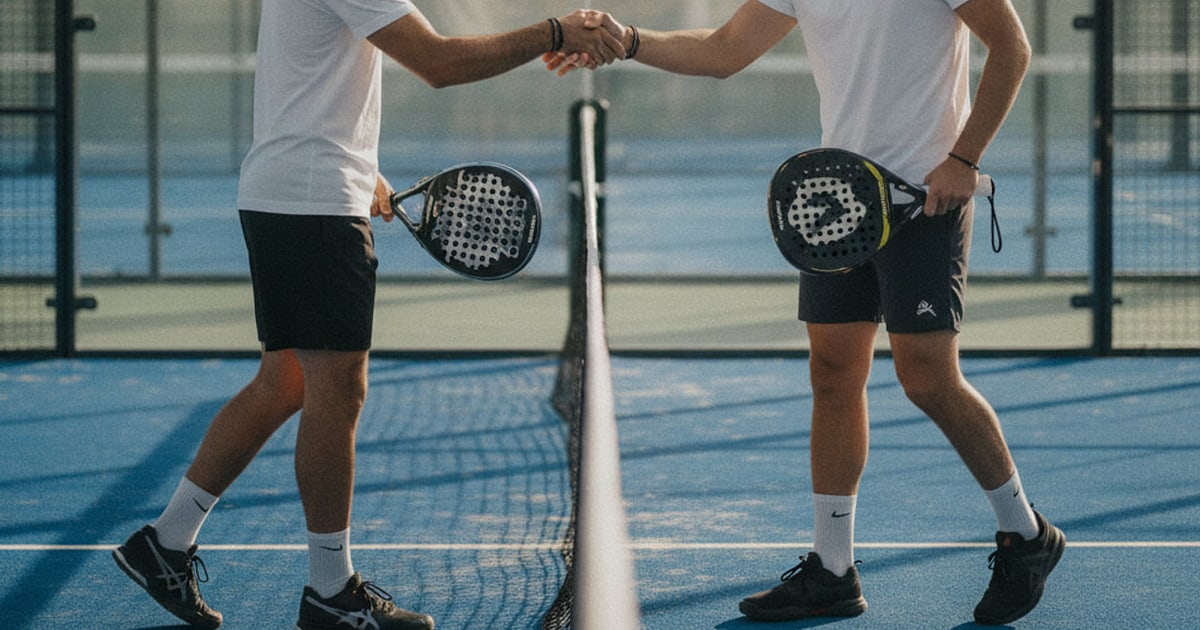
You signed up for a tournament two weeks ago, you've trained since, and the day before it starts you suddenly catch yourself thinking "maybe I should just pull out." Your hands sweat during the warm-up, the serve that usually lands fine turns into a coin flip, and one question keeps circling: "what if I let everyone down." If this sounds familiar, you're not alone — and it's not a sign you're "not ready." It's nerves, and you can work on them just as concretely as you work on your technique.
Why tournament nerves are completely normal
The first thing worth saying out loud: feeling nervous before a tournament isn't a weakness, and it isn't a sign you're "not at that level." It's a standard bodily reaction to a situation where the outcome matters and isn't decided yet. The exact same physiology fires in players at every level — the difference is that experienced tournament players have learned to work with it instead of fighting it.
Physically, there's barely any difference between "I'm nervous" and "I'm switched on and ready to play": a faster pulse, slightly quicker breathing, a bit of tension in the arms — it's the same set of reactions either way. The difference is in what you call it internally. Sports psychologists have long noticed that reframing "I'm scared" as "I'm fired up and ready" doesn't change the body, but it noticeably changes behaviour on court. It isn't self-deception — it's redirecting the same energy into something useful instead of spending it trying to force calm.
The second thing worth knowing: nerves are almost always strongest right before the first ball. Once the match actually starts and your body settles into familiar movements — return, rally, moving to net — the extra adrenaline usually burns off within the first two or three games. That's exactly why experienced players rarely worry about the nerves themselves: they know it's a temporary state, not a verdict on their game.
The week before: cutting down uncertainty
Nerves almost always feed on the unknown: you don't know your opponent, you're unsure how the day will run, you don't know what to do if something goes wrong. The fewer open questions are left by the morning of the tournament, the less room there is for anxiety.
A few days out, it's worth closing off the practical questions in advance:
- Format and rules. Check with the organizers whether it's americano, round-robin groups, or knockout, how scoring works, and roughly when your matches are — so you're not burning nervous energy on logistics on match day.
- Gear. Check your strings and grip, pack a spare shirt and water — we've covered choosing a racket and shoes in separate posts; check our partner shops if you need to pick anything up.
- A familiar court. If you can, practice at least once on the same venue where the tournament runs, or on a similar surface — you can usually find a comparable court type among our venues.
- Your partner. Agree on meeting time, warm-up, and who plays which side — uncertainty within the pair doubles the nerves for both of you.
It's also worth saying something about training in that final week: this isn't the time to suddenly ramp up load or start learning new shots right before the tournament. It's a time to reinforce what already works, not to experiment. If you feel unsure about a specific shot, it's far better to work through it once, calmly, with a coach than to try to fix your technique two days before the event.
The night and morning before: routine beats chaos
The body responds far better to a predictable morning than to a rushed one. Which gives you a simple rule: a couple of days before the tournament, decide in advance what you'll eat, when you'll sleep, and when you'll wake up — then just follow the plan instead of improvising anything at the last minute.
The night before. Try to go to bed at your usual time — not three hours earlier "to get extra rest," and not later than usual watching tips videos. A sudden change to your sleep schedule raises anxiety on its own. A light dinner, some stretching, a short walk — whatever helps you unwind on a normal day will work here too.
Tournament morning. Eat something your body clearly handles well — don't experiment with new food on match day. Get to the venue with time to spare: rushing in the last few minutes is one of the most reliable ways to manufacture nerves out of nothing, even if you were completely calm before that.
A useful trick is a short ritual you repeat before every tournament: the same music on the way there, the same warm-up order, the same phrase you say to yourself before walking onto the court. The ritual doesn't "bring luck" — it signals to your brain "this is a familiar situation, not something new and dangerous," and anxiety drops automatically as a result.
Warming up: it's not just for your muscles
The pre-match warm-up does two jobs at once — it readies the body and it calms the mind, and the second job matters just as much as the first.
The physical part is standard: light jogging or jumps to raise your pulse, shoulder and hip rotations, a few sprints and lunges. The psychological part of the warm-up is the piece people usually skip:
- Start with simple, reliable shots. The first balls of the warm-up aren't the place for flashy overheads. A few simple flat forehands and backhands let your body feel a confident contact with the ball before you add complexity.
- Run through match situations briefly. A couple of serves, a couple of returns, a move to the net, a lob — briefly touch the elements you'll actually meet in the match so your body "remembers" them without the pressure of the score.
- End on a good shot. Try to make the last shot of your warm-up a confident one — a simple but effective way to walk into the serve in a good headspace, rather than feeling "nothing's working today."
If the warm-up didn't go perfectly, that means nothing. A warm-up almost never predicts the outcome of a match — plenty of players have "not felt it" in the warm-up and then gone on to play the best match of their season.
Breathing and focus between points
The real secret of players who look "cool" under pressure is simple: they don't stop feeling nervous — they just manage the pauses between points. Those few seconds between balls decide whether tension builds through the game or not.
A simple trick that works courtside: between points, take one slow breath in through your nose over four counts, then breathe out just as slowly through your mouth over six or seven counts. The longer exhale is the point — it's what actually triggers the relaxation response in your nervous system, not just a moment of distraction.
A second trick is narrowing your focus to one simple thing right before the next point: look at the ball, repeat one word to yourself ("deeper," "net," "steady"), or just look at your racket's strings. Your brain can't fully worry about the whole match's outcome and concentrate on one specific action for the next point at the same time — choosing the second automatically switches off the first.
It's important not to confuse this with trying to switch emotions off entirely. The goal isn't to stop feeling tension, it's to stop it from building up between points. A bit of nervous energy is even useful — it keeps you locked onto each ball instead of drifting into a relaxed loss of focus.
Talk to your partner before the first ball
In doubles, nerves rarely stay one player's private problem — they transfer to your partner almost instantly, especially after the first few missed points. A short conversation before the match removes most of that risk — we covered pairing up well in detail in our piece on doubles communication; here we'll focus specifically on the pre-match part.
Three things are worth saying out loud:
- What you both actually want from the match. It doesn't have to be "win" — for a debut tournament, an honest goal can simply be "play our own game and don't tighten up" or "get at least one point to the net every game."
- How you'll support each other after a mistake. Agree in advance on one neutral phrase for after a missed ball — something like "next one" — instead of silence or dissecting the error mid-game.
- Who calls it, and when, before a point. A simple signal like "mine or yours" before the opponent's serve removes an extra second of hesitation, and with it, some of the nerves on both sides.
A partner who feels you're with them, rather than judging every mistake, almost always plays calmer — and that calm comes right back to you.
If the nerves win anyway: a plan B on court
Sometimes none of this helps from the very first ball, and you still walk out to serve with your heart pounding. That's normal too — and it's worth having a simple plan for when the first game goes sideways.
First — don't try to force yourself to "snap out of it," that usually only adds tension. Instead, use a physical pause: rest your hand on the strings of your racket, take one slow exhale, look at a line on the court — any simple physical action that pulls your attention out of your head and back into your body.
Second — temporarily simplify your game. If your hands won't cooperate for anything fancy, deliberately switch to your most reliable, boring shots for a few points: a deep flat ball, a careful lob, nothing risky. The job of the first game under heavy nerves isn't to win in style — it's simply to stay in the match while your body settles.
Third — remember the stat that's actually on your side: the overwhelming majority of amateur matches are decided not in the first game, but somewhere in the middle or the finish, once both teams' nerves have settled. A rough start almost never decides the whole match — knowing that in advance turns a lost first game from a catastrophe into just a lost first game.
After the tournament: debrief without beating yourself up
How you review a tournament after the final point shapes what you bring to the next one. If the only takeaway from the day is a list of everything you did wrong, the nerves before your next event will only get worse.
It helps to ask yourself three questions instead of just "what did I mess up": what went better today than a month ago; what do you now know about yourself under pressure that you didn't know that morning; and what's the one specific thing worth working on before the next tournament — just one, not the whole list at once.
A tournament isn't a pass/fail exam — it's the most honest practice that exists in amateur padel. Even a tournament where you lost every match but kept your breathing steady and stayed on good terms with your partner is real progress that just doesn't show up in the results table. If you want to build up tournament experience systematically, check the upcoming dates in Events — playing regularly under pressure cuts nerves down far faster than waiting to feel "fully ready." And if this piece has you curious about a first tournament from the ground up — formats, picking a debut event, and the practical details — we have a full beginner's guide; you'll find more on club life and tournaments on the PlayPadel blog.
Frequently Asked Questions
Are tournament nerves a bad sign that I'm not ready?
No. Feeling nervous before a match with real stakes is a standard physiological response found in players at every level, including the most experienced. It means the result matters to you — it doesn't mean you lack preparation.
How long do strong tournament nerves usually last during a match?
For most players, the extra tension fades within the first two or three games, once the body settles into familiar rally patterns. If it lingers longer, deliberately simplifying your game for a few points usually helps.
Do calming drinks or coffee help before a match?
Not as a substitute for preparation. Too much caffeine before a match can amplify a racing heart and a sense of anxiety rather than settle it — if you're not sure how your body reacts to caffeine under stress, it's best not to experiment on tournament day.
What if my partner is the nervous one, not me?
A calm, steady tone and a neutral supportive phrase after mistakes work better than advice or a mid-match breakdown of the game. Partners tend to "catch" your calm far more than they catch instructions about calming down.
Do experienced players still need to prepare for nerves before every tournament?
Yes, in some form — even high-level players do this. The difference is that with experience, the preparation routines get shorter and more familiar, but the need for them doesn't disappear entirely.
Can tournament nerves actually help your game?
Yes — moderate tension keeps your focus sharper than total calm does. The goal isn't to remove the nervousness entirely, it's to stop it from building up and interfering with your movements, so that same energy stays available for focus on each point.


 Tournaments
 Tournaments